

We see here in this image an ancient temple. Many of the ancient schools of mysteries, the schools of initiation, were modeled after the nature of consciousness, the path. Their architecture literally embodied the stages of how the soul reaches divinity. The Voice of the Silence teaches about the fundamental steps of how consciousness transcends matter, energy and terrestrial perception and learns to know the heights of reality, here, in us.
We will talk about states of consciousness, as there are levels, and their qualities, but more importantly how to recognize them. Our consciousness right now is in a potential state. It does not know yet the full gamut of what we can be, of who we really are in our depth. We will talk about four states of consciousness, beyond the three halls mentioned by Blavatsky in her scripture. Spiritual Danger
Something to remember when we study this scripture or approach this type of knowledge, is that it is dangerous. Not physically, like a motorcycle accident, but internally, psychologically.
When we begin to explore our mind, our heart, our senses, our psychology, we begin to perceive and witness that we have many elements in us which are not spiritual, and which are contrary to the work of divinity in us. We call these elements pride, anger, lust, fear, and envy, etc. These are lower qualities of consciousness. They are not the true self (for the lack of a better term, we call it reality, the Being, the truth or divinity). Blavatsky teaches in the very opening where she transcribed this scripture: These instructions are for those ignorant of the dangers of the lower IDDHI. ―The Voice of the Silence
Or to use the Sanskrit term, Siddhis, which are powers or abilities. Just as there are powers in heaven within the spirit, there are powers also in the depths from our own rage, our own animality, our own defects, and as we explore ourselves, we begin to realize that we are filled with a lot of degeneration, a lot of defects, a lot of faults. As we look inside at this reality, we see that there is a struggle. This is symbolized by every single scripture in the world, every mythology, even in Marvel movies. It is the battle between good and evil, positive and negative, and truth versus illusion.

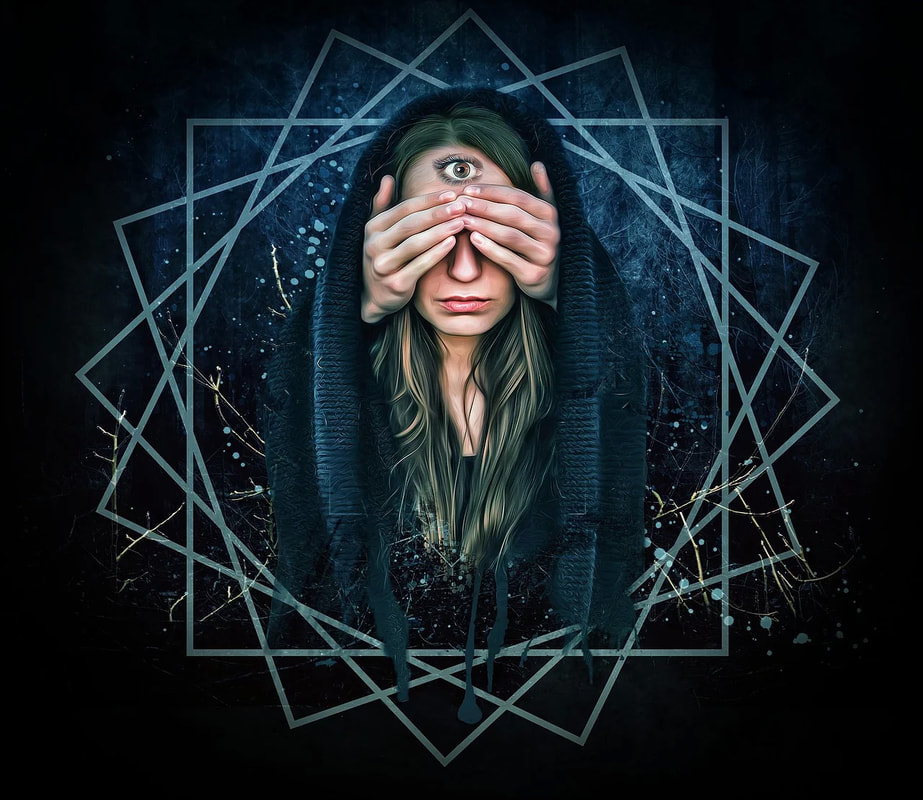
So, these instructions are for those who look to go into their mind, like we see in this image. A strange figure, obviously, some of these images are not perfect, but for our purposes, do communicate a certain point. We must explore the mind and look for the truth of divinity. But in that process, we face many obstacles. We will talk about those.
The solution is in the second verse about the nature of meditation, of learning to concentrate, the focus of attention, to learn about ourselves. He who would hear the voice of Nada, “the Soundless Sound,” and comprehend it, he has to learn the nature of Dharana. ―The Voice of the Silence
The Voice of Nada, the Soundless Sound, she explained, is the perception of God in us, to receive insights, intuition, understanding about how to live, and how to transform our life for the better. It is soundless because it is not a terrestrial voice. It is a psychological one. It is internal. It is consciousness, as we explained.
But to perceive it, let alone comprehend that hunch, we need to pay attention. Examine your mind, your emotional states. Observe yourself. This is not a physical sense. It is a psychological one. Self-observation, the consciousness, the soul, must learn to look, to look at thoughts, feelings, and sensations of the body―to observe, to pay attention, to remember the moment. We learn concentration, of dharana, in our studies in meditation. Focus on one thing and do not forget that you are looking inside at yourself. If you study meditation or practice it for some time, you know that the mind is a wild animal. It is scatty, jumping from thought to thought, idea to idea, never integrated or focused on one thing. If we wish to know the voice of divinity, the mind is the obstacle. We must not be distracted. We learn to pay attention here and now, moment by moment, instant by instant. As we are learning to pay attention, we are examining life through the senses but also with awareness. We are observing our surroundings. We are observing our mind. We are doing it moment by moment in a state of mindfulness. We must also learn to face difficult challenges, hardships, with indifference. This does not mean to not care. It means equanimity. For example, if you were living in Chicago and you see somebody harassing people on the street, we examine our mind. We do not get disturbed. We see the impression. We see what is happening in the experience, but we do not get troubled, or we do not lose our awareness and become filled with fear, anger, or resentment. We watch. When hardships emerge, we transform them. This is why it states: Having become indifferent to the objects of perception, the pupil must seek out the rajah of the senses, the Thought-Producer, he who awakes illusion. ―The Voice of the Silence
This is very interesting. Thought, mind, and intellect cannot know reality. It is a machine. It can store information. It can present thesis and antithesis, good and bad, yes and no. It can compare. It can associate, but it cannot understand divinity. It is a different sense that has nothing to do with thought.
Thought must be suspended. It does not mean we never use the intellect to live in this world. It means that we know how to use it with wisdom as a soul. Thoughts are in themselves, just daydreams, illusion, fantasy, and preoccupations. We have to suspend that and become calm in the face of any challenge or ordeal. This is why the scripture states: 
The mind is the great Slayer of the Real. Let the disciple slay the Slayer. ―The Voice of the Silence
We have an image here of Manjushri within Tibetan Buddhism, a great buddha, an awakened one, carrying a sword of insight and the book of wisdom representing study and practice. They must be harmonized. It is not enough to study this knowledge with the intellect, to learn practices to fill the mind. We must know how to apply it. Insight, perception of the truth, is what kills the illusions of the mind. It is wisdom, understanding.
In our studies, we relate that the mind is ego. It is a Latin term for self. We do not mean this in the conventional language of pop-psychology in the sense that a person with a big ego has a lot of pride. Any self as fear, resentment, hatred, lust, vanity, is mind. That is ego. We are not, in our full depth, mind. We are consciousness that can perceive and understand. It is not a process of thought. We learn this through meditation. We learn how to initiate and sustain that state, and little by little, we gain knowledge of what in us keeps us asleep, why we do not pay attention to our mind and to reality, to circumstances. We do so, again, through self-observation, by paying attention, and as we learn how to observe, not know, but to observe ourselves, we begin to realize that we are not seeing reality 24 / 7. We do not see the facts. Manjushri teaches here that with perfect serenity, equanimity of consciousness, we can learn to look at a phenomenon and understand it and have great peace. One does not react with fear, agitation, or doubt. It knows. This type of perception is very unusual, especially in the beginning. If you tried meditation, you begin to realize that the ability to focus attention on one thing, without forgetting, we become easily distracted. We see that the churning of thought, emotion, mind, and desire are distractions. They are not the true self. They are not our fundamental identity, and therefore they have no substantial reality. They are not real. They are not the soul. By practicing this type of observation, and remembering that state, we begin to realize that even our physical life is, in a sense, a type of an illusion. We do not see it for what it really is. The scripture states: When to himself his form appears unreal, as do on waking all the forms he sees in dreams; when he has ceased to hear the many, he may discern the ONE―the inner sound which kills the outer. ―The Voice of the Silence
This is very deep. The body is an illusion. We do not see it for what it is. It is made up of organs, cells, molecules, and atoms. We do not perceive the fundamental reality of even the emptiness of the body. We see many appearances, not the full depth of what a thing is or why we are where we are at. This is even more true on a psychological level. We do not understand what motives or impulses propel us into life and decide for us. But we realize this when we practice meditation.
When you cease to hear the many, the information from the senses, and focus within the consciousness, you withdraw your senses from external phenomenon and look inside, you begin to see that there is a deeper reality than just the mind, the senses, and even our common dreams. There is another type of perception that is available to us which The Voice of the Silence teaches: Then only, not till then, shall he forsake the region of Asat, the false, to come unto the realm of Sat, the true. ―The Voice of the Silence
Even the prefix A means “without,” and Asat: to not see reality. I am pretty sure we can think about any common experience in our life, maybe we were obsessed with anger or pride about a situation, and then someone communicates to us that this is not what you think. Then we realized that we were deluded, that we were stuck in fantasy. That is one minor, common state where we do not pay attention.
We do not remember the consciousness. We are not learning to focus within. In this way we learn, as we are practicing the techniques of this tradition, to not be so invested with our energy with the tragedies, comedies, and transience of life. 
Identification: How and Why We Suffer
Life fluctuates with its good and bad circumstances, and we tend to go with the flow. We go along with it. We do not watch why we behave or why things happen as they do. We just tend to think what we are thinking and feel what we are feeling.
But that act of knowing is different from observation. You may know that you are seated in this chair, but are you observing the fact? Are you watching with your senses, and more importantly, are you observing your mind, your thoughts, emotions, or reactions? We tend to invest all of our energy psychologically in the things of life, whether it be for food, drugs, alcohol, praise, security, money, the external things, and not looking at the quality of mind and who we are, because wherever you direct your attention, is where you spend energy. If you want to begin to awaken within dreams, it is important to save energy. Psychologically become sealed. It does not become careless or dead. It means you save energy and learn to activate the consciousness. This is why in The Voice of the Silence it states: If thy Soul smiles while bathing in the Sunlight of thy Life; if thy Soul sings within her chrysalis of flesh and matter; if thy soul weeps inside her castle of illusion; if thy Soul struggles to break the silver thread that binds her to the MASTER; know, O Disciple, thy Soul is of the earth. ―The Voice of the Silence
So, if you have studied astral projection, you may know about the silver cord. The antahkarana thread is what we call it, which connects the consciousness of the astral body to the physical body, which is never cut except when it is time for death. But here it is explaining something very subtle, about which if we follow the lower appetites of the mind, it is like trying to cut our connection with divinity. The Qur’an (Surah Qaf) even emphasizes this point.
We are closer to you than your jugular vein. ―Qur’an 50:16
That divinity is within you. It is close to you, but if we identify with life, we expend our energies outward. We are of the earth.
When to the World’s turmoil thy budding soul lends ear; when to the roaring voice of the Great Illusion thy Soul responds; when frightened at the sight of the hot tears of pain, when deafened by the cries of distress, thy Soul withdraws like the shy turtle within the carapace of SELFHOOD, learn, O Disciple, of her Silent “God,” thy Soul is an unworthy shrine. ―The Voice of the Silence
Consciousness is a temple. The body is a temple in which divinity can enter if we prepare, which is taught within the books as well as all the scriptures of the world. They talk about initiation, how to become one with divinity, to make divinity manifest in us. But for that to happen, the consciousness must be still. The mind must be calm, and the soul must be active.
It is an interesting dynamic. The mind must be suspended. Thought must cease, and the consciousness must be in command. It is a different sense than from selfhood, which is a shell that we hide in when great adversity arrives. But as you know from the work of Samael Aun Weor, on the path of initiation we must face hardships, to train our mind and our consciousness, to face them. Then with peace and with understanding we transform them. 
Also, we have this tendency to send our energies outward, investing in the senses and not really understanding how to be awake as a soul. The Voice of the Silence corroborates this:
When waxing stronger, thy Soul glides forth from her secure retreat; and breaking loose from the protecting shrine, extends her silver thread and rushes onward; when beholding her image on the waves of Space she whispers, “This is I”―declare, O Disciple, that thy Soul is caught in the webs of delusion. ―The Voice of the Silence
So, this ego, this self, the sense of “me, mine, what my passions are, my appetites, my desires,” is an illusion. It is not fundamentally real, in the highest sense. These qualities are transient. They belong to the moment.
When the right circumstance emerges, when someone criticizes us, pride and anger emerge. The situation changes and someone praises us, then we are happy. These things never stand still. We are constantly moving in the mind. The mind is always moving, and that is what we ignore unless you observe, in the moment, this state, and are focusing within to understand this sense. There are two qualities that we tend to balance between. They are craving and aversion according to Buddhism. We either seek out in the world the objects of our desires or we want to run away. We want to avoid them. This is the pendulum that swings and keeps us hypnotized and not really seeing the situation we are in, and also, not knowing how to act in the moment with wisdom. This is because of ignorance. It does not mean to be without intellectual knowledge. It means to have wisdom of the soul―observing the fact, to have gnosis, or real knowledge. Life: The Psychological Gymnasium and Our Spiritual Goal
As we learn about these studies, we are entering a path that leads to the realization of these fundamental truths in ourselves.
This Earth, Disciple, is the Hall of Sorrow, wherein are set along the Path of dire probations, traps to ensnare thy EGO by the delusion called “Great Heresy.” ―The Voice of the Silence
This life is a testing ground. This is where we initiate our work. We face hardships and ordeals, challenges, struggles, to test our character. Divinity organizes this. So, as you are working on yourself and you have challenges come up in your life, you see your greatest defects, your weaknesses, and your errors. Also, we face challenges because when the water boils at 100 degrees Celsius, you can really learn to disintegrate what must be disintegrated.
The ego is like a shell, like in the scripture. It is a carapace, a tortoise shell, and by breaking the shell, like breaking a lamp that holds the genie, you free the soul. You free the consciousness, and therefore, you are no longer deluded by this feeling of separateness from people. You feel compassion, wisdom and understanding for them and seek to help them in their journey.
From this supreme light, which the Kabbalists call Kether, the Crown, emerges Chokmah, which means “wisdom,” and likewise, into Binah, which means “intelligence.” Or to use Christian terms, Father, Son, and Holy Spirit. Or in Hinduism, Brahma, Vishnu, and Shiva. In Buddhism, Dharmakaya, Sambhogakaya and Nirmanakaya, the three aspects of Being.
Wisdom is the ability to perceive, to penetrate any phenomenon. It is “vis-dom” or vision, the power of inner sight. Intelligence, or Binah, is sometimes translated as understanding. It is real comprehension. When you look at one phenomenon, you understand it with your Being, and you are able to, with wisdom, intelligence and remembrance of the supremacy of divinity, to know how to navigate life in all of its hardships. But this state of consciousness is very difficult to grasp at this level unless we are really working at trying to change daily. This state of consciousness to our senses and our mind is a state of non-being because we feel in our terrestrial identity we have this self, this “I, me, what I am,” but it is not the Being. The Being does not have an “I, me,” or a “myself” according to how we think and feel. At this level, it is selfless. But it is not annihilation. It is Being. It is perception. It is real wisdom. Saith the Great Law: “In order to become the knower of ALL SELF (the Being, omniscience, consciousness of all) thou hast first of SELF to be the knower.” ―The Voice of the Silence
“Know thyself,” as the gnostic gospels teach, but also at the Temple of Delphi, “and you will know the universe and the gods.”
To reach the knowledge of that SELF, thou hast to give up Self to Non-Self, Being to Non-Being, and then thou canst repose between the wings of the GREAT BIRD. ―The Voice of the Silence
Give up this sense of “I,” “what I want, crave,” attachments, to experience something more, the reality. So, the Being cannot mix with the self, our terrestrial ego, our mind. It is like oil and water. When you clean the mind, when you calm the mind and you purify it, it is like a mirror, and then the light of divinity can, little by little express, but it is a patient work and is not easy. It is the Great Bird because as in Christian terms, it is the Holy Spirit, the energies of divinity. A white bird is sometimes represented in different cosmologies like an eagle. It is pure and immaculate, divine energy.
Aye, sweet is rest between the wings of that which is not born, nor dies, but is the AUM throughout eternal ages. ―The Voice of the Silence
This manta ॐ Aum is the mantra of divinity. It is also ओम् OM in Sanskrit. The three letters A-U-M is this top trinity. This state of being is never born. It never dies. It is eternal. What is born, dies, and develops, is the intellect. These things are transitory because our thoughts, feelings and desires have a beginning, and they will have an end, but what we do with them is the point as described in the path of initiation.
Bestride the Bird of Life, if thou would’st know. Give up thy life if thou would’st live. ―The Voice of the Silence
We talk a lot in our studies about the energies of transmutation, alchemy, and pranayama. The Bird of Life, the Holy Spirit, we state very explicitly, is the sexual energy. It is the power of life to create. By working with the energies, by saving them with prayer, devotion, mantra, meditation, and alchemy, we raise it up the spine to the mind and then to the heart and therefore achieve initiation.
The wings of the spirit are the ability to astral travel, experience jinn states, acquire many powers and abilities, telepathy, clairvoyance, or imagination. These things open up our spiritual senses through this spiritual energy. But to work with this state, we have to give up our life. This is the essential tenet of initiation. By entering this type of work, we give up many things we are attached to, particular to us. But more importantly, we give up our pride, anger, fear, our negative elements. We must give that up if you want to enter a new way of being. 
The Four States of Consciousness in Sanskrit
To understand being, we study four states of consciousness. These states of consciousness do not just pertain to the physical body. They pertain to the soul.
In a conventional sense, सुषुप्ति Sushupti, the lowest level, is profound sleep, meaning you go to bed and for eight hours you do not dream. There is only darkness. Beyond that is स्वप्न Svapna, dreaming sleep, where you may have some fragments of images in dreams and memories from the dream state. This is the second state of consciousness. Then जाग्रत् Jagrat, waking consciousness, which many yogis typically associate with being in the physical body. But in truth, it is deeper than that. We will talk about why. तुरीय Turiya is spiritual illumination, to have a perception like a god, an angel, a master, perceiving not only this physical world but multiple dimensions at once, a being like a Jesus, a Buddha, a Muhammad, a Krishna, or a Moses. While that is a conventional definition of these states, in truth, we experience Sushupti all of the time. If you examine your daily states by performing a retrospection, you can sit to meditate, recall in your mind the images of your day, and try to remember what you did, what you saw, whom you met, what you said, what you thought and what you felt. If there are gaps, where you cannot remember anything, that is Sushupti, complete sleep. The consciousness is not driving the car, the body. The question is who is driving our car? It is ego, I, me, myself, our defects, those vices or errors which we created that bottle up the consciousness. Beyond that, obviously, if you begin to remember some fragments and images of your day, maybe some daydreams or pre-occupations or worries, our thoughts which kind of wander from thing to thing, that is Svapna. That is dreaming, even when you are in your body. If you are driving your car and you are thinking of your friend, your fiancé, your family, you are not driving your car. Your mind is thinking. It is elsewhere. That is dreaming. That is sleeping, sleep with dreams. To be in Jagrat means to remember yourself. If you are driving your car, drive your car. If you are with your family cooking a meal, cook the meal. But do not think and get preoccupied with other things. Do not fantasize. Be where you are at, doing what you are doing. You will see from experience that this state is very difficult to maintain. It is called mindfulness. It is not just observation of the moment, but remembering your state, your consciousness moment by moment, so that you can learn to gather data. You do so by observing your mind, your intellect, your body, and look at the mind at what it is doing. What are its distractions? how does it keep us asleep as a psyche, as a soul? So, that by cleaning up the mind and freeing yourself of these elements, you can grasp glimpses of Turiya, which is the state of being of a mahatma, a god. Physically you maybe asleep, but in the internal worlds, you are fully lucid, awake, talking to an initiate, with your inner Being, with divinity, and even beyond that, there are states where the soul can unite, even but temporarily, as a vacation, or like having a visa, to these higher regions. They are very beautiful, and they inspire us to continue working, because we see from experience that there are realities beyond our cage, the prison of the mind. The Four States of Consciousness in Greek
We gave you the Sanskrit terms, but here they are in Greek. This doctrine is taught in Plato’s Republic, through the Allegory of The Cave, how we go from the subconscious up to the light of truth, escaping the caverns of the intellect.

There are two superior states, which we emphasized, and two inferiors.
Complete sleep is Eikasia. Sleep with dreams is Pistis. Awakened consciousness is Dianoia, and the enlightened state of Turiya is Nous. This is the same doctrine given in Greek terminology. Eikasia (εἰκασία) means “imagination,” from εικόνων eikonon, or “images,” to be asleep without dreams. It might seem paradoxical. How is it that we can perceive images if we are completely asleep? Have you ever watched a television show in which you have lost all attention, and you are only immersed in the images? You only see through the television screen the characters, the drama, the comedy, the tragedy, and we are not even aware of our body. That is seeing images but being passive, asleep, or the consciousness is not active. The mind is active and that is the difference. The mind is active, but the consciousness is asleep, and vice versa. When the consciousness is active and the mind is calmed and still, you can begin to awaken it, to remember icons or images. Also, our deepest defects are images in the mind. This is the state of consciousness of humanity in which people go to war, people commit violence, and embody mob mentality. Big crowds suck in people and they do things that they would never do in any other setting, but they were hypnotized by the crowd, by the mob. That is complete sleep, a state of war. The soul is not there, but the mind is, the ego is. But πίστης Pistis, “belief,” or in the conventional sense, “faith,” is dreams. We may have many ideas about God, many ideas about who we are, our psychology, our tastes, and yet these are convictions without evidence. It is important to emphasize what Pistis really means. Πίστης Pistis also comes from the word, Πιστεύω Pisteuo, “to have conviction” or “to grasp at.” Many people believe in dreams. We have many beliefs, whether it is politics or religion, divinity, or spirituality. But none of that is real. It is not experienced. It is just thoughts and emotions. It is a grasping at things. But Jagrat, as we said, the awakened consciousness, is when the soul is active, remembering, paying attention, and is mindful. Dianoia (διάνοια) also means “imagination,” to perceive images, but this is different. The consciousness is now perceiving images whether in meditation or in dreams, and you are intentionally observing the fact. You may be meditating and relaxing your mind, then suddenly new images emerge. They come to your consciousness, your awareness, without you thinking or anticipating. But you are doing it willingly. You suddenly see things. This is an important step. It means that we are awakening Dianoia, and more importantly, Dianoia is also the observation of thought, mind, perception, from (διά) dia, meaning “thoroughly from side to side,” which intensifies (νοια) noia, “to use the mind” or νοῦς Nous. It is awakened consciousness. It means that you are observing your mind, and you are not a victim of it. You are not its slave. You know how to use the mind in life when necessary and put it aside when you do not need it. This is very different from our modern life in America where everything is intellect, thought, and thinking. Our mind is constantly churning. We are so busy with the intellect that our consciousness is completely asleep. In fact, the consciousness is very lazy. It is ironic right? I mean you may be busy doing things, you think you are very productive, but you are not awake. It is just mechanical. But to be in a state of Dianoia means to learn to use your intellect, “to move side to side,” “to use it thoroughly” because you know how to adapt to the moment. You use the intellect when you need it. But beyond that is (νοῦς) Nous, the superior levels of being. People usually translate it as “mind” or “intellect,” which is a poor translation. It is a state of abstract consciousness, not intellect. Some writers, whether from Arabic or Greek talk about Nous or mind, the mind of God. But it is not intellect. It is not rationalization. It is not thought. It is the ability, the intelligence of looking at any phenomenon and knowing its truth. No thought there. The Being does not think. The Being is, and the intellect is just the tool. 
Psychological States in the Voice of the Silence
The Voice of the Silence teaches these states of consciousness in the scripture. They call them the three halls, beyond which is the realm of Nous or Turiya, the heights.
Three Halls, O weary pilgrim, lead to the end of toils. Three Halls, O conqueror of Mara, (illusion) will bring thee through three states into the fourth, and thence into the seven worlds, the worlds of Rest Eternal. ―The Voice of the Silence 
When you work with Dianoia and you are learning to access Nous, those higher states of consciousness in meditation, you learn how to experience these higher regions of the Kabbalah in your meditations, whether through images, dreams, or visions. You go up these seven spheres, seven sephiroth or emanations of divinity. These are levels of nature or matter and perception to experience the truth.
By entering Dianoia, you learn to access astral projections, lucid dreams, meditative experiences, and then you can even go out beyond in the fourth which is the level of knowledge of a god. You can unite with your Being, your inner God or Spirit. We sometimes say seven realms, seven dimensions, because these ten sephiroth are spheres, manifested in different levels of density. They are worlds of rest eternal, which we seek. If thou would’st know their names, then hearken, and remember. The name of the first Hall is IGNORANCE―Avidya. ―The Voice of the Silence
Again, this is complete sleep, a lack of awareness. Vidya means knowledge. Avidya means without knowledge. Not merely intellectual knowledge but knowledge of perception within meditation.
The name of Hall the Second is the Hall of Learning. ―The Voice of the Silence
This is sometimes translated as probationary learning. Why is this realm of study, of intellectual thoughts, which are in a sense, dreams, a hall of probation? Obviously, in our level, we have intellect, and we need to use it. It is a tool, but we have to learn how to use it wisely. It is probation because when we seek to enter the path of initiation, we study. We learn initially through books, through lectures. We need guidance. We need help in understanding what the doctrine is, what the heart of religion is, what religion means. We need to be taught about practices, and how to actually activate these states.

We chose this image of this big library because fortunately we have a lot of wisdom in the world, a lot of knowledge, a lot of scriptures. But unfortunately, most people leave it there. They leave it in the intellect. They do not go further, and this is why it is probation. Probation meaning, we are tested in our candidacy for entering the higher lodges, the higher worlds.
In the Soul will fill find the blossoms of life, but under every flower a serpent coiled. ―The Voice of the Silence
It is the same statement repeated by Samael Aun Weor here: “The spirit of the letter that vivifies is also the letter that kills” (paraphrased from 2 Corinthians 3:6).
In a sense, some people can get stuck in books, just reading a lot, looking at the blossoms of life, the experiences of other people, reading about other people’s astral projections, but not practicing knowing it for oneself. So, this is the difference. Under each book, a serpent coiled. That serpent is our own desires, ready to ensnare, to become fascinated with reading or intellect. 
The name of the third Hall is Wisdom, beyond which stretch the shoreless waters of AKSHARA, the indestructible Fount of Omniscience. ―The Voice of the Silence
That Hall of Wisdom is Dianoia. Real wisdom is when we experience it. It is when we know it for ourselves. When you experience the nature of mind, the intellect, it is a form of wisdom, perception, but it is also painful because we see that we have a lot of faults. It is not easy. But if we are persistent with meditation, we can experience the truth, even beyond that Akshara, Nous, Turiya, the state of Being, which is free of self. It is pure knowing.
The Beginning of Spiritual Awakening
But within us we must establish order in our psychological house.
Before the Soul can see, the harmony within must be attained and fleshly eyes be rendered blind to all illusion. ―The Voice of the Silence
We need ethics. Ethics does not mean a religious code or doctrine to believe in. It means knowing in our heart what is right and what is wrong, what we should do moment by moment. It is not a belief. It is the harmony we experience when the mind settles because we are not throwing ourselves in the waters, thrashing with negative emotions of pride, hatred, fear, vanity, our defects. We put it aside.
Ethics is the key, the right ways of being here and now. In that way we have to learn to calm the mind, but also, we have to learn how not to identify with life, whether it is extreme or subtle, to not be distracted by the call of sirens which shipwreck men into the reef of destruction. We must be like Odysseus and become blind to that: close up your ears like in the Greek myth with beeswax. It is interesting. The bees are an interesting symbol. We are like a bee trying to transform pollen into honey and transform the mind into the sweetness of the soul. We must become deaf to the mind and what it wants, and to its illusions. Before the soul can hear, the image (man) has to become as deaf to roarings as to whispers, to cries of bellowing elephants as to the silvery buzzing of the golden firefly. Before the Soul can comprehend and may remember, she must unto the Silent Speaker be united, just as the form to which the clay is modeled, is first united with the potter’s mind. ―The Voice of the Silence
To comprehend divinity and remember divinity, we have to pay attention and follow our heart. There is a thread that connects us moment by moment with the truth, our own divine Being, our Divine Mother, our Divine Father, Christ, the many aspects of Being that we have within. We have to know that thread and follow it, to follow the thread of those hunches or intuitions so that when you sit to meditate, you can concentrate deeply, more deeply, and not get distracted.
For then the Soul will hear and will remember. And then to the inner ear will speak― 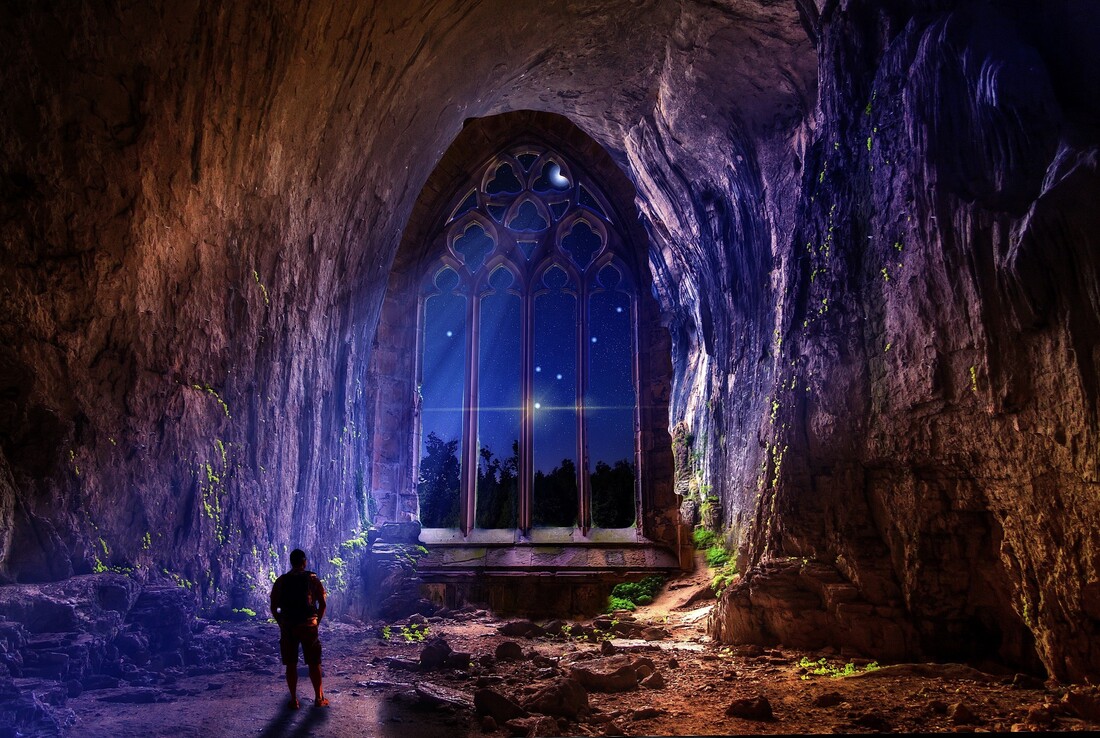
How to Pass through the Three Halls
Those are the mystical experiences that we have talked about. So, here is a bit more advice from this scripture about how to transcend these halls and enter the heights.
If thou would’st cross the first Hall Safely, let not thy mind mistake the fires of lust that burn therein for the Sunlight of life. ―The Voice of the Silence
On a very basic level, we have a lot of fire in our body, our sexual energy. In the basics of every religion, they teach their students to conserve their energy. Do not waste it. Do not mistake the fire of lust, sensations of desire in the body, with the sunlight of life, the meaning of life. Passion is the main obstacle. Because when we lose those forces which can awaken the consciousness through passion, we shut the light off. With the power of the Holy Spirit, the sexual power can rise in us, when we save it, and that opens the wings of intuition, understanding, and wisdom.
If thou would’st cross the second safely, stop not the fragrance of its stupefying blossoms to inhale. If freed thou would’st be from karmic chains, seek not for thy Guru in those Mayavic regions. ―The Voice of the Silence
If you would be free from the Hall of Pistis, dreams, do not look for your Guru there in books. Do not look for it anywhere external. Look within your own consciousness. Yes, there are some people in the Gnostic movement and in other movements who may have some development, but that is not the point. No matter how elevated a master may be, do not look for wisdom in just words, from what someone says. Although it is useful to guide us on some basic level, but that will only take you to a point. We have to live the doctrine, experience it, so that we can transcend our karma, the consequences of our former actions.
The WISE ONES (of Dianoia) tarry not in pleasure-grounds of senses. ―The Voice of the Silence
Meaning that they do not identify with bodily appetites, cravings, and desires, even of the mind, because the mind has its own appetites and desires for anything.
The WISE ONES heed not the sweet-tongued voices of illusion. ―The Voice of the Silence
Meaning the intellect. We have to clarify the intellect.

Seek for him who is to give thee birth in the Hall of Wisdom, the Hall which lies beyond, wherein all shadows are unknown, and where the light of truth shines with unfading glory. ―The Voice of the Silence
The following verses are very interesting. If we would know higher dimensions such as through astral travel, we have to give up, again as I was saying, the mind.
That which is uncreate abides in thee, disciple, as it abides in that hall. If thou would’st reach it and blend the two (if would want to go from Dianoia to Nous, if you go from the awakened consciousness to the consciousness of a god, you have to) divest thyself of thy dark garments of illusion. ―The Voice of the Silence
If you study Blavatsky in Theosophy, you know about kama rupa and manas, desire body (or astral body) and mind.

In the Tree of Life, it is these two spheres. We use these two vehicles when we dream. Hod is the astral body. Netzach is the mind, the mental body. These are vehicles we use even physically. The brain is just the vehicle of mind and heart: mental body and the astral body. Thoughts emerge from that dimension from inside, and then are manifested in our brain.
We have to give that up. We have to give up our lunar ways of being, meaning, our mechanical ways of being. The mind is related to the moon. It is lunar. The moon is a symbol. In all religions, it does not have a light of its own. It steals. It takes from others. It takes from the sun. We want to be like the sun, radiating our own light, our own consciousness. Stifle the voice of flesh, allow no image of the senses to get between its light and thine, that thus the twain may blend in one. ―The Voice of the Silence
Obviously, people think of this basically as the fakirs who train their body with austerities to overcome appetite, or the craving for physical things. This flesh is psychological. It is our psychological appetite. What do we consume with our mind? What desires do we satiate with our intellect, with our heart, not merely the body? So that by allowing no image, no ego, no icon, no idol, no stone or statue can get between the light of divinity and the soul. We must erase that so that you can get beyond.
And having learnt thine own Agnyana, (your own ignorance) flee from the Hall of Learning. This hall is dangerous in its perfidious beauty, is needed but for thy probation. Beware, Lanoo (Disciple) lest dazzled by illusive radiance thy Soul should linger and be caught in its deceptive light. ―The Voice of the Silence
It is sad, but many people who have studied religion and spirituality for decades, who have attempted meditation, do not have that experience because they are not giving up their own mind. The mind is the obstacle. The intellect, the ego is what clouds our understanding. It is a false light, the Luciferian intellect. It thinks it has all knowledge of things, but it doesn’t know. It is just a machine. It has no life of its own. It imitates. It repeats. The light is different. The light is the source of genius and originality.
If through the Hall of Wisdom, thou would’st reach the Vale of Bliss, Disciple, close fast thy senses against the great dire heresy of separateness that weans thee from the rest. ―The Voice of the Silence
So, in synthesis, the feeling of “I, myself” and “other” must end. That is the nature or essence of Mahayana Buddhism. It is the essence of compassion in which we work not for ourselves, but for others, and that is going to be very important to remember as we study the rest of this scripture in relation to the Tree of Life and how to enter the higher stages of initiation.
Are there any questions? Questions and Answers
Question: There are these three halls of Ignorance, Learning, and Wisdom. Do you think there could be any relationship to the thought that Yesod and Malkuth are kind of one? Could that be ignorance and then the astral plane of Hod could be learning and then Netzach with the mental plane could be wisdom? But then you have to go past those into the causal plane with Tiphereth to really access your soul? Do you think that there is any relationship there or is she just talking about these four states of consciousness that you referenced?
Instructor: There is a relationship there. Now more importantly, Pistis and Eikasia, sleep and sleep without dreams, is here in Klipoth. These are the hell realms. Klipoth means “shells” and the ego is a shell. Anger is a shell that traps the light of love. Lust is a shell that traps chastity and purity. Fear is a shell that traps confidence in divinity. All the egos that we possess, our defects in which we dream, whether with some awareness or not, is hell. These regions are not somewhere outside. In fact, we are in hell right now. We have all these defects which belong to that level of nature. It is inferior, but as you are learning to awaken consciousness in this cave, you are gaining light. You are learning to escape to see reality even in Malkuth, this physical body. Dianoia, the state of consciousness of revising the beliefs of ourselves, occurs as we study who we are with meditation, not with books. 
This image of Manjushri with a sword and a book is a symbol of us. We are meditating and with insight, we look inside at our defects. We are examining our own hell realms in us, and by studying the book of our life, every day is a chapter and the book itself is an allegory of that. You learn to gain wisdom to cut through illusion so that you start to understand even higher dimensions. You learn to dream, but not down here. You dream above. It is a duality in nature. If your ego, which is dense, is trapping you downward in hell, you will experience those regions, whether through nightmares and what not. But with Dianoia, you are learning to ascend to higher dimensions.
Now there comes a point when you reach Tiphereth, you go beyond the physical body, the vital energies or the vital body, Yesod, Hod the astral body, Netzach the mental body, and you experience Nirvana, the causal world. Tiphereth means “beauty” in Hebrew. In a sense, that is the middle ground between Dianoia and Nous. In the higher regions of Geburah, the spiritual soul, and Chesed the Spirit, Being, Atman, the truth, no “self” can go there. That is Nous. There are levels of Nous, obviously levels of divine being. As I said, this was mistranslated as intellect, and above that we have even higher spheres. These are ways of being that are so sacred that it is really impossible to communicate with words. You have to experience it. Dianoia takes you to a point, but in the world of Tiphereth, the world of willpower, is where you learn to either follow selfish will or divine will. Question: You said Dianoia was back and forth. Does that have anything to do with the left brain and the right brain going back and forth? Instructor: Good question. I would say that Dianoia is a psychological attitude. It does not correlate physically with the brain. The brain itself has its mechanicity, but we need it as it is a marvelous instrument. It is a vehicle that has been created with so much intelligence that even scientists do not understand. But the thing to remember is that rather than focus on physicality, we must focus on our psychology. How can we as a psyche, as a soul, learn to evade the machinations of the ego, the intellect? The physical brain is a vehicle. It is not the mind. It is a machine we use to process the mental body physically. These dimensions are not only outside of us, but they are inside here and now. The way you practice Dianoia is when you see in meditation or in your day, certain egos that emerge while you are watching. Maybe pride starts to come up in relation to a person in your life and then you understand “Ah, this is an ego!” and then you do not act on it. Do not repress it. Do not feed it but understand it. That active understanding is Dianoia. You are revising your beliefs. You are thoroughly using the mind or going beyond the mind. You do not get caught up. 
It is interesting that even in Japanese mythology and even in the Chicago Botanic Gardens there is a bridge that leads to the garden. It looks like the Rune Sig (ᛋ), this bridge that leads from one part of the island to the other. I am sure you have seen it. The myth says that demons cannot cross bodies of water. More importantly, they cannot cross a jagged bridge because the mind, the devil, is mechanical. It only acts in accordance with its conditioning. But the consciousness knows how to adapt in the moment. It is interesting to know that demons cannot cross bodies of water. They are referring to the purity of the sexual energy. When you are transmuting that energy, you can form the Rune Sig, the fire of Kundalini. So, it is great that we have botanic gardens that have that, but Dianoia is that adapting, that side to side, being thorough in one’s analysis of the consciousness of the mind, knowing the intellect for what it is.
0 Comments
Your comment will be posted after it is approved.
Leave a Reply. |
The Gnostic Academy of Chicago
Free online courses, lectures, podcasts, and transcriptions. Categories
All
|

 RSS Feed
