

So, welcome to the conclusion of this scripture and this course.
We have discussed a lot about the path of initiation, some very elevated concepts, and the orientation that meditators need to be able to comprehend the causes of suffering. It is good to preface with understanding the goal, the goal of this work. Jesus of Nazareth said, be perfect as your Father who is in heaven is perfect (Matthew 5:48). Obviously, as we explore ourselves, we find that we have many imperfections, and it is a source of pain. It can be a source of great conflict. It is not easy to emulate the great prophets, their character, their nobility, their aspirations, their ethics, their virtue. But it is possible if we are willing to look in ourselves to what we don't want to see and to face ourselves head on, to have the courage to aspire and to make practical efforts. Our Focus
The purpose of today and in the conclusion of Blavatsky's writings is a discussion of what is known as the पारमिता paramitas. These are very well known within Mahayana Buddhism, especially. They outline principles or steps that we can apply to ourselves psychologically, so that we can change.
We will focus on the psychological and the spiritual parameters for awakening our complete and divide potential, because the पारमिता paramitas, from the Sanskrit, “perfections,” are qualities of being, states of perception that we can access when we observe ourselves, watch, and meditate. Part of the paramitas in their practical value is that they teach us how to meditate, step by step, in a very dynamic and didactic way. Part of the paramitas is that in Buddhism, they teach us about obstacles that we face daily, moment by moment, psychologically, but they also present to us in our interrelationships with humanity, our family life, our marriage, in the work of the inner psyche, different remedies for how to overcome certain obstacles, certain challenges. Part of the purpose of this scripture, at least, and especially this section, is that we are going to synthesize many aspects of different traditions in terms of contemplation, whether it is from Christianity, Buddhism, especially, even Hinduism, Islam, Sufism, because they all teach the same thing. Extemporaneously, different traditions have diverged in their codes, but the heart is in the doctrine itself, in the original scripture. So, the पारमिता paramitas in Sanskrit literally means “perfections,” “that which has reached the other shore,” to reach the goal of the heights. Lastly, we will convey how these paramitas, these perfections of being, synthesize the whole path, step by step, towards self-realization, initiation, and the practical work on ourselves. 
The Paramitas or Great Perfections
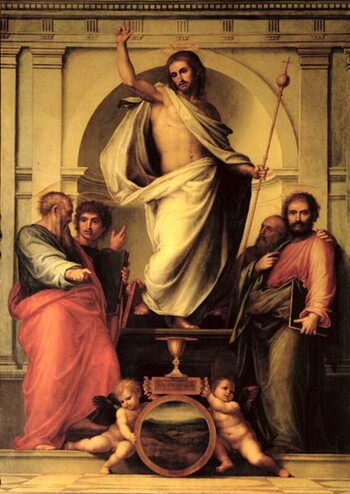
You may notice that from this course, we have talked a lot about the Tree of Life, the synthesis of being, the map of consciousness. We also juxtapose this mysterious glyph with another powerful painting of Christ with four apostles and two cherubim with a mirror. This painting represents the Tree of Life in synthesis, and we have talked about מלכות Malkuth, the physical body, יסוד Yesod, the vital energies, הוד Hod, the astral vehicle or emotional state, נצח Netzach, the mind.
The four apostles: Matthew, Mark, Luke, and John, in the Bible represent these four lower qualities and the four Gospels. They also relate to the four elements. The four animals are the holy creatures of Ezekiel: the bull, the lion, the cherubim or angel, and the eagle―earth, air, fire, water. What is interesting is that these four apostles stand above two children, two innocent, kind, divine souls. In a sense, these two children hold up a mirror, and these children are תפארת Tiphereth, the human consciousness, the Essence, likewise, גבורה Geburah, the divine soul. These two souls, human and divine, are what really concerns us with meditation, because the human soul, concentration, the ability to focus on one thing, is תפארת Tiphereth and that will is augmented by perception, consciousness, גבורה Geburah: the quality to receive information, to focus on one thing and to extract knowledge, real wisdom. That wisdom is our true being, the mirror. It is our true self. That mirror is חסד Chesed, the inner spirit, the real Being, the real self. Obviously, these figures, these lower vehicles, are the bodies of Christ, the highest truth: כתר Kether, חכמה Chokmah, בינה Binah, the Father, the Son, and the Holy Spirit. In synthesis, this Tree of Life can show us, in the lower seven spheres, especially, what are known as the essence or heart or the qualities that we need to develop in relation to each of these spheres, the lower seven sephiroth. These lower 7 sephiroth, from חסד Chesed to מלכות Malkuth, related to the paramitas. So, paramitas are attitudes, qualities of being that we need to understand about overcoming certain challenges. The physical body, obviously, relates to מלכות Malkuth, the earth, but as we begin our studies, we learn to cultivate generosity, to generate the life force of the spirit through transmutation, through the work of the sexual force. 1. DANA, the key of charity and love immortal. ―The Voice of the Silence
Dana, generosity, charity, relates with יסוד Yesod, the power to generate, to give life, spiritually, especially. To be generous is to create new circumstances, not only of money or physical goods, but spiritually. It is an attitude, compassion, and the power of compassion is found in the sexual force, how we use that energy, because literally it regenerates the psyche when harnessed.
Any beginner meditator as they are calming the body and transforming the creative forces of יסוד Yesod enters a great problem. We face great conflicts in terms of our life circumstances. We are challenged. As we are observing ourselves, we find that we have anger and pride and fear and laziness and lust, because now we are actively looking at ourselves and seeing with the creative force what we really are, because that energy empowers the consciousness to be able to watch, to observe, to understand. Therefore, we need ethics, because in relation to הוד Hod, the emotional center itself, we have to develop real harmony, Shila, according to The Voice of the Silence: 2. SHILA, the key of harmony and word and act, the key that counterbalances the cause and the effect, and leaves no further room for Karmic action. ―The Voice of the Silence
Because in the heart is really where we are tested, in our very core. Ethics, Shila, creates harmony, controlling those negative reactions to life.
Next is Kshanti. 3. KSHANTI, patience sweet, that nought can ruffle. ―The Voice of the Silence
It relates the נצח Netzach. We need patience when we deal with our mind. Our mind is a great animal, a great beast, and its distractions and thoughts keep us jumping from association to association, and not understanding who we are in our fundamental depth.
4. VIRAG, indifference to pleasure and to pain, illusion conquered, truth alone perceived. ―The Voice of the Silence
This relates to מלכות Malkuth, the physical world, because in life, we have to be indifferent. Good or bad, happiness and sorrow, pleasure and pain, are temporary. These things don't last, and why be attached? The virtue of מלכות Malkuth is indifference, not apathy, but equanimity, neutrality, not being tossed around by good or bad, but being in the middle.
5. VIRYA, the dauntless energy that fights its way to the supernal TRUTH, out of the mire of lies terrestrial. ―The Voice of the Silence
This is תפארת Tiphereth, willpower. The real beauty of the soul is diligence, not merely keeping a job or having a career, although that is useful and we need it, but the virya, the dauntless energy of תפארת Tiphereth that we need, the diligence that we need, is one that is willing to fight spiritually and to make changes, and to try again and again, and to strive in the way of God.
6. DHYANA, whose golden gate once opened leads the Narjol (the initiate) toward the realm of Sat (the Absolute) eternal and its ceaseless contemplation. ―The Voice of the Silence
Dhyana, as we are hinting at, is גבורה Geburah, the divine soul. So, in meditation we learn to concentrate and then we extract knowledge. We can use our visualization, our imagination, our perception, to understand the the essence of a given thing, and that is real meditation. It is a state of being, and גבורה Geburah relates to Dhyana, meditation itself.
And lastly: 7. PRAJNA, the key to which makes of a man a god, creating him a Bodhisattva, son of the Dhyanis. ―The Voice of the Silence
This relates to חסד Chesed, the inner Being, the spirit, Prajna.
With meditation what we want to do is to embody these virtues, to develop them so that by understanding these principles, we control our body, our energies. our emotions, our mind, our, will. This control does not mean repression, restriction. It means understanding, how they all function together, how they interrelate, so that when our will is serene, it knows how to apply itself to anything and to understand the heart of reality. We can extract new wisdom through the mirror of our consciousness, to understand the depths of anything. These are principles that help us in terms of our psychological work. We will explain them in synthesis. 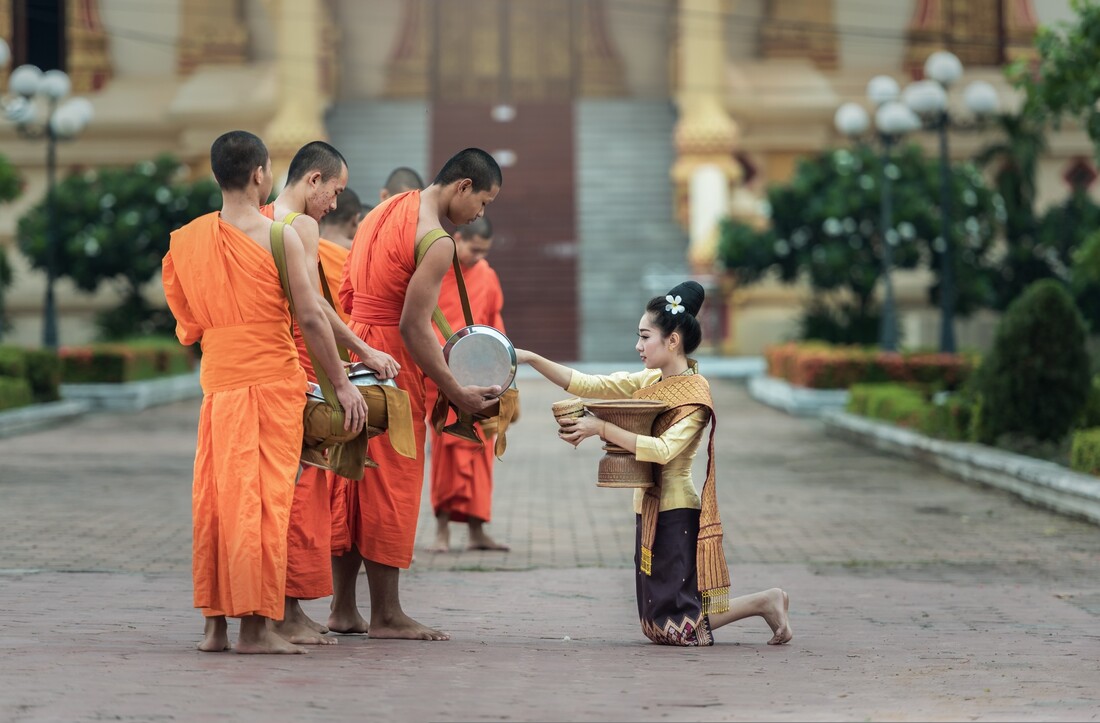
Generosity (Dana, יסוד Yesod)
The first is Dana (generosity). So, The Voice of the Silence emphasize that in the beginning of any spiritual path, when we are learning about generosity and kindness, that obviously it is very easy. We become inspired to want to practice and become a spiritual person. We are joyed by the beauty and depth of the great initiates, what they wrote, especially from the scriptures.
They have a lot of deep emotional power because they are generated from a state of being that is transcended, individuals who fully perfected that quality of themselves and were able to express the generosity of God, the compassion of divinity. This is Dana. This is the spirit of religion―to give, regardless of one's self, and to be in service of others despite our needs. Obviously, there is a balancing act. In our modern culture, we like to talk about self-care. It is important, but the attitude of a bodhisattva is that other people take precedent. Charity is a fountain, and that attitude of rich compassion is born when we work at transmutation, especially, the power of life. This is the beginning of religion, real religion, the beginning of the path. We talk about the work with the Holy Spirit because it is the power of genesis, the power of life. The Voice of the Silence explains the following corroborating these points: Armed with the key of Charity, of love and tender mercy, thou art secure before the gate of Dana, the gate that standeth at the entrance of the PATH.
A lot of times in the Qur’an you find images of verdant leaves and crops and beautiful flowers, land of milk and honey, paradises. All those images in the Bible of lush forests and vegetation, flowers seen in dreams, is a symbol of a flowering of the soul. You see that in your visions. You are being shown, like a rose or a lotus born from the mud, you find the purity of the consciousness. It flowers radiant and pure as we extract the mud, which is why we have ethics.

Ethics (Shila, הוד Hod)
Shila, this is where the path gets difficult, because as we are exploring ourselves, we find that we have many vices. What we need in this level of discipline is understanding the code and conduct of the initiates, the examples of the great prophets, because they could help guide us in terms of our work. We need to learn from people who have done this, not merely from any physical group, but from the scriptures, because they demonstrate a caliber of being which is possible for us. The way that they reach those heights of realization was by controlling their animal mind.
And to the second gate the way is verdant too. But it is steep and winds up hill; yea, to its rocky top. Grey mists will over-hang its rough and stony height, and all be dark beyond. As on he goes, the song of hope soundeth more feeble and the pilgrim's heart. The thrill of doubt is now upon him; his step less steady grows."
It is important to emphasize that these steps are not merely plateaus in which we reach one level, like we stay there and then we move on to the next. They are interpenetrating and related. They build on each other. They connect. With ethics, it is like an armor. In a moment of great crisis, we find that our own mind is reacting. Our ego emerges and wants to dominate, wants to control us, wants to harm in any way.
Shila is when we look at that element and we watch. We do not feed it. We do not justify it. We do not repress it. We look. The ethical response is when we understand intuitively what the right way of being is. It just comes to you like when you are not thinking. You are not expecting it, but you are watching and you are understanding. You are getting data about that defect so that we can learn more about it. If we do not understand how the mind and the heart function and why they operate the way they do, we will make mistakes. We will not gain enough insight to really eliminate that fault deeply. When we lack ethics in our life, we suffer, because we make our situations worse. Obviously, there is no way to escape the pain of the path. In fact, what matters is voluntary efforts, voluntary suffering, being willing to enter those challenging circumstances and not run away, but to learn intuitively the right answer. 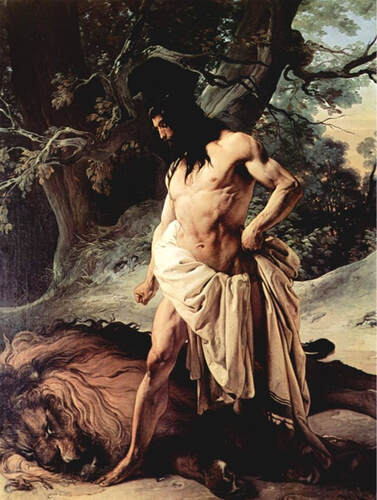
Patience (Kshanti, נצח Netzach)
This leads into Kshanti (patience), because we need to be patient. We are not going to change overnight. I mean, becoming perfect like someone like Jesus or Buddha or Muhammad, great initiates, is a long process, and we have to be willing to endure our own mistakes and to change.
We have an image here of Samson from the Old Testament, where I will explain some verses from John Milton, especially his Samson Agonistes, a great work of literature in which we find, by his example, the need to patiently endure the sufferings of imprisonment and blindness. The Voice of the Silence explains: Be of sure foot, O candidate. In Kshanti's essence bathe thy Soul, for now thou dost approach the portal of that name, the gate of fortitude and patience. ―The Voice of the Silence
Again, patience and ethics are like armor. They shield us when we are tempted. In a sense, patience is almost like a bath, like you are cleansing yourself. Through patience possess ye your soul (Luke 21:19).
John Milton explained the following, corroborating these points. But patience is more oft the exercise
It is impossible to purify the psyche without facing those great ordeals. In initiation, we talk about facing challenges and circumstances that really test our character, our state of mind, and in that state when we we are boiling at 100 degrees Celsius, we feel like we are reaching a threshold. Like in a moment, we are going to maybe snap, like maybe you feel anger arising or negative emotions with thoughts, words that want to express.
If we are watching this process, we see that part of us is trapped in anger. In a sense, it is very overwhelming. It can be overpowering, but the key is to watch, to observe, and to remember God, as difficult as it may be. Patience is our own deliverance, and really, we have to be patient when we study ourselves, because we see that we have elements that are contrary to this work. But it is patience that allows us to face any situation, any challenge, the tyranny of our own mind or misfortune, because from the state of consciousness, we learn that karma, circumstance, is impermanent. Or situations are impermanent, and that we have to face the consequences of our former actions, to bear them willingly―voluntary suffering, conscious works, to take responsibility of our own actions and mistakes. 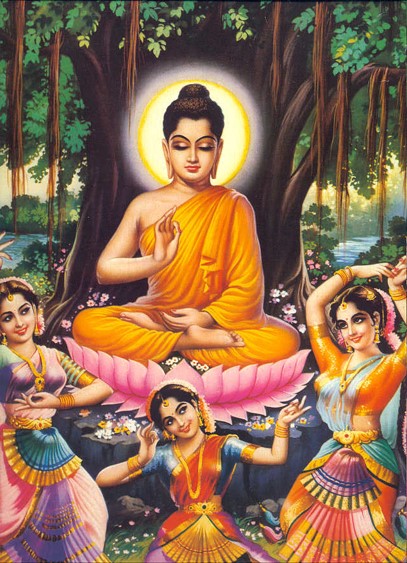
Indifference (Virag, מלכות Malkuth)
Virag is indifference. We see that Buddha here is meditating with Mara's daughters, who in the traditional mythology is the temptations of mind, heart, and sex. These are not figures outside, but something psychological in us, how our own mind, our emotions, and our desires keep us hypnotized or distracted.
The virtue of of מלכות Malkuth, of Virag, indifference, is when we approach life. We awaken the consciousness. We observe. We are mindful, but we do not crave or want to reject the circumstances of existence. We face them and we are not either favoring or running away. We have to be equanimitous. What good may come, we accept. What negativity comes, we accept, and our attitude does not change. It does not mean apathy, like we do not feel anything, like, “It does not matter. I do not care.” It is not the point. That is living like a zombie, in a sense, which is a state of dysphoria. It is not the state of indifference from the consciousness. Indifference means you can be happy or content, regardless of what anyone else says, and be compassionate regardless. There is still a dynamic range of conscious emotion and perception, of feeling, but it is not driven by desire. It is serene. Here is what The Voice in The Silence emphasizes about this: Close not Thine Eyes nor lose thy sight of Dorje (and a Dorje in Tibetan Buddhism is like a symbol of the holy eight, a scepter which is used in Buddhist rituals, a symbol of man, the masculine sexual organ).
These arrows of Mara are precisely our own passions. When our desires want to take control of our human machine, the intellect, the emotions, our movements, our instincts, or our sex, and if we are not watching the different functionalisms of those centers and how they all integrate and relate, we get pulled in multiple directions―maybe our thoughts in one way, our emotions in another, our movements in one direction.
These are like Maras arrows. The impressions of life hit us. We are usually just reacting, and we do not actually watch ourselves or understand why we react the way we do, except we kind of externalize. Instead, indifference is that separation where you are watching. You are in tune with life, but you transform the impressions. They no longer hit us and impact us in a way that makes us negative. We understand what is going on in the world. …on Path [the] fourth, the lightest breeze of passion or desire will stir the steady light upon the pure white walls of Soul. ―The Voice of the Silence
So, this emphasizes some points that Gurdjieff made about the five centers, especially. You know we have the light of consciousness, which is observing through the three brains. We are trying to integrate those centers and make them a unity. We are conscious and concentrated in ourselves. We are watching and observing ourselves. It is a light, the light of perception within our human machine that is trying to operate the five centers or the three brains. If we allow passion to interfere in any one of those centers, we lose that light. It gets tainted or corrupted, and we get distracted.
Indifference, Virag, is the ability to watch, to see, observe, and understand without being disturbed. It is strong the more we develop it, which is why The Voice of the Silence emphasizes: The smallest wave of longing or regret for Maya's gifts are illusive, along Antaskarana (the silver astral cord) ― the path that lies between thy Spirit and thy self, the highway of sensations, the rude arousers of Ahankara (selfhood) ― a thought as fleeting as the lightning flash will make thee thy three prizes forfeit ― the prizes thou hast won. ―The Voice of the Silence
Blavatsky speaks a lot about the Antahkarana thread, which is what connects the astral body to the physical body, especially when we are awake. When we dream, the astral body has this cord that connects it to the physical body, so then we travel in those dimensions, we can always return to our vehicle through that cord. In a sense, the Antahkarana thread that is being described here is the path that lies between spirit and self, the internal and the external, in that the impressions of life that you receive are, in a sense, registered through our astral senses.
Physically, we cannot point at our feelings, but we sense them. These are psychological senses, the senses of the astral body that are permeating our physical body. If we in our physical life do not transform the impressions of existence, whether it is for pleasure or pain, whatever it maybe, we get hypnotized and we do not see reality. In a sense, our perceptions of self known as Ahankara are precisely the defects we experience, the self, pride, anger, laziness, whatever it may be. The self are all these desires and impressions, states that are provoked by the circumstances of life. So, if someone praises us, we feel pride emerge, and that pride is feeding on the sensations of pride, or if it is for lust, sensations of lust, passion. Or, fear that wants security, that wants to run away from the impressions that there is uncertainty in our financial, social, or marital relationships, whatever it may be. We perceive the sensations or impressions of life, and our reactions bubble up. They sprout. They emerge in the five centers, and they are always trying to feed on certain sensations or impressions, but unless we watch this state willingly, we will not see the exchange or the process. Instead, we just kind of go with the flow and if we do, if we are just thinking and thinking and feeling to whatever happens in life and not watching this, you know, a thought is fleeting as a lightning flash. It will take away our energy, the prize, right? I mean the prize is, as we are watching ourselves, we are saving energy and we are building up a reservoir, psychologically speaking, not merely physically or sexually, but emotionally too. We have energy, mentally as well. If we are constantly feeding our desires, then we deplete our mind, our heart, our body. Indifference teaches us to be sealed, hermetically sealed. Do not lose the precious energies of our psyche so that we can awaken more perception. So, obviously this path is very demanding. As it states here: Stern and exacting is the virtue of Viraga. If thou its path would'st master, thou must keep thy mind and thy perceptions far freerer than before from killing action. ―The Voice of the Silence
Meeting, real action is spontaneous, intuitive, novel in the moment. It does not mean to be impulsive. It means to know how to respond to any situation with wisdom and understanding.
Thou has to saturate thyself with pure Alaya, (the universal soul) become as one with Nature's Soul-Thought. At one with it thou are invincible; in separation, thou becomest the playground of Samvriti (empirical or conventional truth through the senses), origin of all the world's delusions. ―The Voice of the Silence
What does it mean to be saturated with pure alaya? Practically in our work, it means means to be mindful, be alert, be conscious. That pure soul, that universal soul, is compassion. It is Christ, a state of being, and if we wish to be, in a sense, invincible, psychologically speaking, spiritually speaking, it is important that we remember God, the presence of divinity in our heart, moment by moment, observing ourselves, remembering a state of clarity, compassion, patience, wisdom, and endurance.
Otherwise, if we, in a sense, lose our connection in a moment of great trial, we say something we regret or we become angry or fearful, and we feel the pain of that, obviously, the remorse. To be invincible means to not be separated from divinity, because divinity is the source of real power, of real being. Otherwise, we become a playground. Our intellect, our emotions, our movements, our centers, just pull us in whatever direction, so we are kind of adrift, but self-remembrance keeps us in a unitary state. Diligence (Virya, תפארת Tiphereth)
Virya (diligence). Virya literally means “warrior.” This is the diligence or willpower needed, especially in meditation, to concentrate, focus on one thing unwaveringly without distraction. That is the essence of real willpower or תפארת Tiphereth in the kabbalah. Concentration, serene observation, is the power of a spiritual warrior. It is the faculty that allows us to apply ourselves spiritually to any endeavor, and in a sense, this is all depicted in the Mahabharata.
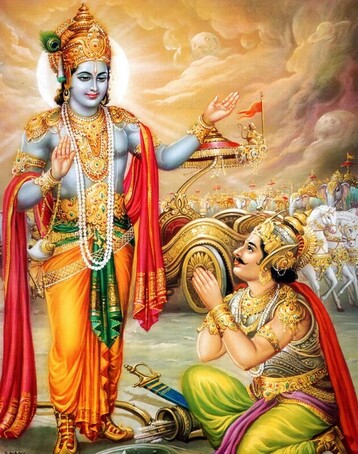
We see Arjuna speaking to Krishna, the Hindu Christ! where he is told on the battlefield that he has to confront all his family members, his loved ones, who are symbols of his own desires, his passions. Obviously, in the beginning he is fearful and says, “I don't want to fight the ones I love,” and psychologically we face the same problem. We do not want to give up fear or pride or anger or resentment. We love that part of our self so much and we are not willing to fight it. This is evident when we have an argument with our loved ones or a spouse, and we see something in us that is very overwhelming and powerful, maybe anger or pride, and we need willpower to even be willing to look―to look at the situation and even the pain that we cause.
Willpower, Virya, diligence―it does not mean get up at 5:00 a.m to meditate every day and go to work, work a hard job, be busy all day and be distracted and doing multiple things (I know we live in the era of multitasking), but in a sense, this is not the diligence we are talking about. It is conscious diligence. Those moments in which we are very awake, and we are seeing new things about ourselves, and we are gathering data, and we are willing to do that again and again, that is real Virya, diligence. The fearless warrior, his precious life-blood oozing from his wide and gaping wounds, will still attack the foe, drive him from out his stronghold, vanquish him, ere he himself expires. Act then, all ye who fail and suffer, act like him, and from the stronghold of your Soul, chase all your foes away ― ambition, anger, hatred, e'en to the shadow of desire ― when even you have failed... ―The Voice of the Silence
Most people who begin to study themselves will run away from the reality. But obviously, the emphasis in The Voice of the Silence, in the many religious scriptures, is that a meditator is one who is willing to face again and again, despite the feeling of wounds and weakness and vulnerability, to try again and again, to strive, because this path is not only for our own benefit, but for others, improving our communities.
Diligence is the quality of the consciousness that is able to penetrate into the mind and to focus on that, specifically, so that we can extract wisdom and knowledge about the roots of our defects, so that by understanding them, we can remove them. Remember, thou that fightest is for man's liberation, each failure is success, and each sincere attempt wins its reward in time. The holy germs that sprout and grow unseen in the disciple's soul, their stalks wax strong at each new trial, they bend like reeds but never break, nor can they e'er be lost. But when the hour has struck they blossom forth. ―The Voice of the Silence
It is easy in the beginning to maybe get discouraged. We try these practices, and we feel like we are not making changes. But the real results come with those tests and ordeals in which we find that before, when we would have broken in a moment of anger, we bend like a reed. We are more flexible. We do not react like we used to. Progress, little by little. Flexibility and strength are born with time, with patience.
These verses are emphasized in the Bhagavad Gita, especially, in which Arjuna receives advice from Krishna, encouragement. That emphasizes a holy war as emphasized in the Middle Eastern traditions, especially, but also in the Bhagavad Gita. Here are some things, words of encouragement given by Christ, the Hindu Krishna, in a verse from “Sankhya Yoga” in that this path is an obligation upon us, a duty. 31. Having regard to thy own duty, thou shouldst not waver, for there is nothing higher for a Kshatriya (of the military caste) than a righteous war. 32. Happy are the Kshatriyas, O Arjuna, who are called upon to fight in such a battle that comes of itself as an open door to heaven. 33. But, if thou will not fight in this righteous war, then, having abandoned thine duty and fame, thou shalt incur sin. 34. People, too, will recount thy everlasting dishonour and; and to one who has been honoured, dishonor is worse than death. 35. The great car-warriors will think that thou has withdrawn from the battle through fear; and thou wilt be lightly held by them who have thought much of thee. 36. Thy enemies also, cavilling at thy power will speak many abusive words. What is more painful than this! 37. Slain, thou wilt obtain heaven; victorious, thou will enjoy the earth; therefore stand up, O son of Kunti (the sacred feminine), resolved to fight! ―Bhagavad Gita, Sankha Yoga
In many ways, this is explaining that any person who approaches religion, who has some practical work and is making some changes and realizes the value of the honor of this work, it is a grave downfall to go backwards, because not only is our benefit and our own level of being inhibited, but we prevent other people from benefiting from us too. So, it is a responsibility and that is why it is a challenge. This is something not to be taken lightly. He says, if you strive in this way or seek to enter it, be sure, because there are consequences.
Meditation (Dhyana, גבורה Geburah)
When we develop the ability to concentrate, to focus on one thing unwaveringly, sustainably, we enter what is known real Dhyana, meditation. Dhyana is a state of being. When we are able to focus and concentrate serenely on one thing and wait, we can visualize whatever it is we want to understand. Suddenly, images come, insights, perceptions, maybe through a vision or a dream, but also maybe just through an understanding. We understand something deeply about what we are trying to comprehend. This is Dhyana.
Meditation means to extract information from any phenomenon, and in that way, it is like a mirror or like a vase that contains a beautiful light. That light is our own Being, the quality of perception itself, the ability to even see it and understand. Dhyana is ascribed in relationship to the divine soul. If you have read what Samael Aun Weor explained about גבורה Geburah, Buddhi, he explains that this divine part of ourselves is like an alabaster vase wherein the light of חסד Chesed, the spirit, shines. The spirit is God and can express through our consciousness, when we have set the parameters up by entering a state of serenity with our physical body, calming the energies, calming the heart, calming the mind, and focusing our will and entering in a state of meditation. Then our inner Being can enter through our imagination and show us visual things, teach us through dreams or visions. So, he is the light that shines like in the alabaster vase as explained here. The Dhyana gate is like an alabaster vase, white and transparent; within there burns a steady golden fire, the flame of Prajna that radiates from Atman. Thou art that vase. ―The Voice of the Silence
Prajna means “profound wisdom,” to immediately see something and understand it in the full depths. Jna means “knowledge,” but pra means “beyond,” to see beyond the limitations of our senses, our mind, our thoughts. Atman is the spirit, חסד Chesed.
When we enter and resonate with that level of being, we will have entered the prerequisites steps of serenity. In this way, we gain real experience, real knowledge about anything that we want, which is why it is very different from just mere intellectual study, as explained here. Thou hast estranged thyself from objects of the senses; travelled on the “Path of seeing,” on the “Path of hearing,” and standest in the light of Knowledge. Thou hast now reached Titiksha state (which is patience, forgiveness, and tolerance). ―The Voice of the Silence 
(Arabic calligraphy: Al-Nur, "The Light")
To go from the path of hearing the knowledge in order to see it for oneself, this is all emphasized in the Qur'an, in Surah al-Nur, in which we find the same teaching:
Allah is the Light of the heavens and the earth. The parable of His Light is a niche wherein is a lamp ― the lamp is in a glass, the glass is it were a glittering star ― lit from a blessed olive tree, neither eastern nor western, whose oil almost lights up, though fire should not touch it. Light upon light. Allah guides to His light whomever he wishes. Allah draws parables for mankind, and Allah has knowledge of all things. ―Al-Qur’an, Surah al-Nur [24:35]
The light of the heavens and the earth is our Being, the ability to perceive and have insight and wisdom. That light is in the lamp of גבורה Geburah, the spirit or the divine soul, better said, “Lit from a blessed olive tree.” That olive tree is our Tree of Knowledge. By working with the oil of the Tree of Knowledge, the creative energy, the sexual force, is how you have light. “Untouched by fire,” meaning passion or lust, and is “light upon light” because there are levels upon levels of being that we can experience in meditation, related to this Tree of Life―degrees. Divinity draws to himself whomever he wishes through visions, through meditation, through experiences.
Wisdom (Prajna, חסד Chesed)
The last of this is Prana (Wisdom). Real wisdom, as you know, is when we are able to focus, concentrate, observe, and receive images in meditation. We get an understanding, and the insight or understanding of a given phenomenon is Prajna, related to the spirit. It is when we understand. It is the “aha!” moment, in which we get something really deeply, but imagine on a more profound level.
Some steps related to Prajna in The Voice of the Silence, emphasized, again, some ethical prerequisites: the need to be compassionate. We receive in accordance with what we give. It is the law of divinity, reciprocity. In a sense, if we long for insight and understanding or blessings from divinity, we too have to do our part by whatever our capacities. We have to be a part of our community, or maybe it is our job or career. We learn to give of whatever we are able to, and in accordance with what we give, we receive. In a way, we get insights from divinity as we are helping people at our capacities, which is why The Voice of the Silence teaches: Know that the stream of superhuman knowledge and the Deva-Wisdom (the wisdom of divinity, the angels), thou hast won, must, from thyself, the channel of Alaya, be poured forth into another bed. ―The Voice of the Silence
It is not enough, as we said, about gaining enlightenment for yourself or ourselves, because it is not about us. We have to learn to help our communities. We should strive to become a vehicle for divinity so that divinity can provide for others.
Know, O Narjol (saint or glorified adept), thou of the Secret Path, its pure fresh waters must be used to sweeter make the Ocean's bitter waves ― that mighty sea of sorrow formed of the tears of men. ―The Voice of the Silence
Again, emphasizing these points. We want to make our knowledge practical, things that we understand and learn from meditation, so that we can improve our own state to improve our communities.
In a sense, we are striving towards that אין סוף Ain Soph, the star of Bethlehem, our inner monad, the truth, which means “unity” in Latin, the essence of the spirit, that star of our inner truth within the void. Alas! when one has become like the fix'd star in highest heaven, that bright celestial orb must shine from out the spatial depths for all save for itself; give light to all, but take from none. ―The Voice of the Silence
A very high ethical demand. It is not easy to strive in this way, because we have this ideal of divinity and their capacity as initiates, and they are very rare. But obviously we are going to make mistakes, but we should strive regardless.
Continuing on these points: 
Alas! when once thou hast become like the pure snow in mountain vales, cold and unfeeling to the touch, warm and protective to the seed that sleepeth deep beneath its bosom ― 'tis now that snow which must receive the biting frost, the northern blasts, thus shielding from their sharp and cruel tooth the earth that holds the promised harvest, the harvest that will feed the hungry. ―The Voice of the Silence
Again, this goes back to indifference. So, notice that the the paramitas interrelate. In terms of indifference, one must be not unfeeling, but in a sense, shielded from the suffering of life and maybe the negativity of humanity, and by protecting the seed, the soul can grow underneath the snow. This metaphor of the snow itself―the snow obviously relates to chastity, the work of the sexual force, the purity of the psyche. This seed is really, the people in our life, our communities. People have a seed of the soul within them which can grow, and as we are striving on this path, we want to help nourish the soul of others and to shield them from pain. We do so through understanding of the highest wisdom Prajna, from experience.
So what is interesting about The Voice of the Silence, especially towards the end of this scripture, is that Blavatsky touches on these paramitas to emphasize the psychology of the great masters of compassion and how they really embody these higher virtues. They do so not for themselves, but for others. They are known as the Guardian Wall: those initiates who have really mastered the higher paths itself, who have reached their inner star, their אין סוף Ain Soph. They come and they remain to help countless humanities through many ages. We call them, like beings like Sanat Kumara, who is the organizer of the College of Initiates, Bhagavan Aklaiva. You have Moses, Buddha, many masters. Even Muhammad was described like a brick that finalized the house of the successive lineage of the prophets. He is a brick in the Guardian Wall, one master of many who are helping humanity in the internal planes, in that they stay and remain in order to teach us and help us internally, especially, dooming themselves throughout many ages to help and guide. Obviously, this is the goal that in this path, we are striving towards, but obviously, that is the heights, you know, just talking about the end goal, because we do not begin there. We begin where we are at. Self-doomed to live through future Kalpas (cosmic periods), unthanked and unperceived by man; wedged as a stone with countless other stones, which form the “Guardian Wall,” such is thy future if the seventh gate thou passest. Built by the hands of many Masters of Compassion, raised by their tortures, by their blood cemented, it shields mankind, since man is man, protecting it from further and far greater misery and sorrow. ―The Voice of the Silence
That is the height of real wisdom.
Conclusion
In conclusion. We recommend you study a course given by Glorian Publishing. It is called The Path of the Bodhisattva. Some of what we explained in this scripture is that Christianity and Buddhism have the same roots, or the essence of their teachings emphasize the same knowledge, and that by studying both traditions, we can better understand what Blavatsky taught and also how to understand the whole scope of the spiritual path, so that we know the map. These are some basic principles that can guide us in that way.
If you have questions, feel free to ask. Questions and Answers
Question: When it said the seventh gate, in that last slide, is that referring to the tree, getting past that seventh level and then getting above that?
Instructor: Yes. So, kind of from the bottom up from מלכות Malkuth to חסד Chesed. חסד Chesed will be the seventh gate and beyond that is higher levels related to Christ. But yeah, Prajna in a sense can relate to חסד Chesed the spirit, but also even these higher sephiroth of the Trinity because even beyond our own inner spirit, the light of our Innermost, our inner God, is levels of levels of light, as mentioned by the Qur’an. Light upon light―degrees. Question: Could you give an example of repression as opposed to just saying no to something? Maybe like just for anybody's against smoking, drinking, eating ice cream? Instructor: I think more than eating ice cream, a good example I think would be something like pride. You talk with a loved one, maybe as an example, your partner and your partner says some criticisms, which are perfectly valid and objective. They are true. If you are observing yourself, the impression emerges, and if you are watching, you see elements of pride or anger emerge. You feel maybe, “She's wrong. She shouldn't have said that. I don't deserve this! I am angry! How dare she say that to me?” and you feel that boiling in yourself. Repressing would be, “Oh, I am not feeling anything,” wanting not to look at it. Like you may feel the emotions boiling inside, and yet that part of us, which is on the threshold of being perceptive and awake, we do not really register the full depth of the emotion. It is like we are only conscious of the surface, in a sense, like you look at an iceberg. In many ways, we do not even pay attention to how we are feeling unless we are really watching. We may think that we are not necessarily that mad. Question: So, let us say, for example, let us say something like mainstream media, to say, “I am not going to follow that because it does something to me,” where your ego comes out. Would that be something to say, “I don't want to look at that or watch that or do that.” Is that the same thing as repression? Instructor: It can be. You may have the the ego watching television and watching movies or the appetite to consume media, or internet, or whatever it may be, and merely just saying, “Oh, I am not going to look at that.” In a sense, this could be a common reaction, or in the case of some people, lust. People may, in the beginning of our studies, become inspired as single persons, “Oh, I am going to practice transmutation, pranayama, I am going to dedicate myself to not being lustful anymore,” avoiding situations or maybe even just avoiding, circumstances that before we may feel uncomfortable with. It could be a form of repression, meaning we are not willing to look at those kinds of circumstances or the reactions that are associated with them. This does not mean that we want to go looking for trouble on the other end of the spectrum or the other end of the pendulum, where, “Oh, I have to go look at pornography or lustful things or whatever so that I can conquer my lust.” That is, in a sense, kind of fooling oneself. But repression is like avoiding, right? Avoiding the situation and not really being willing to look at the truth when those circumstances do provoke those elements. Another Instructor: Can I add on to this? I think with the cigarette example, but like you said, it can be applicable to many things. It starts off with you knowing that a part of you is curious. It does want to try. It does want to indulge mainstream media, right? So, maybe a part of you does want to know what is going on there and repression is just pushing that down. But willfully pushing that down and avoiding, that is going to come out somewhere else, right? So, you say no to the cigarette, you push it down, “Nope, bad, bad, bad. I don't want that,” and then later on you find yourself, you know, eating a tub of ice cream or doing some other thing, because of that tension, that psychic pressure of having repressed it, whereas if you say no to the cigarette, but you still allow yourself to feel that desire and to see that desire in you and you are conscious of it, you are using the conscious observation of that desire in order to transform it. Thus, you can retain and almost extract the energy out of that desire and purify it, and kind of awaken your consciousness further through it, versus the conscious avoidance of something just creates a psychic tension that then is going to come out somewhere else. In either case, you have lost the energy there through that desire. It just might not have happened here. It happens over there instead. But this skill to be able to consciously observe something and not act on it, I think it relates to the patience that was just talked about in this lecture, right? Samael Aun Weor talks about the need for a magician to forbear, to keep silent, to know how to suffer, to know how to die, and that is exactly what we feel in a situation where a temptation is there and we desire it, but we are holding firm with our consciousness. We are keeping a kind of spiritual integrity, and we are observing what is happening inside of us without acting on it, because as soon as we act on it, one way or another, pushing it down or indulging in it, we have lost that energy. We have lost that consciousness. We have gone further into unconscious behavior. But if we are there and we are observing it consciously, this kind of transformation of the impression occurs, which is what we are always talking about, right? That is the magic, right? That is what the magician is doing, is extracting the energy out of his own unconscious mind and transforming it into a conscious substance that can be used for spiritual work and development. Instructor: All the paramitas work together to ensure that obviously we generate the spirit of altruism, of giving. We work with the creative energies to generate light in ourselves. Ethics is how we refine that light, remove our perception from anger, fear, lust, whatever it may be. Patience is the stability of the consciousness that knows how to look at life with equanimity, and to endure suffering when it does arrive, not acting mistakenly. But obviously, then, willpower and meditation and wisdom relate. As we are cultivating a state of serenity, when we sit down to meditate, we can start to go deeper into our reactions of the day, so that we can understand in a more fundamental level, how are we repressing and how are we indulging. In the surface level we can get a sense, but obviously to go to the most deep levels, it is important to put aside the senses and go look within, because there is a lot of depth to us that are operating without our conscious control or awareness. Question: I have seen a tree has a card like downwards, like the duality of the tree, so if I for example, cannot find patience, is there like a sephirah there, I think those are like Klipoth, right? Instructor: Yes Question: The sephiroth that represents patience. If I focus on the opposite, does that also helps me to understand it? Because sometimes we talk about these concepts that are very high, but I am more familiar with the opposite. Instructor: Yeah, that is all of us, because if you really want to understand the virtue of patience and yeah, understand anger, look at the vices, and every vice has its opposite. With anger, its opposite is precisely this patience, and I believe the term that Blavatsky used was, “Kshanti is patience sweet.” It is sweetness. Sweetness is patience, when someone comes at us aggressively and we respond with love. Yeah, serenity. It is like, you do not react, but you do respond with level-headedness. You endure the reactions in yourself or the intensity of the emotions, but also the reactions of oneself that want to get angry or retaliate, and sweetness is that state of patience. You understand that by looking at hell. We have to look at the negative first so that you develop the virtues. It doesn't work the other way around. I mean, in a sense, it is important not just to meditate on our mistakes because that can make us very one-sided and very morbid, because we look at ourselves and say, “Oh my God! I am angry, I am proud, I am lustful!” you know, all these errors, like you just go on forever, but in that sense, by looking at those negative vices and comprehending and eliminating them, with meditation we learn to eliminate those faults. You extract patience from anger. Anger is like the cage it is. It is broken. In that way, you can also meditate on the virtues too like, do not just meditate on anger, but meditate on the paramitas, because they teach both sides of the spectrum of consciousness. We want to invert these hell realms, this inverted sphere into its positive, and the roots of the Tree of Life are born by removing the roots of the tree of death. Question: Back to the example of, let us say, an argument with a loved one or your spouse, and it is not good to just be like, “Oh, I don't feel anything,” and you just like crush it, but in that moment, you just want to absorb it and practice mindfulness, to just say, “Okay, this is what I am feeling this moment. I am going to try and let it pass so that I can be more level-headed and respond, and you know love without hate or anger,” is that kind of the the route to go about it versus the repression where it's like, I don't feel it and need to step away? Instructor: I would say it would be good to communicate. “I am not saying this is right or wrong, but this is what I am feeling,” and talk about it and express it. It is a threshold. There is a fine line between not addressing it and then going all in. It is a delicate balance. We can consciously experience those emotions when we are looking at them, observing them, and approaching them with the Essence, the soul. That means communicating what you are thinking. It is like, that is really the best thing, is being transparent, because it is not good to bottle it up, because it is going to explode. Better to let off the steam by saying, “Hey, I am feeling a lot of anger right now. I am not saying this is right,” but expressing it, talking about it delicately, you know. Another Instructor: Yeah, and I think that that is the beginning: is seeing it and sometimes if you are able to express in a respectful way, that can help, but ultimately the work we are trying to do is to take these heavy elements of the psyche and to transform them into the positive elements of the psyche. So, taking the vices of anger and transform it into love. In the beginning, you are going to observe it and recognize it and say, “Okay, this is how I am feeling,” and it will pass, like you said, but if you do not go back later in meditation or in contemplation and really reflect on, “What was I feeling there? What is the root of that anger? Where did that come from in this life, in past lives?” maybe, if we if we go back even further? What triggers that anger? What does that anger really want in contemplating, “If I feed that, where will it get me?” Little by little, the consciousness of that anger and its quality and its shape will start to break you out of it, right? Because as you become more aware of what it is, your own remorse and your own conscience will start to be like, “Yeah, that is not really as justified as I felt in the moment. That's actually something that I don't really feel a desire for; I don't really feel an attraction to,” and so you can kind of reclaim that psychic energy as I mentioned earlier and take it back. But if we are not doing that work later on, to go back and revisit the kind of little nuggets that we found throughout the day that came up within us, then they will just continue to emerge and emerge and emerge and we will be constantly having to hold it, observe it, let it pass every single day, and that is not really our goal, although that is better, maybe, than just indulging in anger and feeding it more and more. Our goal is really to go deeply into it to kind of dissect it, to comprehend it with consciousness, and let divinity teach us about it and then to be free of it, so that we enter those situations as was mentioned earlier, where we respond completely differently, because that is no longer an element in our psyche. Now we have developed a virtue by extracting the energy out of that vice. So now we have love and patience where before we felt anger. Question: It is like doing alchemy, right? Instructor: Exactly, it is alchemy Question: And the substance that is not transformed, when we meditate, it is like the transforming process until we have this gold? Another Instructor: When you realize that you need the lead in order to create the gold, in a sense, then you are looking for the lead everywhere. You are saying, “Where is the next little nugget of lead that I am going to find come out of me in reaction to somebody or something? That is my chance. That is my chance to apply my conscious will and to transform that into my gold.” We cannot actually develop our psyche spiritually. We cannot develop our soul without the lead, without the defects, because we need them to understand and to strengthen ourselves. We need something that we are resisting, something that we are overcoming to develop the muscle of the soul, and we also extract certain materials out of them, which we purify through that transformation of impressions. That is exactly alchemy, as you mentioned, and suddenly, we want to find all of those things and work on them and comprehend them because we know that the great gift we get at the end is the spiritual gold, you know, the soul. Comment: So, years ago before I encountered these teachings, I always thought, the ego just meant someone saying, “I am the best,” like I never knew what the ego really meant like the attachments, and especially after like reading the books and coming to these classes, you realize, I realize my ego, like it really is 97% ego. When I get into conversations like with people, whether it be family members or work, now I am starting to see, in retrospect, I am starting to see everything that I am saying is ego and it gets almost overwhelming. Then you are noticing it from other people. It goes back to what Shakespeare says where he says, we are all actors. Instructor: "All the world's a stage..." Comment: So, that being said, it becomes very overwhelming, point number one, but now I am just starting to realize it is just best to be silent unless... like speak only when spoken to. Instructor: Speak only when necessary. Yeah, it is hard to do. Comment: Everything is based on ego. Instructor: And silence is golden, but it is also necessary to know when to speak. Knowing how to do that requires intuition, listening more to our Essence, because your heart will tell you when to act and how to act appropriately and in what way. But because we are very disconnected in our three brains, our five centers, we get an intuition, or a hunch, our mind pulls us. We get pulled in a different direction. Part of the work is that we are trying to integrate all the parts of ourselves, so that everything is working into unity. That only happens when we are conserving energy. In the beginning, it could be good, especially, if we are very prone to arguments, cut it off for a while, like you said. Maybe even not engage in so many arguments or discussions. Save your energy, and you'll find that like a vow of silence on a retreat, you start to see new things, because you are no longer investing so much energy into the personality. But yeah, it is overwhelming, especially, but patiently we can gain more stability. That happens as we are implementing the paramitas. You know, working with all seven. In Buddhism, they say six, but the the ones I gave today were seven in total, including Indifference (Virag). Study those virtues. Study what that looks like in yourself, in your daily life. That is the important thing, because those are dynamic living things, and maybe the diligent thing to do is understand other people better or understand and work harder at our own reactions. Question: Could you expand a little bit more on the word indifference? Because it was a confusing part of it. When you think of indifference, you think of apathy, you think of, “I am indifferent. I don't care about it,” but in reality, it is like caring about it on a different level. Question: It is like serenity, right? Because apathy is not a virtue. Comment: It is nihilistic. Comment: And serenity is... calm. I remember this Aztec story that says the warrior is sitting down and they are throwing arrows against him, and he is just sitting down. Instructor: It does not mean not caring, but it means that we are integrated. So usually with indifference, it can be like a dullness, like you do not feel, but serenity is a superior state of feeling or compassion which is not pulled by impressions. People can be saying awful things, but we still are calm, and we have love for them. But it is a delicate thing, because so much of our attention tends to be dispersed. We will have our senses hyperactive and our personality active, in the sense that like, usually our go-to mechanically is to just react or to get sucked in and to give our energy into a circumstance. But serenity is different. It is not that you have distance in terms of caring, but you have distance in terms of your energy. You are integrated or you are observing and you maintain your patience and your love for them, regardless of what they see or do. Identification is in a moment of anger. You just say what you are thinking and feeling and you feel depleted, whereas indifference is when you see the anger emerging and you have enough serenity and control to see it for what it is and to not act on it. It does not mean we are pushing and fighting and struggling, but we are comprehending it to an initial degree. But obviously with meditation, we have to go deeper so that we can extract the roots. Another Instructor: Well, I think too there is a good example of this because the indifference of a spiritual virtue is transcendent rather than like the apathy which is kind of dull and dead. If you think about being trapped within our ego, our false self, it is like having a small glass of water and putting one tablespoon of salt in there. So that salt, you react to it right? Because you are trapped in a small mind. But when you have this transcendent quality of mind which sees all things in their cosmic proper places, that is like a Great Lake. You dump one teaspoon of salt into that lake, you are going to feel that, but you also see it in perspective. You know that you do not have to react to it, right? Question: Would you relate that to the laws of polarity with hermeticism where you have hot and cold, where it is like we rise above taking sides? Is that the same concept? Part of indifference? Because if you notice, there is like a lot of things thrown at us where we are divided on so many different issues that is really just rising above the laws of polarity. Instructor: it is the pendulum. The mind works in extremes. Left-right, good-bad, yes-no. Politically, same thing. Socially, more importantly in terms of our reactions. We have a pendulum effect. We are attached. We are craving or averting, you know, repressing. We do not really see that there is a middle ground. The middle is serenity, equanimity. It is like being anchored, in which you can see all the diverse impressions of your mind swinging to and fro in a chaotic way. But serenity, in the beginning especially, is an insight, or a clarity that we understand that we are not either extreme, and that they are parts of us, but they do not predominate. They are not really the full expression of who we are. They are like surging parts of a wave in an ocean, from the bottom, and you can sense enough of the current that is running underneath our perception. With the law of hermeticism and the seven principles, when we we talked about the law of duality, especially we synthesized with the Tree of Life, obviously the virtues are these top sphere. Those are cultivated as we are removing the roots of the tree of death, Klipoth. So, there is that duality there, heaven-hell in a sense, in terms of a spectrum of consciousness. The way to learn to develop those higher virtues is precisely by exploring hell, our own mind, and the only way we can do that clearly is we are not identified by extremes―not willing to just justify or to repress or to label, “This is bad. This is a defect,” because that is just another element of the mind. That is fear and that is chaos. While I know we organized these lower glyphs of the Klipoth in terms of the nine spheres in a clear structure, we know from experience that hell isn't like that. We just use this image to have some side kind of concept, certain chaotic qualities in us. It is really a confusion. It is the definition of hell. The only way to look at the roots of our defects is with equanimity. We have enough serenity that we do not get disturbed by what we see, because as soon as we get fearful or afraid, we want to invest ourselves into it, we are directing our energy into it. It is like the cage gets stronger in a sense. But serenity is like, you are looking, you are watching, and you are not wavering in your attention. You are able to observe it without being disturbed. Those are the higher qualities we are talking about in relation to meditation and concentration. Focus on one thing. Do not get distracted at what you are looking at and not get bothered. That in a sense is indifference in a spiritual sense. It does not mean that we do not experience a type of remorse or happiness. It is strange because in our studies we say that the greatest joy of the gnostic is the discovery of one of his or her defects. I know in many cases we can see our defects and become really ashamed. We have a lot of remorse. We may tell ourselves “that is a horrible part of myself. I wish I didn't feel that!l Again, that is also just shame. That can be another defect, but remorse is a very different quality. It is the soul that knows in a state of equanimity that we are responsible for creating this aberration. But with serenity, with the nine stages of concentration and stabilizing our perception and sustaining it more and more, we have more strength by which to again and again, continually approach, in a state of balance, every defect that we discover. There is a certain joy to that in the soul because we realize the way out. But, with patience, right? Yeah, the seven principles, again, I think the number seven numerically relates to, again, those seven paramitas we talked about―the seven spheres of the Tree of Life, seven virtues, seven vices. But there are connections there too.
1 Comment
Danielle K Darelius
11/17/2024 10:56:27 pm
Spiritual Gold. Your comment will be posted after it is approved.
Leave a Reply. |
The Gnostic Academy of Chicago
Free online courses, lectures, podcasts, and transcriptions. Categories
All
|
 RSS Feed
