

We all long in our depths to understand reality. This is why we have so many different schools of thought, that teach us how to understand the nature of being in relationship to our communities, our relationship to ourselves, and our relationship to, more importantly divinity.
Unfortunately, that latter relationship is something lacking. We do not tend to know what religions have called God, what spiritual gurus talk about enlightenment, and yet, we feel this inspiration and drive to approach teachings and schools and scriptures, to understand what that is, because honestly, we feel a very deep chasm in our heart, typically that we seek to fill with so many other things. We try to substitute with money or a career or good social status, which while useful and good, cannot replace the connection with the truth. What we want to explore is precisely that relationship to the divine, and to understand it practically. How do we evoke that in ourselves, and how do we connect with that on a daily basis? How do we recognize it and understand it when we have it? 
Our Focus
Our focus particularly will be to identify, define, and describe three distinct forms of perception, primarily because the type of perception we have talked about in this school is called in Greek, γνῶσις gnosis. It is knowledge from experience. It is a way of perceiving reality in the world, ourselves, and the divine.
We are going to talk about what that is, and how do we differentiate between common ordinary ways of seeing, because what we want is to cultivate that perception of the truth, not merely from a material sense, from matter or substance, but from consciousness. We also want to understand that perception beyond thought, and of course, a lot of schools talk about going beyond the mind. That is important, but a lot of times there is a lot of confusion about what that really is, because the mind is subtle. In this vein, we are going to differentiate between what is subjective and false from what is objective and real, because that is primarily, personally, what alarms or challenges people in any religion or faith. How do we really know? How do we verify what God is, what divinity is? How do we experience that? In most religions, they do not even teach that you can experience divinity, because that, in a sense, is almost taboo, but unfortunately, it is a great misconception, because all religions were founded by people who experienced the truth, and they codified it for us. We will explain what this perception is in relation to our multi-dimensional nature, because contrary to atheism, we are not merely just a body. We are many things. We will prove that in a very simple example. Then we will clarify how experience of divine reality can transform us, how that radically changes who we are, how we relate to the world and ourselves, and how to improve our communities, primarily, to dignify the soul, to elevate our way of being. 
The Multidimensional Nature of Perception
Our consciousness is multi-dimensional, and I do not mean this in a very new age kind of banality, but I mean it practically.
Thoughts, feelings, and impulses are not physical. They do not belong to matter. We perceive them, but we cannot see them with our physical senses. That proves to us that we are more than just a brain, a machine. Part of understanding the experience of divinity is precisely understanding ourselves. What is thought, feeling, and desire, and what are they made of, primarily? It is not merely just an epiphenomenon of the brain or nervous systems, but there are distinct realities that we can verify, especially when we dream. When we dream, we are not with physical materiality. We are interacting with a different world, a different dimension, relating to our thoughts, feelings, and desires, which are not made of hard matter, but they are made of a different type of material. It is more spiritual. If we want to understand how to cultivate something higher, we have to understand that. The purpose of our studies is precisely to increase the capacity to perceive, and not merely leave things at the level of our physical senses, or even our ideas. So, going back to the meditation we practiced, we reflected on a moment in our childhood in which we felt and knew something real, something of real value, something that hit our core, that, in a sense, transcended our mundane life. Also, with adulthood and development of our psyche, our personality, we in truth lost something valuable, something deep, something profound. It is perhaps that knowledge or experience of something beyond matter, maybe even in our dreams. We want to cultivate that perception merely beyond the senses, as I said, and we want to emphasize that there are three distinct forms of knowledge that we are going to talk about, that from the senses, that from concepts, and that from the consciousness, from experience. 
Three Types of Mind
We sometimes denominate them as the three minds, although this term mind is sometimes often confusing, especially for Westerners, especially if you look at teachings like Buddhism where they translate “consciousness” into “mind.” In our Western habit, we think it means the intellect, which is not the full gamut. Intellect is one aspect, but mind in Buddhism, such as from words like buddhadhatu, means buddha nature. It is the soul. It is something beyond your intellect or your emotions, even the body. It is a type and way of being that is profoundly deep and more real than us sitting here. But it is something that has to be activated, cultivated, but there are layers to this.
There is the sensual mind, the intermediate mind, and the inner mind. We will talk about all three. 
The Sensual Mind
Obviously, the sensual mind relates to the five senses: sight, hearing, taste, smell, touch. It relates to physical matter, relates to our ways of being in the physical world.
We develop many ideas and understanding of the world based on the senses, which is valuable. We owe a lot to science having taught us how to master this world itself and acquire many new understandings and benefits, but it is not the full totality of who we are. The senses themselves, our ideas about the world through our five senses, do not give us complete data. We do not get a full picture of everything that is going on in ourselves and in the world by merely the five senses. They are a necessary medium for being here, but in truth, they are not what can define our full potential, our full depth. I am pretty sure we know many people in our social circles who are very materialistic. They believe that only what you see, feel, taste, and touch is real. That this is all there is, and yet, there are many of us, as going back to the previous example, we may have had a dream where you saw things that are beyond the physical senses, and you saw a type of perception that was very profound and more real than this. There is always a battle between the senses, in the sense of material thought with spiritual thought, but we can reconcile the two. 
The Intermediate Mind
Part of the purpose of the intermediate mind is to do that, but unfortunately, in our modern world we take our ideas at face value. The intermediate mind is precisely that: it is the buffer between the senses and our consciousness. The intermediate mind is a way of thinking, understanding the world through beliefs, concepts, ideas, philosophies, interpretations, and metaphysics. It is a way of thinking. It is like you have a system of ideas that help explain phenomena and is useful. We need that.
Even when we give lectures about more spiritual topics, we have to use the intermediate mind to communicate that. So, we need it to some degree, but the problem becomes when the senses are all we think there is, or our ideas somehow transcend reality, because we do not think it is true. It must not be real. Of course, the whole purpose of the scientific enterprise is to verify the truth and experiment, to find out the facts, and then develop and validate or verify theories. One has to be an experimenter, to test things with the intermediate mind. Sometimes we call it the mystical mind, the metaphysical mind, the believing mind. This, in itself, by itself, is insufficient. We sometimes call it the metaphysical mind. We are going to continue with the intermediate mind here because it relates to the idea of that which is beyond or among, behind, matter. So, we use our thoughts to validate or correlate, what is going on here. The word metaphysics comes from the Greek, meta―formerly Facebook―an explicit awareness of itself or oneself as a member of its category. We need the intermediate mind to categorize things. We could not have a conversation if we didn't have this type of way of thinking to be able to interpolate, correlate, talk about, validate, verify, but if we live only in the world of concepts, we are going to be missing something very profound. This cannot be filled by that skepticism or doubt or any type of thinking, that believes its ideas are greater than reality. We have to be willing to put that aside and awaken the inner mind. 
The Inner Mind
The inner mind is the reality. It relates to mystical, meditative experiences, astral projections, visions, or awakening in dreams, states of consciousness in which our awareness is expanded, like we discussed in the former lecture called Observe Your True Self.
Awareness is a spatial perception, when you see with greater clarity. Concentration is the ability to focus, to apprehend phenomena with more lucidity. It could be spiritual perceptions and insights, like what people talk about, visions of God like Moses on Mount Sinai, talking with Elohim, divinity, talking with his inner Being. The inner mind is precisely that capacity to know the truth and has nothing to do with thoughts, in the physical senses, but it is a type of mind that needs to be developed intentionally. It cannot be left of its own accord. It is dormant, asleep. We need to awaken it. 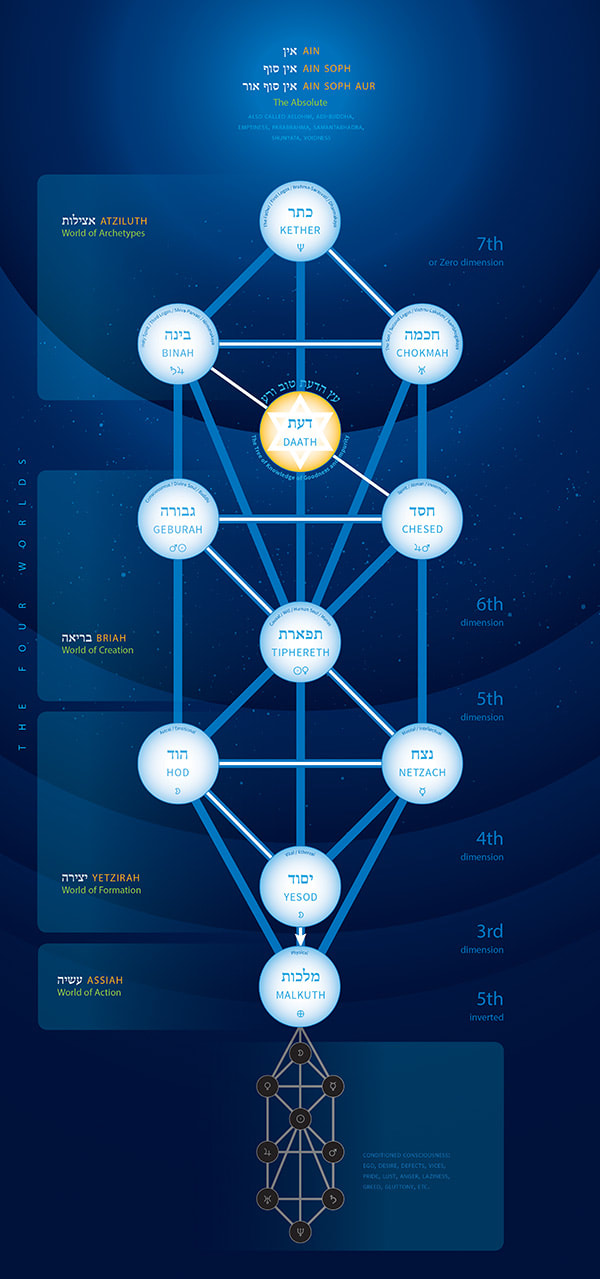
It is awakening to divine reality, and it is like walking towards a cliff and seeing the beauty of a sunset, and apprehending its full depth and power and beauty without having to mar it with our thoughts. We understand and see things, not merely in this physical world, like we go back to with the Tree of Life, but the higher worlds. We verify it personally for ourselves what these dimensions are, what these states are, and then we do not have to believe in anything. You just experience it.
You can use your intellect to convey that knowledge to other people. So, the intermediate mind goes in between the inner and the senses, the inner and the outer. But the only way for the inner mind to develop is if we understand and comprehend the ego, and if we annihilate it. If we do not annihilate the ego, you cannot pull the light of the genie, the source of genius, from the bottle of anger, the bottle of pride, the bottle of lust. By breaking those shells, you integrate light, and so you have greater capacity to see and do all these things that Samael Aun Weor in his books talks about, and are able to do it with greater confidence, because we are not trapped down here, because our ego belongs to the inferior worlds we call Klipoth, hell, world of shells. Biblical Representations of the Three Minds
Now in relation to these three minds, the Bible speaks abundantly about these three types. In the interactions with Jesus and the Pharisees and Sadducees, he was talking about the battle between the inner mind with the sensual and intermediate mind, the senses and concepts, because all the trained and learned scholars of Israel were coming to Jesus and challenging him, pulling up the scriptures. “Which is the greatest commandment?“ because, there is almost 600 and it is a bit of a loaded question, trying to catch him off his guard, because they did not believe that... obviously in the story they did not believe Jesus was the Messiah.
But he represents the inner mind that knows the truth, and the intellect and the senses are constantly trying to invalidate and to contradict and to fight with that part of us. "Which is the greatest commandment?” “You shall love your God with all your heart, all your mind, all your soul, all your will, all your strength, and your neighbor as yourself. This is the greatest commandment of all." Obviously, that kind of synthesizes the whole Jewish tradition in a Christian way. So, the inner mind is not caught in the the mind that does not understand reality, because the intellect cannot know the truth. It can only label and compare things, but it is not the actual experience of it. So, Jesus in the story is basically teaching, “Rely on the inner mind. Your inner mind will guide your intellect and your heart.” Obviously in the story too, there were rabbis who joined Jesus' flock and even like Nicodemus, someone who is learned, who understood, “My intellect cannot verify all these things, but I know he is a man of divinity.” It is something inside. We convert our senses and our intellect to understand these higher truths. 
The Symbolic Adulteration of Yeast and Unleavened Bread
In the process of this, Jesus warned in the Bible that, “You must not eat of the leaven of the Sadducees and the Pharisees.” Do not eat unleavened bread. This is a deep symbol.
Bread is a symbol of knowledge, not knowledge from books or scriptures or lectures. It is knowledge from your consciousness, your soul, what you experience. If we let our mind, our senses, and our intellect pollute it, we insert leaven. If you do not know what leaven is, it is like a yeast or bacteria that is used to insert into bread, so that when you bake it under intense heat, it rises. It changes form. It does not do anything nutritionally to the bread―unless we have any nutritionists here who can contradict that―but it does not really do anything but make it look better. It changes the appearance. This happens with every religion. These masters of the inner mind teach from their consciousness about these realities, and there are followers or individuals who―addicted to the senses and to intermediate thoughts, the intermediate mind, beliefs―adulterate the traditions. They insert their interpretations, their biases, their prejudices, their fears, their fanaticism. Then, the bread of original knowledge that was so rich and nourishing is lost. We have to eat unleavened bread, meaning, the knowledge that was not given to humanity, or that was given to humanity but is pure. Obviously this is very hard to find, because humanity is so corrupt at this point where, if you approach any religion or tradition, you look at, like, say, tantra being taught in the West―horrible corruption. It is harming a lot of people because people are eating leavened bread: knowledge that does not anymore resemble the original teachings given by these initiates. This is the symbol of a matzah, the Jewish tradition. One symbol escaped from Egypt in which they would eat unleavened bread as a remembrance of their slavery. It is a symbol of how we are enslaved to our passions, our senses, our intellect, and until we free ourselves from that, we have to remind ourselves by eating unleavened bread, bread that does not try to appease our intellectual palette or our appetites. 
The Sensual Sadducees
The Sadducees are the people of the senses. These are people who believe only what you see with your five senses, that this is all there is. These types of people or this way of thinking, even in ourselves, constantly battles against our consciousness. We may have a vision in our youth. We experience like an astral projection, or see reality in a very deeper way, and yet the mind will come in the senses and say in doubt, “This cannot be real. This cannot be the truth.” Senses, doubt, skepticism, the sensual mind is like that, the mind that critiques and only identifies with the five senses.

The Metaphysical Pharisees
Personally, I think the metaphysical Pharisees are the worst, because they believe in spirituality, they believe in religion, they believe in mysticism, and yet they do not experience it. Or, if they have some experience, this type of mind is very fanatical. It believes that it is the authority. It has the traditions. It knows all the scriptures and all the lingo.
While metaphysics can apply especially to religion, there are many people of many diverse philosophies and ways of thinking that are Pharisees―people who may be in science or any political party who firmly believe their way of thinking and their idea, their system, is right, and they refuse everything else. They do not look at the nuance between problems. All of us have this inside. We all have our own convictions and beliefs that we are right and other people are wrong. This is hard to really see in ourselves and work on. But a Pharisee or Farsi means “worshiper of fire.” It can mean really any person who really is worshipping divinity in any level. It could be even a gnostic, a gnostic Pharisee, gnostic ego. It believes that it knows the truth because it is in the tradition, but is not humble. 
The Awakened Prophets
We want to emulate the awakened prophets, the prophets of the inner mind like Jesus, Moses, Buddha―people who fully developed themselves.
These are people who are able to fully convey in their being an intense level of knowledge, a very deep level of knowledge, without corrupting it with their own mind. Obviously these sources are the most rich and profound reservoir of wisdom that we can extract, but also, it is very dense and very difficult to digest, which is why many people cannot read the works of Samael Aun Weor. His inner mind, very lucid, conveyed things which are very direct and go against a lot of traditions and beliefs of the senses, of the Sadducees and the Pharisees. It makes people furious. There are a lot of people write to us who criticize us or criticize Glorian Publishing for the work they are doing, because this type of knowledge is very deep and does not placate certain sensitivities and sensibilities for things. While we have diplomacy when we teach or try to teach, at the same time, we must be honest, even if it hurts, even if it is difficult to digest. So prophets are like that. That explains why in any tradition, you find these prophets are always fighting verbally with the Sadducees and Pharisees of any religion, but more importantly, this is something that goes on inside of ourselves. As we awaken our mind and see these realities for ourselves, the sensual mind, the intermediate mind, will constantly try to interfere. The senses will say, “This cannot be real.” The intermediate mind will say, “This does not fit my ideas. I do not understand this. I cannot interpret this.” It is a necessary process, but with patience, as we awaken more and more, we gain more clarity. They learned to be like, maybe even in this image, Deborah, a prophetess of Israel, who judged many situations in the Bible, the Old Testament, with wisdom. That is what a prophet can do, what the inner mind can do. 
Why Experience is Better Than Belief
In synthesis, to use Glorian Publishing's statements, why is experience better than belief?
Beliefs give comfort. Beliefs can give us a sense of stability in a chaotic world, but unfortunately when our beliefs are challenged, our whole world goes upside down, and then our foundations get flipped and we are not really on sure ground in the first place. It is better to be honest with ourselves, and when we are confronted about our own inadequacies, look to the experience. Is this real? Is this the truth? Beliefs may be right or wrong. It could be more or less correct, beliefs, but they cannot substitute for the experience or the reality. 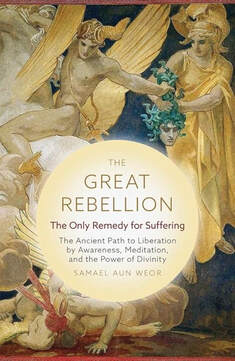
The Doctrine of the Inner Mind
So, it is difficult, but we try to put it aside with meditation. One way we can start to learn that is through a book by Samael Aun Weor called The Great Rebellion, where he talks about the three minds that we just explained in synthesis.
Question and Answers
Question: So, you say that the inner mind is the real mind, or sorry, you said the inner mind is reality. But could it also be argued that the sensual mind is part of reality, or are we talking about degrees of realness? Or are we talking about the sensual mind is bad because it rejects any inner experiences, but the sensual mind still has some kind of reality to it? Or could you clarify what is the difference between those two that appear to be real?
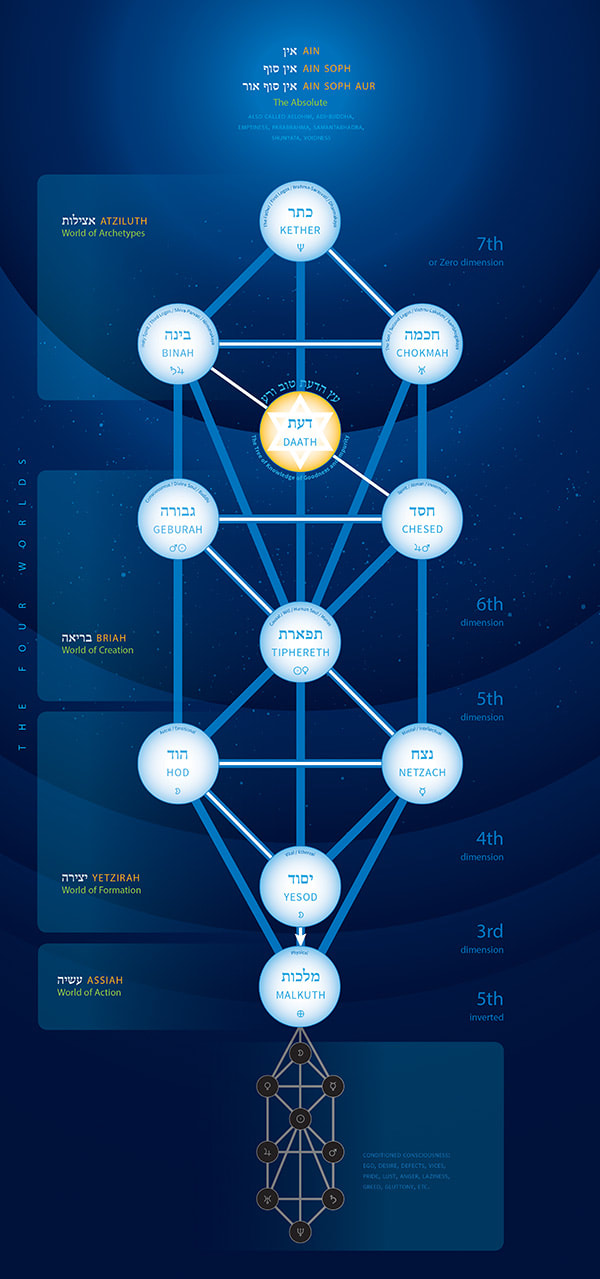
Instructor: Exactly that, levels of reality. Physical reality is Malkuth, to use the Tree of Life. Malkuth here in the bottom sphere is the physical world. So, our senses can give us a sliver of knowledge here, but the problem is when our senses have us believe that there is no such thing as Yesod, the vital world of energy, or Hod, the world of dreams, and rejects anything that is not within its purview. So, levels of reality, and the struggle is how much do we really understand of the whole spectrum? Because, if we take one sliver and believe it substitutes the rest, then we are missing out.
Question: How much does karma play into that, into our intellectual functioning? Instructor: Karma is cause and effect. What we think, feel, and do, has repercussions. We like to think in our modern world that we are isolated from people, like, we can just think and feel whatever we want and the people around us are not going to be affected. But the truth is that even if a person is not physically expressing certain emotions, we can sense their anger, or their pride, their fear. So, our mind affects people, and if we cultivate negativity, then it is going to affect other people. This is why even though certain movements like, related to atheism, where they believe because there is no metaphysical reality, they can think and feel and do whatever they want (nihilism). Meanwhile, they have terrible consequences for themselves, mental, emotional deterioration, a lack of meaning in life, no direction, and that permeates all their relationships, which is why a lot of people who are atheists, not all, but a lot of people, are miserable. So, it is better to replace, even if one is atheist, with some type of ethic, some purpose or goal. But our mind affects people, and, whatever we act, think, feel, and do, permeates our life and those of others. Question: So, I have this question that connected with the Kundalini. So I saw a girl and she explained that when she got the Kundalini awakening, she felt this sensation all the way from the bottom to the top. She was in euphoria some how. Could you explain exactly what this is? Another Instructor: What I should clarify is that what many people describe on the internet as Kundalini is actually what we would call Kundabuffer. So that serpent can go two directions. It can go up that Tree of Life to the highest levels and it can go down, that Tree of Life into the infernal worlds. You will still experience extrasensory perceptions and changes in your body, and those kinds of sensations potentially of euphoria, but also then, conversely, you will experience other times where you feel extreme pain and burning, and those are the fiery serpents in the desert that bit the Israelites. That is the Kundabuffer that goes down and experiences the internal dimensions but of the lower plane. Since we are not well established in this objective thinking, we can perceive that and believe that that is the Kundalini, and so, unfortunately, much of what is described on the internet are these very intense changes that people go through. They lose all their friendships and relationships and their body is changing. Unfortunately they are misusing the energy. They are trying to force it to awaken so fast and what they are actually doing is awakening consciousness, but in the in the inverted sense, the Kundabuffer. Through a practice of gnosis and sexual alchemy, you are going to awaken Kundalini in degrees, hopefully, gradually going up, and you are going to be able to start perceiving some of these higher dimensions. You are going to awaken chakras with sensitivity like telepathy, clairvoyance, clairaudience, and those are all gradual changes. So, it is not like describing, “Oh, in this one instant, suddenly, I had this Kundalini awakening and everything was very dramatic and extreme.” Those are often Kundabuffer experiences because the consciousness is being forced to awaken, but in a lower state. It is against nature. Nature is gradual and slow, and so, the changes that you will experience from awakening Kundalini will experience more unification with divinity and more perceptions of higher dimensions and more truth. So, this should not drive you away from relationships with people. If you are having awakening of Kundalini, you should have true knowledge, true compassion, and wisdom, and that should harmonize in your relationships and not isolate you. That is one of the key signs when you are hearing someone's account online is, if they are saying, “Oh, I had such a huge knowledge of awakening and now no one in my family or my friends understand me,” it is very out of balance. It is not the natural way where Kundalini slowly, naturally, and gradually awakens, and family and friends may not understand everything, but you have the wisdom to know how to interact with them without creating harm in your relationships. So, part of that is just people wanting to rush it, wanting to get there so fast, and unfortunately, it produces some negative side effects in these cases. Instructor: The reality of the inner mind and the Kundalini is that the Kundalini, the Divine Mother, the intelligence of God, only rewards the inner mind. The sensual mind, the intermediate mind, cannot work with or evoke those forces, because the senses and our passions and our intellect do not belong in our current state to divinity. Another Instructor: Merits of the heart. The Kundalini awakens according to the merits of the heart. So, you can do all of this. You can meditate and practice pranayama or transmutation or sexual alchemy and you can do all those steps, but if you are not eliminating ego, meaning, if you are not getting rid of vices and sacrificing your desires, your selfish desires like anger, on the altar of God, and transforming that anger into love, if you are not doing that work to develop the merits in the virtues of the hearts, then you will not be rewarded with Kundalini. That is another way to look at the ethics of a person, and to discern, is this really Kundalini, or are they having all these kinds of unethical behaviors where they are hurting a lot of people and hurting themselves? Then it is probably not Kundalini in those cases. Instructor: They are following the doctrine of the senses: passion and lust, or intellect, theories, Sadducees, Pharisees. They believe they are right because they have experiences, but they do not understand, like she was explaining, that those perceptions are usually down here [pointing to Klipoth in the Tree of Life poster from Glorian Publishing]. The inner mind is a child of the Divine Mother? It has to be cultivated patiently. Question: Do you think humility plays a huge factor? Like if you are someone that has―me, myself, has had some intense spiritual experiences―in trying not to let it kind of out my ego? Does it come down to humility, like if that person is boasting, “I have been in touch with God,” if you had humility, you would just keep it to yourself? Another Instructor: Yeah, because those experiences are not for the public. Those are very private personal experiences and gifts from God that we receive, and when we want to go out there and show everybody what we are doing, we are adding the yeast into our bread right? You get that bread and you start puffing it up and creating a lot of pride, bringing it into the world as a very powerful identity. Then you are not transmitting the essence of that knowledge to people in a helpful way, but you are transmitting that knowledge to people in a way that benefits you and gets you maybe some followers, or makes you feel proud of yourself. That is why often in this tradition, we do not discuss our spiritual experiences, because we do not want to create envy or pride or all these other things, but we will discuss them only in context in which it is of benefits to students. Instructor: I know other teachers from different schools, part of the marker of my admiration for certain missionaries has been, they teach very profoundly, but when people ask them what your level of development is, they are silent. They do not say anything. Personally, I know certain people who are masters of Major Mysteries, but they are very humble. They are simple. People come to follow them, but they say, “No.” That is the nature of the inner mind, humility, because "Be humble to obtain enlightenment," Blavatsky wrote in The Voice the Silence, "but when obtaining enlightenment, be humbler still." Or as the Sufi say, Alhamdulillah, “All praise is to God.” Question: Do you have any advice for the people that are kind of on the religious side that lack that? Not to get too personal, but my older sister, she had gotten converted to Christianity and she is like, “This is the best! I know all the deeper truths,” all this stuff... and I am like, “It is great. I am glad that you found something that nourishes your soul,” but also, kind of keep your ego in check. Not everyone needs to know every nourishment of your soul. Instructor: Love her. Be glad for her. She feels good. She has found something that is benefiting her. So be it. We get respect when we show respect. It is hard because I know when we study certain things and we feel inspired, that we want to bring other people in, but at the same time, our doctrine, our doctrine of the Gnostic Church is tolerance. The pillar of it is compassion. If other people do not want to follow, so be it. If they want to share and try to indoctrinate us, then be patient and be kind, because people are more inspired to try things by example. When we try to force on other people what we think, just as the Pharisee there―and we must be careful in gnosis too―even though we have a rich body of knowledge that we want to bring to other people, we must be careful, because we can adulterate our yeast, the knowledge that we are trying to give. Another Instructor: The white magician always respects the free will of others. Others want to walk a path, and we disagree with it, we have a right to share and communicate our thoughts. But if they say, “No, I do not like that. I disagree with you,” we have to respect their free will. If we get too caught up in trying to change others, then we are not doing enough work on ourselves. Question: I had a question during the talk. How do the gnostics define reality, and then, the second question is, what is the gnostics view on non-dual teachings? I followed Tony Parsons for a while. There is no person there that is enlightened or unenlightened, so you just don’t do anything. Reality reveals itself. It did not make sense to me. Instructor: Sure. We talk about the Tree of Life. It is a map of the cosmos from the most material dense and physical, starting with Malkuth at the bottom here, and going up in layers of matter, energy, and perception of a more subtle type. So, the higher up you go, the more spiritual that reality becomes. So, obviously we have our body, but also, we live in this physical world. But the higher spheres here are different dimensions in internal space, not physical, but psychological, spiritual. You can access this when you dream. When you dream, you are in the world of Hod, astral plane, but there are higher levels that exist in more rarefied levels of experience. The higher up you go, the less caught in duality you are, the idea that “I am this person; I am not that person.” We have a sense of self that is very much dense here, but when you go up to, say, the world of the astral world, like it is obviously in the dream state, it is more subtle. It is a different reality. You can become, sometimes in our dreams, we can become different people, or we change form. There is less restrictions and different laws that exist there, and those laws get less and less and more refined until you reach the heights, which is which when one is with divinity. That state of experience is the universality of divinity, the real self in which there is no duality of this person and that person and myself. You experience the consciousness that is within all beings, and it is a unified perfection. But we are here so we are caught in between the pendulum of extremes, “to be or not to be. Good and bad. Yes and no.” We talked about the Tree of Life in other lectures too, but it is a basic map that maps out where we exist here physically, who and what is our self, and how do we go beyond. Another Instructor: I think the clear duality that we would see in gnosis is the duality of that which is false versus that which is true. We talk about ego all the time, meaning, ego is a false self, of self-centered desires that seeks to always perpetuate itself―to keep feeding its pride so it continues to have that sense of self, and we say that that is kind of false. It is an illusion. It is created in your own mind, and it is something that you feed your energy, especially your vital energy to keep it alive. But eventually it will disintegrate on a long enough timeline [through devolution in the hell realms], but we want to disintegrate it faster through this kind of spiritual work [willingly on the path of revolution]. When we are free from the false, then that which remains is that which is true, which is non-dual. The reality itself, I would say, is non-dual, but you are not going to achieve that just by sitting around, because so much of you is already caught up in a false sense of self that you are feeding your life force into. Question: What always did not make sense to me is non-duality for a person, or it is non-dual in the sense... there is not a non-dual experience by a person? Another Instructor: Maybe at the highest levels. So, if you awaken your whole consciousness all at once, a part of you is connected to those highest levels, and you would see that it is non-dual. You would see that everything in reality is one. Question: So that very top circle, is that one person’s reality? Another Instructor: It exists within the physical body of a person. But let us say you die, what is left of you? Well, consciousness, the soul, may be part of those other dimensions even when it is not physically incarnated. That is why we say at our highest point, we see that we are one with all, everything in existence. That is the non-duality. There is not “you and me.” Everything is one. A part of us can sense that because we are connected in that highest state, but because most of our awareness and perception is trapped here and here [in Klipoth], especially down here, we feel very separate. We do not feel connected to people. You can punch somebody in the face and not feel any remorse, right? When we start to remove ourselves and extract ourselves out of these dimensions of delusion, the hell realms, and we enter and awaken ourselves more and center our perception here [the superior sephiroth of kabbalah], perceiving these higher aspects of who we are, that is when we see the reality of non-duality more clearly, because our perception is up in these higher states of who we are. This whole thing [Tree of Life] could be me. It could be my state of consciousness, but I I'd say that 97% of the time, I am focused down here [in Klipoth] and maybe 3% of the time I get a little bit here and .0001 percent of the time I will ever perceive this. We can shift that perception up by removing it out of here [Klipoth] and awakening our perception in these higher states. That is when we will see what is true and what is false. We will see that the true aspect of reality and of people and of ourselves is that non-dual aspect, but we will not get there just by sitting around like some people might suggest. Instructor: Also, Klipoth is obviously our center of gravity. We think, we feel, and do things that are in the level of hell. So, as she was saying, Klipoth, we are stuck here. We want to go to Kether, the heights, but the way to do that is even while being in hell, so to speak, in a state of suffering, and humanity (the conflicts), we can experience non-duality even here when we are awakening our inner mind. Our inner mind knows how to deal with problems, like a prophet was basically in the face of the Pharisees and the Sadducees, dealing with them with intelligence―non-duality. They did not get caught up in, “Is this the right answer? Is this the wrong answer? What do I say?“ and deliberate and stumble. They just knew how to act in the moment, and we can do that if we awaken the inner mind. That is our intuition: the ability to perceive circumstances for what they are and to find the truth and the falsity. So, to go beyond the duality is to see what is real and what is not, and to work appropriately with people. That is the quality of the inner mind. Question: I was just going to ask: turning off the mind, is that the absolute? Is that the non-duality? Non-thinking and complete acceptance of everything? 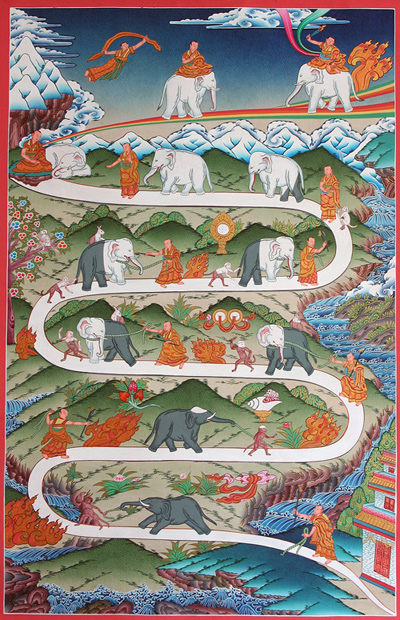
Instructor: It is a beginning. As you see right above you, there is the nine stages of meditative concentration poster from Tibetan Buddhism. That maps out the beginning of concentration where, when we are calm in mind, silent, not caught up in duality of good and bad, associative thinking, worries, anxieties...
Question: Because that is what traps you in hell, bottling the mind? Instructor: The mind is constantly fearing. Yes, the mind is going back and forth, “Good / bad. Yes-no. What do I do? Act / do not act,” but serenity knows how to respond, how to act in the right way, in the right moment, at the right time. You learn that through serenity. So, serenity is the beginning. We need serenity to have a foundation by which to awaken the inner mind, see things for what they are, and as we deepen that serenity up that glyph, you eventually can cultivate other aspects of the consciousness called imagination, which allows you to perceive those heights. But first serenity is the beginning, the foundation. You can study a course called Meditation Essentials on Glorian. They go into great detail about how to establish that foundation. Another Instructor: We distinguish between inferior mind and superior mind. We call it inferior manas, superior manas, as well, because the kind of mind that we are talking about being trapped in all the time, that wants to get stuck in these opposite decisions or is caught up and focusing on our desires all the time, is inferior mind. But there is a form of superior mind. There is a way to use the intellect in a superior way. So, let us say hypothetically, there is a master who needs to build a city. They are going to use the mind, but they are going to use the mind that is superior―this kind of pure mind without egotistical confusion, and a mind that can just receive directly from its higher divinity, and then use the mind as an organizational tool in which to plan out building that city. We do not want to completely get rid of the mind, but we want to clean that mind out and use it in a way that is not caught in opposites and decision-making, but a way that is just a recipient of divine light. Instructor: So, to conclude, we need the senses. We need the ability to think and have concepts to communicate, but we need intuition and the inner mind to guide it.
0 Comments
Your comment will be posted after it is approved.
Leave a Reply. |
The Gnostic Academy of Chicago
Free online courses, lectures, podcasts, and transcriptions. Categories
All
|
 RSS Feed
