

Happy New Year, everyone! I wish you many blessings to the beginning of this year, especially as we think back to what we have accomplished, also things that we look forward to in our own personal journeys.
Part of what I wanted to start the New Year with today is a discussion about resolution, and how we think of the common parlance of finding a new beginning to things. I think it does apply very well to how we approach life, but more importantly, how do we approach ourselves. I think that we all have the ambitions and the longings to find some deeper purpose in our communities, in our experience, in our spiritual lives, and we seek a type of practice to make it happen. One of the challenges we all face is obviously the resistance. So, we may have an endeavor that we want to solve, a problem, a challenge, and we seek to enact certain conditions to make it happen. But unfortunately (we all know this), we promise to go to the gym—we do not. We think about things we want to do, and yet we do not fulfill them, despite our intimate impulse to seek the new. The reason why we often get stuck in resistance for ourselves is a lack of energy. We have the inclination to start something, but then we face the friction, whether it is in our families, our communities, our marriage, our relationships. That friction requires a type of energy and a type of understanding. So, by understanding who we are and what it is in us that is creating the problems we face, we can change the situation. Our level of being determines our life. That has to do with, as a term in this tradition, to psychologically where we are at: Are we defined by problems or anger and resentment? Or are we defined by a more luminous character, embodied by the best teachers of humanity, messengers, prophets, founders of religion, whatever they may be? Our Purpose
In this lecture we are going to talk about an exercise called pranayama, because it is an exercise in yoga that helps to augment, conserve, and develop energy, and learn how to direct it at will. Because we may face these oppositions in life, but not to have the energy or zeal to continue.
We often feel depleted or drained in our endeavors. This exercise is very well known in Hinduism, but it is something that we also practice in this tradition, the Gnostic tradition especially. We will talk about the purpose of the practice, its role, its efficacy, how it practically demonstrated in our life, and the importance of pranayama for mastering more of ourselves, our potential, because it makes sense, logically. If you have energy, enthusiasm, there is more you can do. Not merely just in a material sense with our jobs, but in developing our spiritual character. We are also going to tie pranayama into a less known aspect of Hindu yoga. Pranayama is deeply related, in terms of its expression and utilization, with creative energy, the power of sexuality. The power of life is the power of creation. That energy, when it is used spiritually, and with understanding, and with purity of heart, that force can awaken the ability to perceive the spiritual, but also to develop our best qualities, the power of life. We will also tie in how pranayama can develop spiritual inspiration, conscious awakening, and inner development. It is interesting that this term inspiration especially relates to breath, to inspire, “to take in.” The breath physically has a correlation to how the energies of the bodies work, and how it flows. We will talk about that. We will also emphasize the need for pranayama, especially for people who are single. Obviously, we place great emphasis in this tradition on the use of the sexual force, in terms of harnessing the power to awaken the soul. That can be developed in any relationship, in terms of whether single or married, especially. But obviously, single people can use this practice to prepare for marriage, especially. We will talk about that. Lastly, we are going to elucidate how pranayama strengthens and is amplified by ethics. This is something that many people skip over, especially in meditation. The first steps of meditation and yoga have to do with character. Without a strong foundation and the proper use of our mind, emotions, and body, we cannot achieve insight or stillness, because we are engaging in actions that agitate mind, body, soul. What happens is when people sit to meditate or practice spiritually, they cannot sit still. Irritated. Mind is all over the place. Cannot concentrate. One is easily affected by problems. Pranayama is a tool for learning meditation, primarily, and meditation proper is the ability to get insight into problems, into issues, into crises, so that we can resolve them. These ethics are, these actions of our character become magnified when we save energy and learn how to direct it. This is why character and ethics are the foundation of any religion, because with power comes responsibility. 
Our Potential Situation
So, we could talk about perhaps what might be our potential situation.
Personally, this was definitely me 20 years ago, as I was trying to find my way in the world when I was growing up. I felt that there was something missing in education, in life, in my relationships, in my relationship to myself. I felt that I was deeply in yearning for some stability, some kind of purpose. Also, as we know from youth, or if we work with youth, or have been in education, people know that especially in the modern era, people are constantly depleted. People lack force. People are tired. They do not have the energy to sit, to concentrate, to listen, to participate, to pay attention, to be a part of something meaningful. By recognizing that, I think a lot of people recognize that, but do not want to make the changes necessary to fix that. This is because we tend to be addicted to these ways of being in life, constantly distracted, identified with fear or problems and suffering, as much as we say we want to avoid it. We still do the things that make us suffer, as we know from the New Year's example. We may feel that we want to do something meaningful, and yet we deviate. We have a purpose, a goal, an object, and as we strive towards that aim, resistance comes up, and we get diverted. We deviate. We do not follow a linear trajectory from point A to goal. Now, there is a lot of reasons why we do that, and we might find that we try to initiate a project, a purpose, a goal, and yet we seem to lack the will to do it. A lot of the time, it is because we are depleted. We are wasting energy all the time. We are not, to use the medieval alchemical tradition, hermetically sealed, like a chalice or like a crucible, in which nothing from the external world can come in and affect one's serenity. The challenge is, when we face the hardships of life, where, to use a medieval symbol, the athanor is boiling, the temperature is rising, we often become so caught up in the emotion that we boil over, we explode. We do not recognize that when the temperature is hottest is when the impurities can be burned, but there is a threshold that has to be mastered there to see how much we can handle. what is the tension in life, what is the emotional crisis we are facing, and also what is our reactions to it. By facing it, one can be still and to understand what psychological elements in us are producing the problem. So, we may recognize intuitively this is the reality, but we lack the method how. One of them will be pranayama, to gain energy, so that we have enough force to do, to be able to push forward, to gain momentum. We also see that people today, despite our advancements, are suffering a lot. We have a lot of pain in our communities, a lot of confusion. We often tend to not discriminate between desires, especially in us. We tend not to see what psychological way of being we enact or identify with creates the situations of life. What do we produce? We tend to just react to problems, situations. Does this not mean in life we need not to learn how to respond? But I think a response is much more intelligent and meaningful and profound rather than just reaction, mechanical, like a machine. We want to be able to stop being mechanical, repeating the same habits day by day, same patterns of life. But if we are searching in spirituality for something to change that wheel or to get off that wheel of Samsara, to use Buddhist terminology, to cut through it, we need force. We need zeal, not religious zeal, but enthusiasm towards a directed purpose, a spiritual goal. We often tend to get identified with the whims of any thought, feeling, or impulse. We have tried meditation, or especially beginners realize the mind is all over the place. Body cannot sit still, like we are talking about, and emotions can really suck a person down into a pit. So, pranayama can deal with that and help that. It is also, we may have a deep yearning for internal peace, but the ignorance for not only how to find it, but also, more importantly, how to experience it, and lastly, how to make it intentional, how to cultivate it. 
Inspiration
So, we will talk about, in the theme of this lecture, the nature of breath, breathwork. Pranayama is the technical term. We will break it down.
Inspiration is interesting from the Latin inspiritus, “to breathe into.” It also means “to excite or encourage or inflame,” and from the 13th century, meaning “the immediate influence of God or a god.” This image is by William Blake (the Creation of Adam), when divinity created the human being to the breath of life. A beautiful symbol about how not only physical breath gives life and animation to ourselves physically, but spiritually. By harnessing the breath and saving energy, we can create life in ourselves, which is spiritual experience. We know the term inspiration to feel like a sudden “aha!” We got it. Something comes to us. It is a revelation. Inspiration is that actual realization of when we resolve a problem. Things come to us not from thinking about them, but by putting the mind aside and letting that revelation appear. Inspiration is that faculty. It is the influence of divinity. It does not matter the religious terms we give. To divinity, obviously, people come from many walks of life, but divinity is specifically a state of being, a quality of consciousness that is very transcendent and very elusive to the intellect. But it is something that can be cultivated personally through breathwork. 14th century theology refers to inspiration as literally “scripture inspired by God,” and, also, to corroborate mid-16th century, “the drawing of air into the lungs.” People have referred to scriptures as inspiration, meaning there were people who were once like us, who through that particular spiritual work, were able to develop themselves spiritually. Therefore, they were directly in connection with divinity, their divinity inside, and were able to document that type of insight to people. That is where you get religion from. Different communities have different scriptures because divinity is eternal. People are temporal. Therefore, divinity expresses in many places, in many times, to many people, and not just one at the exclusion of the others. So, there is a universal theme prevalent through these inspirations that these scriptures teach, and so, in this school, we study all of them so that we can get to practice, to understand how the practice of inspiration, literally in our bodies, can cultivate that type of realization and experience. We find the scriptural reference in the Book of Genesis in Chapter 2, Verse 7, where we see in William Blake's illustration (the Creation of Adam), which we can say is a symbol of creating a real human being. A real human being is a person like Jesus, like Buddha, like Moses, like Krishna, the prophets, people who really developed themselves, because they worked with the power of life in themselves: And the Lord God formed man of the dust of the ground, and breathe into his nostrils the breath of life, and man became a living soul. --Genesis 2:7 
The Power of Prana Within and Without
So, in pranayama, prana has to do with nature, and prana is a force. Prana means “life.” It is the vital force in nature, in the air, in the rocks, in the trees, in the stars. It is the vital force that we also carry in our body.
Our body is like a tower. We find different centers in which we operate. Psychologically, we are made up of different elements, and we study this diagram called the human machine, because we understand that the body is a mechanism. There are certain tendencies in the ways we think, feel, and act. We sometimes call these the three brains, because they are modes of operation. Physiologically, with our chemistry, or metabolism, catabolism, vital vitality, breathing, digestion, but also our physical brain, but also our emotional brain. A brain, in spiritual terms, is not merely just the cranium. It is a center of operation. There are different intelligences informed in each center that we need to understand. By understanding the mechanism or machine of thought, feeling, and will, we can learn to drive our car with intelligence, and get to our destination. Prana (vital force) is found in all these centers, except this force or energy is modified in different levels of density. So, the intellect, we can say, is one of the most dense. It is also very slow apparatus. We know this when we are cooking. We put our hand on a hot stove, and we retract our fingers. We suddenly feel emotional anger or frustration, and then we think how much it hurt. You see that there are different speeds operating here. Our movement and our instincts were quicker, and our thought came later. Likewise, emotion is really quick. This is why it is also hard to control, especially when we get overcome by emotion. But more importantly, the most difficult force to control is the sexual force, the power of life, and that power is the most volatile. It is also the most powerful. We know it is the power of divinity. Divinity creates through love and through that force to create a physical child. But to use the injunction of Jesus of Nazareth in the book of John, “that which is born of the flesh is flesh, but that which is born of the spirit is spirit” (John 3:6). The same energy, but controlled and directed with the intelligence of divinity, is what creates spiritual life, to be born again. It is a sexual problem, and pranayama teaches us, especially for single people who are learning to work with this energy in a spiritual way for the first time, it applies to them. Pranayama, you may be familiar, is breath work. We will do a sample practice after the lecture if you are interested, but it involves breathing through the nostrils interchangeably and directing the force up the spine, to the mind, and then to the heart. In that way, you create like a circuit, a flow, coming from outside to inward. In that process, we are developing and controlling, we are yoking the force of prana in our breath, but also in our bodies, because we find prana in ourselves, but also in nature. It could be good to practice pranayama even in the woods, especially if you have the opportunity, because nature is beautiful, and we are vibrating at a different level of density, much less than Chicago, especially also New York too (I think New York takes the cake above Chicago. Sorry for people who may be New York fans)—but literally prana is “to yoke the wind” (Sanskrit): प्राणायाम prana-yama. यम Yama means “to yoke or restrain.” प्राण Prana is “breath,” but also vital force within and without. 
Aspiration
Now this ties into the theme of aspiration, because pranayama is used to develop our spiritual longings, our yearning.
To aspire comes from the late 14th century aspiration, “a spirant,” which means “uttered with a continuous expulsion of breath.” Now every religion has its practices. Some traditions have mantra recitation, like they call japa in Hinduism. They repeat prayers, rosaries, using the breath to recite or pray, or to evoke a state of yearning for divinity. How we use breath determines a lot of things, not merely just in our physical speech with people, but also through exercise. So, every religion taught how to use the breath, because it is the expression of divinity, and the quality of our words determines the quality of our relationships on one basic level. Likewise with aspiration, by combining longing and prayer with a mantra, a sacred sound, with pranayama, we have a type of amplification of force. Something happens psychologically when we are focusing on a prayer, asking for assistance, and developing a relationship in our heart to divinity in whatever form. The forms are representations of one abstract reality, which has no form. But when we pray to the divine, something happens when using that force in order to direct it. A channel opens up, the heart opens up, we aspire, we feel longing, and there are many even emotions that can come with that—not hallmark card sentimentality, but real deep in-depthness of the soul, real depth of the soul.
You find that range of spiritual emotion reflected in a symphony of Beethoven or a nocturne of Chopin, and these were initiates who taught and knew divinity and expressed it through music. Because we gave a course on this before, The Secret Teachings of Opera especially. But aspiration is deeply connected with how we breathe, but also even if you listen to music like great choral symphonies or choral music, you feel the elevation of the heart, like a yearning up to heaven.
It can be inspiring, but also it is aspiring. Not only do we inspire and breathe in different influences, but how we use that breath determines if we aspire or expire. We will talk about that term more specifically. But to aspire from the 1530s comes from “action of breathing into,” from the Latin aspirationem, a “breathing on, a blowing upon, rough breathing influence, to direct breath to a purpose,” and tying into what we were talking about too, aspirare: “strive for, seek to reach, literally breathe, blow upon”; and the 1600s term, “steadfast longing for a higher goal, earnest desire for something above oneself.” 
Cultivating Conscious Faith: Direct Experience of the Divine
It is a seeking and a striving, and pranayama is very good for developing that connection in the heart. I think a lot of people may have realized and have seen in their life, personally for me this has been the case, where life was so much suffering that many people's heart become dead of feeling, like just calloused from all the “slings and arrows of outrageous fortune,” to quote Hamlet. But there are exercises like this with breath work that can learn to open up and break the shell. They can develop the real subtlety and sentimentality of the spirit, superior emotion, which is not a state of suffering or affliction, but is that yearning and depth of the soul and the consciousness that seeks to experience for oneself what divinity is.
All religions and their foundation teach how to experience divinity, and the most basic method is meditation. But to clarify, meditation is not merely sitting still and not thinking. It is also not spacing out. Meditation proper comes from the Sanskrit term धी Dhi or ध्यान Dhyana, which means “to see, to perceive.” It means to perceive internal images and experiences, like when we dream. Unfortunately, in our case, we tend to be very cluttered in our dream states. We see things, but they are incoherent, fragmentary. There may be a narrative, but it does not make any sense when you wake up. “Why was I talking to Barack Obama? Why did I assume that he was coming to my job to congratulate me?” I mean, honestly, this is like a random example, but you got to think there is a narrative to dreams, and there is a story to dreams that can teach us something about ourselves. But a dream is something of fantasy. It is an illusion. It is not objective. It is a state or reflection of our psychological reality, but it is not objective. It is not reflecting like a revelation of Moses on Mount Sinai, or Buddha under the Bodhi tree. Many of those stories are revelations from dream experience, but not of a subjective mechanical type of dreaming, but a state of real perception. Meditation, the ability to first calm the body, still the mind, do not think, concentrate on one thing, and to visualize. Visualization is the faculty of the consciousness to perceive divinity, and when the mind is perfectly still, suddenly new images will come. We may experience something very out of the ordinary, where one has an experience symbolized by all these great stories. Some people take them as literal physical fact, but these are meditation stories. Being on a mountain is the symbol of going up in spiritual elevation to proximity with divinity. It is not a physical story of climbing a mountain. It is a symbol of spiritual work, and then meditation is seeing that for oneself. But unfortunately, we tend not to have enough energy to perceive. If we do not dream much, it is because we tend to waste emotional energy. This is an energy that fuels our dream experiences, and, also, meditation. Because meditation, it is not merely just about a silent intellect, but it is also a calm heart. It is fueled by modalities of force, and that emotional energy, when it is conserved, can guide us. There are levels of energy, and by having energy in the soul, like you put fuel in a car to drive, you have the means to get to your destination. So, meditation is the ability, again, to perceive imagery of an internal type. 
How Creative Energy Empowers Pranayama and Integrates the Psyche
That is fueled by different gradations of force. You might have seen this image before, especially we have here on the wall. This is the Jewish Tree of Life.
It is called the kabbalah. It is a Hebrew term for the map of reality—not merely just physical, like this bottom sphere (Malkuth). It is also a map of our internal spiritual dimension, levels of dimensions in nature, where we go when we dream, but also how do we react and act psychologically. There are states in nature that we gravitate to when we dream, depending on our quality of life, our level of being. If we are dense and filled with negative emotion and anger and resentment or fear, our dreams tend to be not above, but below, metaphorically. That is mapped by the inversion of the Tree of Life at the very bottom. We call that Klippoth. It is basically the word for Hell, “world of shells.” Going back to the shell analogy, if our negative internal states like anger and pride encage us, we are trapped in hell. We are suffering. But there is a way to break those shells and free the energies inside them so that we can reintegrate with divinity. That is the purpose of any religious path, what it should be: religion, religare, “to reunite,” or yoga from the Sanskrit yug, “to reunite.” So creative energy can empower all of this. So this Tree of Life has been mapped in many ways. You can map it out to the body with its different trinities, mapping out the three brains—one trinity superimposed in the head, the heart, and towards sexuality. You find that the three pillars represent left and right: positive/negative, solar/lunar, man/woman, and the spine, the tree that upholds our body. This map has many correlations and they are very intricate. But I want to emphasize this tree not in terms necessarily of dimensionality, spaces where we go when we dream necessarily, but also energy. What energies exist in us and how do use them? Obviously, our physical body is operated by mechanical energy. Above that, and when you go vertically up in this diagram, you enter less dense states or gradations of force. So, the physical body is the most dense, and the physical energies that operate it are also the most coarse. So the further up you go—not in vertical space physically, but psychological space—you enter a hierarchy of being, more elevated states of spiritual perception. Those forces become much more subtle and refined and pure. We have vital energy, which is really the sexual force, the power of life. That energy animates our body and our life every day. When we physically get up in the morning—after maybe sleeping eight hours, or you have been lucky on a nice long winter break, maybe from job, vacation, 10 hours if you need it—you are refreshed. You find that you have a certain currency or depository of force by which to be in the day, meaning, you have enough energy to get you through certain obligations. Maybe you have more, maybe you have less. That is deeply integrated with the vital force. This vital force is not merely just in the sexual glands, but it circulates all throughout the body. You know, Qigong or Chinese medicine especially, they study what are called the meridians or currents of vital force, which flow throughout the physical body. They are not physical, but they integrate with the physical body and interpenetrate. You could say that without vital force active, the physical body dies. It degrades. So, we are deeply interested, when we study and practice pranayama, to conserve this force, to save it, to have a battery housed in the body, so that when you do pranayama, you have enough energy to jumpstart your car. A dead battery cannot operate anything spiritually. If we are wasting our energies all the time, then there is no force by which to develop a circuitry in our physical body, but also to have that spark or connection with divinity, because unfortunately, us, our meridians in our body and our vital energies tend to be out of whack. That creates a lot of problems. We not only have to save vital energy, but also emotional energy, as I was saying. How do we use our emotions to the day? Are we characterized by maybe fear or anger? Do we have certain problems we repeat? Maybe certain relationships, social connections in our life create friction. It is not to say that we avoid these situations, but it means that when we face problems of an emotional type, there is a bit of a separation, not in a sense of dysphoria or unreality, but watchfulness—watching the person, watching their emotional reactions, and understanding what is making us tick, so to speak. By watching and observing all this, we try to see what is our quality of being, what emotions tend to waste energy. We can also learn what emotions save energy, too, because it is not about just avoiding problems or avoiding what's in ourselves, but cultivating the superior, the virtues. When we save emotional energy, we have more energy by which to dream consciously. But also we need to save mental energy, too. Mental energy applies to the intellect. If we overuse the intellect by reading too much, what could happen is that we lose our train of thought. Our energy gets depleted. We feel tired. We lack a type of focus. One thing I will mention, too, is that when we exhaust all the forces available to us, whether through our intellect or emotions or our body, we get sick. So physically we get sick, because internally these forces in our dimensional state of constitution are depleted. People who lose their mental force and waste it on too many intellectual activities eventually develop illnesses like schizophrenia or mental illness or delusional disorder. They have used their intellectual machine so much or have abused it so much that their physical brain becomes sick and therefore they have an imbalance. Likewise with emotions, we know from even seeing some certain actors and actresses, people who abuse the emotional energy through too much passionate display of reaction become very sick—bipolar, depression, manic depression, whatever it may be. Physically people who abuse the body can lose their ability to walk. For example, you see football players like Ohio State and Texas playing. You see these guys do amazing stunts and maneuvers and you are amazed. But how many of them end up physically destroyed by what they do? Because they abuse the body. Pranayama will teach us how to integrate all that, how to save energy and how to make all the levels of our psyche balanced, because you are redirecting force, you are conserving intellectual, emotional, physical, vital force and you are creating an interconnection with your own divinity, your spirit, your intuition, your conscience, so that you have emotional, mental, psychological stability whenever crisis of the external world enter us. Above that, there are more subtle forces like volitional energy, which is willpower related to concentration, and obviously concentration is necessary to meditate. But above that, when we learn to concentrate and save our ability to act with intentional will, not merely desire or whim, but focus, we can become more conscious, which is the ability to perceive and to understand. Beyond that is the spirit, divinity, the spiritual force, and that spiritual potential is what guides the whole process, because the inclinations of the heart are guided by our inner divinity. 
Elevating the Creative Energies
So how to elevate the creative energies? There is a symbol that some of you may have seen in medicine and health. It is the Caduceus of Mercury.
That is a beautiful symbol of how there are energetic currents in the spine that are symbolized by two serpents. So, there are two serpents that rise from the base of the spine and then intertwine around the spine in the form of energy up to the brain. Then there are currents that then go down to the midbrow, throat, and then the heart. There are wings here because when we save energy and with pranayama elevate those energies to those currents and the vital depth, they go up to the brain. When rising up, they create the wings of angels. Now, it is a symbol of spiritual elevation, like our emotional level of being, our mental quality of being becomes more refined and relaxed, more patient, more compassionate, more serene. When those forces rise, they help to solidify and integrate our spiritual practice. When you do pranayama, the pranayama that we will explain today, you do not necessarily need to visualize. Although with more advanced practitioners, you can learn to visualize these energies, these two currents. One of them tends to be called masculine, the other feminine in relationship to images of the sun and the moon, meaning there is like a positive charge, negative charge. This does not mean negative in terms of morality, like to look down upon. It means electricity. When you have two conduits (positive/negative), and a reconciliation through the spine, it is like you have a current and now the energies can flow. It is the same thing with the spinal column. When you are practicing pranayama, and you know, obviously these exercises, you can even imagine this imagery of the two energies or the two serpents rising up the spine. Then you can see that, because if you are imagining it and also practicing it, and when you learn to see internally, you can feel and sense the flow of those energies, although that is not necessarily mandatory. So, I think some people do get caught up when they practice pranayama in any tradition, that they get hyper fixated on trying to see the images, but also feel the sensations in the body. The physical body is not a deep predicator or indicator of success. You may have types of perceptions. You may feel like a lightness, kind of electricity in the body. You may feel or even see images, sounds, lights, like you're about to dream, where you get really relaxed, especially. But none of those necessarily indicate that you are, you know, doing anything wrong. It just means that now that the energies are beginning to flow, you are opening up your senses, and so you start to see things. The important thing is not to get caught up, like, “I need to have this sensation or this experience to know that I am doing it right,” because those sensations and experiences are temporary. They are of the past. They do not last, and so, what you want to do is just return to the visualization if that is necessary and just keep practicing. The real indicator of success with pranayama is that you have more focus and concentration. You are more serene. You are not irritated as much when you face crisis or crises. You have more patience. You are more intuitive and understanding of people. You comprehend problems and how to solve them. You have greater flexibility in your emotional range. Maybe you feel like, or you have the sense of how to navigate social circumstances with people. Maybe there is a conflict with a person. You learn how to face that without fear and to transform it for what it needs to be. Psychological indicators of success are precisely that. Do not get caught up on sensations. I mean, those things are temporary. They are not necessarily reliable, too. But they happen. They happen to a lot of people. 
Ethics and Chastity: The Basis of Pranayama
One thing to emphasize, too, that we have been talking about is the nature of ethics.
So, really the basis of pranayama, especially in the yoga tradition, is the necessity of conserving the sexual force. That is the foundation of any religious practice. It does not mean one abstains from a relationship. What it means is that in the relationship, if one is married, one enacts that protocol. That has to do with the practice of what is known as the perfect matrimony. There are people who even practice pranayama while married, and it might seem confusing or maybe contradictory. How can a person practice the conservation of the creative force in a marriage? Because those couples, if people are familiar with Karezza, I mean, that is a kind of a kindergarten introduction to this, but they are married couples who can be with their partner, connected, but with purity and with love, not desire. Desire wants to satisfy sensation and wants to use the person to get a sensation. But love is conscious and is spiritual. The couple who practices this can connect sexually, but they never lose the physical sexual force or any force. They learn to train the body to make it flow through breath work in the marriage, through prayer, through devotion, especially to what is known as the Divine Mother in Hinduism. The Divine Mother is represented, or the sacred feminine in all religions is represented in many ways. She is been known as Athena among the Greeks, Kali, Durga, Mary. Or to use the Hebrew term, מרים Miriam, which in Hebrew means “to raise.” So couples can learn to use that force, conserve it, still raise it up the spine to the mind and then to the heart. They never lose that force because they train their bodies. It is something that can be learned if one has the inclination or the dedication or the interest. It is very sincere. But not everyone is married and can practice what we call sexual alchemy, the perfect matrimony. Therefore, single people learn pranayama to learn how to direct that force individually so that when they do get married, they have some stability and learn how to develop that. But it is not always necessary. You know, we are all in our situation in life because that is what we need to be. It is a learning process. So be patient. But obviously in yoga, pranayama is based on what is known as Brahmacharya, and Brahmacharya means the conscious conservation, but not only the saving of sexual force or the physical entity of our life force, the prana, it also means it is sublimation, “to make sublime.” You have heard the term subliminal, like between two worlds, right? Subliminal messages like people joke about going to McDonald's and hearing those messages on the microphone that say, “eat, order, get out,” and then repeat. So, people just go mechanically. I have heard of stories like that, but no. But sublimation, what I really mean is sublimation has to do with that force which is in a static state usually, or it is, you know, being used with passion and lust. It is in a liminal state. It is beneath. It is even in physically, you know, in terms of our Tree of Life, located in the sexual glands. It is beneath the heart and the head. It is the foundation. How we use that force determines how we equilibrate our heart and our mind. Sublimation means to sublimate, is to take that force which is below and raise it, conserve it, make it go inward, upward to the mind, then the heart. In that way, when we transmute that force. The word transmutation means “to mutate” that physical substance into energy through prayer, breath, pranayama, sacred sounds, mantras. We learn to create a circuitry and we save an abundance of force that is our battery for doing spiritual work, because we need a good battery in the body to be able to apply force and get things done, especially spiritually. Pranayama, Brahmacharya, is based on the Hindu tradition. The term Brahma is the Sanskrit name for the creative force, God, and Charya “to be followed in observance.” It has to do with restraint, to restrain an energy that is normally expelled and to redirect that force. The word, even in the term Jordan, like the River Jordan where Jesus was baptized, is a symbol of this, “to be born again” [since ירדן Jordan means “descender,” and pranayama reverses the typical river-like flow of sexual energy, to make it flow instead from outward to inside, spiritually, and not the other way around]. The force which can give life is instead conserved, raised to the head and then to the heart. Baptism, purification of the mind. The force can cleanse the intellect and develop the heart. It is an observance because it is a virtue. It is a practice that these religions taught as the basis by entering into meditation. Now by this I am not saying one needs to be married to meditate, but single people can practice with pranayama and learn that how to use that force so that the mind is not crazy. 
The emotions are not like a wild elephant as you see in this image of the nine stages of meditative concentration, which in the beginning is running around crazy. Instead, you want to be like that monk who calms the elephant and purifies it, makes it white. He does that by controlling the fire of his passion and using the rope of mindfulness and the hook of self-observation. I mean, that is one way to look at those tools that he uses.
When we conserve and elevate that force, we learn to empower our consciousness. Like I said earlier, with power comes responsibility. With more energy, we have more ability to do. What we do depends greatly on our ethics. What is our quality of character? Are we just saving energy and still acting and reacting the same way as before? Because that is harmful. Unfortunately, there are many people who abstain from the sexual energy and relations. They save that energy, but they do not transform it. There are many priests in certain traditions who practice abstinence. But unfortunately, what happens is that when fuel is conserved in a car for like three months, it degrades. If it is not circulating or being used, it pollutes. Same thing with the sexual force. This explains why there are people who, they may be putting on the garb of spirituality, but they do things which are contrary to the penal code. People who do not respect physical laws do not respect spiritual laws. So, with sexual power comes responsibility. Expiration, Spiritual Death, and Loss of Inspiration
When wasting that force, we can see that we expire. So, I know we are tying in the breath work to inspiration to breathe in, aspiration to elevate that force. Expiration obviously has to do with “to breathe out,” expirare.
It is also a reference to the ending point of a formal termination or death. We know that someone has their last words, their last breath, they die physically. But also, since we have wasted energy many times or tend to waste energy, we tend to be very dead inside. I mean, I have already explained that. So, a lot of us may feel like, especially when seeking a lecture of this name and title for inspiration, we may be finding some kind of goal and purpose to do, find some interest in spirituality. Really, inspiration is also really that kind of insight in the mind and the heart of seeing something new and realizing something original or profound, especially deep. But unfortunately in us, because we waste energy so much, we tend to be psychologically, maybe very dead inside. Spiritually, pranayama can change that. Conserving the life force, circulating it, can help to give inspiration. But it depends, you know, it depends on if it is our inclination or study, something that even today we can, if you stay after Q&A, get some coffee, tea, take a break, you are welcome to stay for a sample practice of how to do pranayama, especially. We will do that. When Pranayama Does Not Work
It is important to remember that there are cases when it does not work. It works when we are relaxed, we are calm, we are at peace, we are not agitated. Some people, and I have seen this in certain traditions and certain groups where they will do pranayama like, like really, like they are [super fast breathing like one is hyperventilating]… no, it does not work that way.
You do not want to be agitated. You want to be so still when you are breathing that you seem dead. According to one instructor, one instructor's wife, would be alarmed because he would be doing pranayama and, you know, even just perfectly still in meditation and breathing so silently and still that his wife thought he was dead, could not hear a sound. We do not want to be exasperated or exaggerated or agitated. We want to be calm because the purpose of harnessing energy is to be still. If we are breathing deeply, we are passionate, that is when the energies go out because we are too excited. We need control, relaxation, serenity. Pranayama does not work if, you know, we are trying to do these exercises but we are wasting energy in life, intellectually, emotionally, mentally, sexually, especially. That is the foundation. That energy is often misused in many ways too. I mean, that is the most obvious, but one way people misuse energy is that we also, well, we do not realize that typically that how we think, feel, and act modifies energy. Intellectually, if our mind is impure or we are indulging in fantasy, passion, that will taint or color that energy, will corrupt it. Now, I would not say be paranoid, but in the beginning, we learned that we have a lot of defects, a lot of psychological errors that kind of cloud the mind or maybe are dense. But with time, those energies flow and with deep yearning and aspiration, relaxation especially, the mind calms. When the waters are no longer stirring, you can see what is in the cup or in the glass and whatever layers or stratification of soil and dirt and mud just becomes still in layers. You can see what is in the contents of the cup. But if we are in life just constantly shaking the contents of our inner psychology, whether it is through fear or anything that is super intense, you know, defects we talked about, emotional reactions, we are agitated. We cannot see clearly. We already talked about excessive loud and fast breathing, performed with agitation, excitement, lust, passion, or fear. But also, a lot of religions talk about avoiding intoxicants too as a baseline because in yoga practice, for people, the goal is to not add more conditions to the mind. If you let the mind settle, you direct energy, you do not add anything in—no garbage, no unnecessary fuel and elements, nothing that does not belong there, then the waters will become clear of their own accord. They will just rest and everything will become still… baseline. I mean, we have a lecture or we have an article on our website too about this topic especially. I will not go into too much detail right now. But if you are interested in knowing more about how those certain elements or substances can affect our spirituality, it is on our website under the articles section [How Do Drugs Affect Our Spiritual Development]. 
Respiration
Lastly, respiration, from the Latin root, respire, respirare, re- “to meaning again” and spirare “to breathe.”
This term comes from Milton, “the act of returning to life,” “to breathe again.” So, obviously in our body, we inspire. We direct that force. We breathe out, and then we do it again—respire, return. To breathe again is to make this practice consistent and stable, to do it every day. It comes from the Anglo-French spirit, old French esprit, “spirit, soul,” 12th century modern French esprit, the Latin spiritus, “a breathing of respiration,” also of the “wind, breath.” Again, going back to inspiration, breath of a God, hence inspiration, breath of life. So we included this image of, I guess you could say, an angel of death with the flowers of life, because by eliminating the impurities of the psyche by working with pranayama, we give birth to virtue when those forces are flowing in us, and then we make it a consistent practice. 
The Importance of Continuous Practice
Now pranayama does not work if you practice 10 minutes once a week, five minutes once a month, or inconsistently.
It builds stability and momentum and ground when we do it every day. So, if you practice every day, even beginning with 10 minutes as a simple practice, that develops consistency and stability. Depending on your needs or inclinations, you can also deepen the practice and continue with it. So I do not recommend people go on a spiritual binge where it is like they get inspired by tradition or practice, and then they say, “I am going to meditate for eight hours now. I am just going to jump right in.” People burn out. Do I try it for a day or two? Then they do not have the energy or the ability to. So that is why monks and many traditions, like in Buddhism especially, would basically practice meditation in short spurts, and then would develop that. We will do it frequently. So if you begin practicing, keep it short, and if you want to do more, make it more frequent. Then that is how you build stamina. Otherwise, people do burn out. 
A Basic Pranayama
So, the basic pranayama, very simple. It comes from a book called Sacred Rites for Rejuvenation by Samael Aun Weor, the founder of this tradition.
With your right hand, you take your two fingers, your thumb, point / index finger. You close your left nostril (with your index finger), and then you obviously close your eyes, you relax. You inhale the breath into your lungs, the right nostril. Close and retain for however is comfortable (with your thumb now closing your right nostril). Some people can do longer, 10 seconds, 15 seconds. Then release your index finger and exhale through your left nostril. The point is not to strain the body. As you are retaining that vital breath, you are in a state of prayer. You are praying to your inner divinity, “help me to circulate this force.” You can pray to the Divine Mother, because she is that energy itself, who circulates. She is the intelligence of God, to use a term of kabbalah. They refer to Her as this top sphere, בִּינָה Binah, which means Intelligence. She is that force. She knows how to manage our energies with intelligence. So, she never harms Her child. So if you feel uncertain, like “am I doing this wrong?” Or “am I not visualizing correctly?” This meditation does not require visualization, but it does teach how to get the circuitry going. You got to remember that divinity is intelligent and does not harm anybody. So just putting that faith in our inner divinity, our Being, to do this practice, we are fine. So from the beginning: Inhale through the right nostril. You retain by closing both nostrils. Exhale to the other nostril, the left. And then repeat [breath through the left nostril, retain, exhale through the right nostril]. Slow, prolonged, relaxed. Do not strain. However many seconds it takes to fill your lungs. You want to fill your lungs, but do not feel like you are straining, like you are trying to maybe fill too much above your reach, your diaphragm, right? You do not want it to be tight. You want your body to relax. When you inhale through the right nostril, close your left nostril with your pointing finger, index finger. Retain the air and close both nostrils, with your thumb on the right. Then exhale through the left nostril. Repeat by breathing in through your left nostril, retain by closing both nostrils, then you exhale to the right nostril. That constitutes one Pranayama. Inhale, close, retain, exhale. Inhale, close, retain, exhale. (One Pranayama). Formula: Inhale, close, retain, exhale. Simple. You do not necessarily have to learn visualization for this one. And 10 minutes, 15 minutes, it is good. Learn to ride the bicycle, so to speak. So that, later on, when learning how to master this energy, one has the ability to ride a motorcycle, or ride a spaceship, which is kind of what a marriage can do, you know. Just do not crash, because, you know, with power comes responsibility. 
Resources
There are two books from this tradition, written by Samael Aun Weor, available from Glorian Publishing, which talk about pranayama. One of them is called Kundalini: The Sacred Fire of All Religions. The last one is The Yellow Book: The Divine Mother, Kundalini, and Spiritual Powers.
They both give exercises about how to use pranayama. The one I recommended is from, or just demonstrated, is from the book Sacred Rites of Rejuvenation too, but these two books also have additional types of pranayama, which have their own rules and principles of how to do it. I suggest that if you try one pranayama, stick to whatever the directions are. Do not mix it up. Some people think: “Well, this pranayama is a little different, should I do both?” No, just stick to one. It is like, they are different techniques. Like you train in martial arts, it is not like you are mixing techniques, but you are learning different kinds to see which ones are developing your own strengths, rather than get caught up or confused by which ones apply. Any questions? Sure… Questions and Answers
Question: I remember the pranayama for women, it is the opposite, right? We start with the right finger and then we switch it, right?
Instructor: That is for the Christian-Egyptian or Christic-Egyptian Pranayama from The Yellow Book. So, there is a specific pranayama in that book where there is a very intricate visualization where those two currents in the spine, based on being masculine and feminine. There are currents that rise up the spine in men, differently from women, because women are the opposite polarity. So, for men, the right side is solar, left side is lunar, in terms of how those two serpents flow. In women, it is reversed because women are the complement to men, physically, energetically, sexually. So, they are opposites because that way, when they meet, then the energies can circulate in a marriage. So, that Egyptian-Christic Pranayama practice teaches different breathing for, different order of nostril breathing for men and women, because of the intricacy of those visualizations. So, women start with a different nostril than men, but same effect. Question: Okay, can we do pranayama to wear as women on their period, too, or? Instructor: No. So, women, especially, should not practice transmutation on their period, and here is why. During a cycle, the body is naturally releasing toxins, elements from the body, and that is the time for the feminine body to process and release build up of force from the body, so that it can stay clean, physically, I mean, spiritually more especially. When one is transmuting, if they transmute on their cycle, those energies, when they are going out, are going to get recirculated. So, it is good to take a pause from pranayama [and alchemy] on one's menstruation cycle and dedicate more to prayer and meditation. I mean, there are other practices you can do, too, but pranayama should be left aside. Question: Would that be the same, then, if you are, like, maybe fighting off some kind of illness? Instructor: I mean, yeah, it could depend. I mean, you got to gauge your body, because if you are feeling too sick where, like, you cannot breathe, obviously take a break, you know. Do what you can. It is not fear-mongering, like: “Oh, I cannot do my practice! What am I going to do?” Give your body a rest, and you gauge yourself if you are able to do it, if you need to. Some people are too sick to. Especially in a marriage, some couples want to practice but get sick, and therefore they should abstain from alchemy, too, because the body has to heal. Let it recalibrate. Question: On that list of when not to do pranayama, what is an example of an expelling creative force? Instructor: Orgasm. Yeah. So that is the definition, strictly speaking. The thing is, well, there is a lot of scripture, there is a lot of teachings about why that is the case, and it is a very deep topic. I recommend, if you want to understand why that is the case, I mean, there is stories such as the Garden of Eden, especially, and the first act that kicked Adam and Eve out of paradise. It is a sexual symbol because it is about literally a naked man and a naked woman in a garden, and there is temptation. So, there is a sexual trope to this story. Good book about it is a book called The Secret Teachings of Moses, which is available not from Samael Aun Weor, but it is a book explaining why that is the case. So obviously, we do not expect people to take this at face value. But to understand what are the narratives and stories that teach this in an implicit way. Now we are in a different time where we can explain what these stories mean and symbols mean so that people are not just like: “Why cannot I do that? Or why should not I do that?” Question: Are they saying do not do it during sex, or do not do it after an orgasm, or do not do it while they are having sex? Instructor: Ever. So, in strict guidelines for The Perfect Matrimony is another book, too, which talks about this. Couples who want to practice what is known as alchemy, sexual alchemy, never lose their energy physically, never orgasm, never expel it. It is a very strict practice, but one that is very deeply rewarding if one is serious about it. That book is good, too. The Perfect Matrimony and The Secret Teachings of Moses talk about the stories that explain why that is the case. We do not have the time to kind of go into too much detail here, because I want to respect people's time, but we have a lot of resources about why that is the case. But all religions taught chastity, and not meaning necessarily sexual abstention, but purity of sex. Question: So, if you have sex in the morning, should you do the breathing act that day? You kind of get more into the practical part. If you are going to have sex later on that night, do you do the breathing in the morning? Instructor: Well, it depends on what we mean by the sexual act, but that is what I recommend [do not orgasm and mix lust with spiritual practices ]. Study, also, The Perfect Matrimony because that really clarifies very deeply what do we even mean by this. Obviously, people who are practicing pranayama can practice that as much as they want, any time of day. But the work of sexual alchemy is only performed at most once a day, primarily because the couple's bodies need to recharge, recalibrate, balance, because it is the power of life. It is the most powerful force we carry in ourselves. To do more than once a day is to infringe on the natural body's cycles, to recalibrate, relax, and become stable. But yeah, The Perfect Matrimony is a great book. I believe we might have it available, but Secret Teachings of Moses is good, too, especially about pranayama. Question: Like practicing alchemy and having an ideal partner for that. You know what I mean? Someone would say there: “Okay, I'll try it, but what makes...” Instructor: It has to be based on love. There are people who want to get with a partner in this tradition because they are enticed by the idea, but then they have the ambition, and ambition does not create love. That is why in the book The Perfect Matrimony especially, the first chapter, I think one of the first chapters is called On Love, and literally it explains when you are getting married or before you get intimate with someone physically, that here are some advice to consider when you are choosing your partner. It is a very beautiful, poetic, deep... I do not have the memory or the eloquence to relate it all word for word, but it is very profound, and basically emphasizes that your partner should be someone who is in affinity with you in three ways: There is thought, feeling, and will. Obviously, chemistry is one thing. Couples need... There is a level of attraction with couples, and that is an important thing, but not the signifier of compatibility. So, people obviously in our modern culture are very much indoctrinated by, if you have chemistry or desire for the person, then you should be with them. But unfortunately, the problem is that while one part of the psyche is aligned, three others are not, and that creates problems. If we want a long term, stable, monogamous, healthy relationship, one that's very integrated and profound, there must be affinity in these three spheres of thought, feeling, and will. Emotions have to be in line, like couples share sentiments. Maybe their thoughts are aligned. They do think similar. Obviously, you do not want a partner who thinks just like what you think, but you want to be challenged and to be pushed to a level to be your best. That can only come about with someone who can see your flaws and who will help you show them to you. If they are really great, they will communicate it to you, but not everyone knows how to do that, unfortunately. Mind has to be balanced or aligned, and then more importantly, willpower. The same will, at least in the same general direction that the couple wants to go, because people who may be emotionally or mentally aligned to a degree, maybe they have the same religion or have the same types of compatibilities, but their will is in different directions. Their marriage is, to quote Samael Aun Weor, that I do remember, “that marriage, instead of being a true paradise, would be a true hell.” So, if the will does not align, that is the worst. You know, disagreements and conflicts. So, those three are basic, and because when the will especially is aligned, it aligns with the spirit. You can even look at this in the Tree of Life. 
Chemistry with our vital energies, below, with the Yesod and Malkuth, emotional energy with Hod, mental energy with the Netzach, Tiphereth is will, which is the direction that people take. Then above that, when people's wills tend to be aligned in a marriage, it often happens because the spirit and the soul of both members of the couple are in agreement, and that there are cases where divinity has agreed to work with this person.
Often what happens is that happens in accordance with what we call karma. There is a form of destiny. But to understand it, and to experience it, and to know it, and to really align with it, obviously is our will, because we are down here, in this physical world, Malkuth, which means the Kingdom in Hebrew, and the spirit is above. But yeah, ambition is not good. Love—love to the point that you are willing to sacrifice your life for that person. If it meant that you had to die so they could live, you would do it without flinching. He says in the book, “to shed even the last drop of your blood.” That is kind of demonstrated by the Passion of Christ, the Christ story, as a metaphor of that. But yeah, single people, practice pranayama. That is a good way to begin working. Obviously, in terms of finding that partner, you also got to think: “what is my level of being? And what kind of person do I want to be married to?” So, think like: “do we want a person, or do we want to attract a person that is going to ennoble our best efforts, and is going to inspire us towards a higher level of being?” Because if we do not change psychologically, then we will attract what we are inside. Unfortunately, a lot of people want to find that ideal based on desire and passion. When the person does not match up with that, the ideal slays the couple. But if we change psychologically, and if we are humble, and we work on our poorest defects, then by improving our quality of mind, we attract a partner that is going to reflect that. There will be more stability and a greater Eden, or return to Eden, so to speak. But yeah, we have to be patient and to accept what is it divinity wants for us, because divinity is managing the circumstances that apply to our situation.
I think a lot of people, when they approach the Gnostic tradition of Samael Aun Weor, become particularly inspired by the beauty of his experiences. He really conveys a lot through his own personal anecdotes, which I know for a number of people may not be scientifically sound. But the methods that he taught and the particular practices he gave are meant to be performed individually, and that these types of experiences and insights are something that are universal, but also something that we can verify for ourselves.
Primarily, this type of knowledge is very practical, and while, in a sense, we cannot measure with material scientific tools, some of the things that he is talking about―which obviously have to do with more spiritual phenomena―in reality, they are very profound when experienced. He talks a lot in his book The Perfect Matrimony many techniques for achieving this type of development. What we will do today in this lecture specifically is discuss not only some of the experiences he provided as a type of signpost for our own work, but also some practical tools by which we can enter and experience what he called and what many esoteric writers have called the path of initiation. 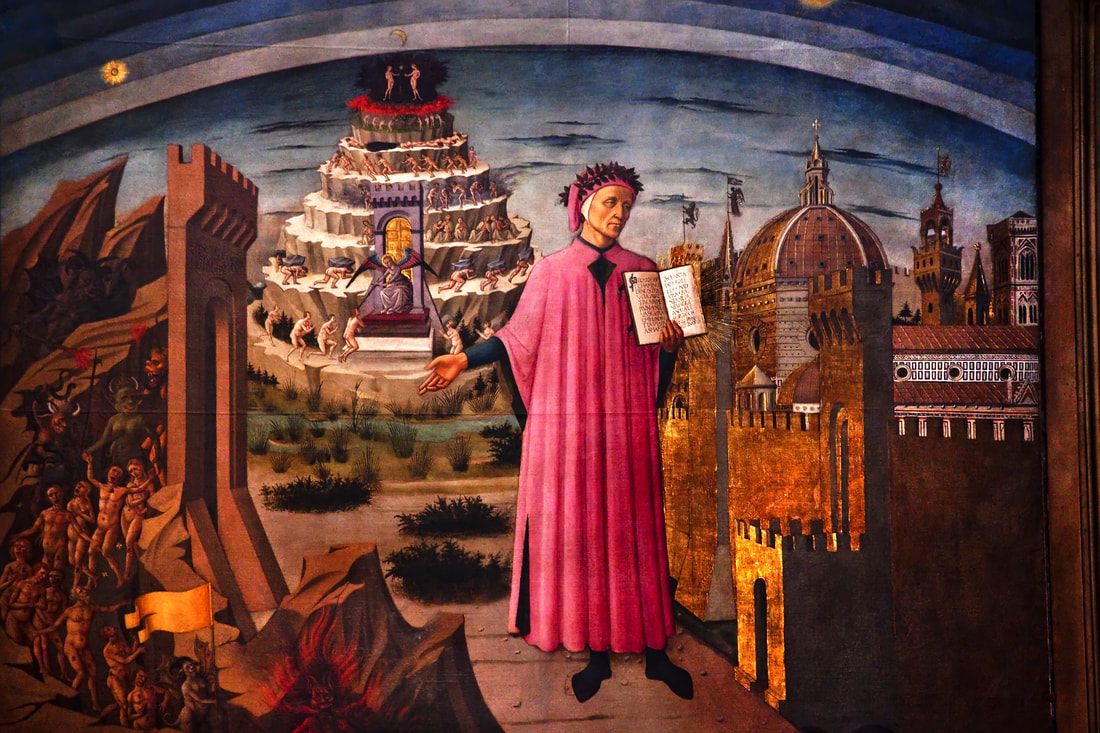
We see here Dante Alighieri depicted holding a book of knowledge. His hand is pointing towards a mountain, Purgatory, where souls in an upward spiral ascend towards the path of purification. Obviously through a great effort and will on their part, and great hardship, great ordeals, they achieve the goal.
Our Focus
In the continuation of this series, we are going to explain how we enter certain steps and requirements. There is a process obviously involved, in which we gradually develop our spiritual capacities, to experience what many initiates have talked about, people who have fully developed in themselves these mysteries.
Also, we will relate the requirements, better said, the challenges that we must experience as a necessity. I know a lot of people do not like conflict. Personally, in my own life, it has been a challenge to face certain ordeals and circumstances of life, especially in relationship to people in society and certain careers. But the reality is that these types of challenges are precisely what help us to grow, not only in a material, economic sense, but spiritually. So, we will talk about these spiritual requirements, these steps of initiation, especially in relationship to a greater hierarchy of development. Previously we talked about the Minor Mysteries, where beginning candidates enter into a type of probationary path, where they must be tested in their caliber to see whether or not they are going to qualify for the Major Mysteries, which is really a higher gradation of development that, due to its accomplishments, also requires more. We will also explain how to enter and experience, to realize what is known as mastery. This is a term that a lot of people throw around, especially in pop psychology and New Age circles. But we will talk about what mastery is in the Gnostic tradition of Samael Aun Weor, but also how it is defined practically in life. Then next we will examine how it is that the perfect matrimony, how a relationship, a married couple, husband and wife, serves as the foundation for really experiencing, developing, and entering what is known as these Major Mysteries. 
What Constitutes a Master?
So, the question becomes, what constitutes a master?
We included two very interesting images here. The first is the Tree of Life. It is a map known in the Hebraic tradition as kabbalah. It is a diagram that shows us the structure of the soul. It also maps out gradations of spiritual development, not only within our physical world, but also what are known as the internal worlds. These internal worlds are something we experience when we dream. More importantly, those types of vague, phantasmagoric dream states can be transformed into conscious revelation, divine visions, real profound spiritual insights, experiences of the soul. These are qualities of consciousness that are very refined and more divine the further we ascend up the verticality of this glyph. Likewise, not only do these spheres, which in Hebrew are known as סְפִירוֹת sephiroth, “emanations,” map out the structure of our consciousness, they also map out levels of materiality. So, while physically we have our body here in this bottom sphere of מלכות Malkuth, there are higher vehicles related to a type of internal dimensionality and matter. When we dream, we experience a type of matter, energy, and perception that is not physical, but we interact with it. We think it is real in the moment. It is only when we wake up that we question the validity of that experience. But the reality is that we were interacting with matter and energy of a more subtle dimension. Likewise, the further up we go in this glyph, one experiences refined states of matter, energy, and consciousness. We operate in these worlds, these higher dimensions, with vehicles, with different types of bodies. Some people refer to the कामरूपा kama rupa in Theosophy, the astral body, or the mental body, the causal body―vehicles that in us tend to be something given to us by nature. We do not have a conscious control of, really, these elements. We operate in dreams mechanically. This is obvious when we go to sleep and measure how awake we were when we were dreaming. What did we perceive? What did we see? How much control did we have? The purpose of mastery is to know all of this for oneself, to know how to competently navigate not only our physical life, but also the internal worlds. In the path of mastery, we have to ascend this glyph. This means that we enter a stage of development that requires a great amount of work. It requires hardship. It requires, by necessity, a type of shock. In order to develop something profound and spiritual in us, we need to face adversity, which is the whole point of the probationary path. Without ordeals given to us by divinity, whether it is at our jobs, our career, our marriage, our friendships, our family, we cannot change. We cannot confront the negative and disparate psychological elements of our mind that are the obstacle, because they will remain submerged within the depths of our subconsciousness. We will not see them. Unless we see the full totality of ourselves, it is impossible to rectify the conditions that limit us. In this way, by confronting our own errors, our own ego, our defects, our desires, we have the ability to comprehend them. Only by comprehending the deep root of any complex, of any impulse, of any thought, any desire, can we purify ourselves―remove that which is negative, like anger and fear, pride, jealousy. In this process, we have to be shocked. In order to ascend, we must face great descents. This means to face one's own hell realms. In relationship to the Divine Comedy of Dante, he first descended into hell in order to re-ascend to heaven. In this way, we are facing a type of shock, a conflict, in which we have to face the aspects of our psychology which are very difficult to see and to acknowledge, because they are very painful. This is why these are called shocks. We also tend to operate in a negative type of psychology. We tend to be very instinctive. Maybe we are more emotional. Maybe we are intellectual. Life enters us through the form of impressions. We experience situations, and we react mechanically. Meaning, if someone insults us, we feel hurt. If we are betrayed, we may feel great fear or a sense of revenge. We react in our emotions. We have perhaps the instinct to want to fight or flight, and maybe our thoughts are churning with plans and strategies for how to rectify the situation. We tend to get stuck in these lower three elements of our psyche: our mind, our emotions, and our instincts. The problem is that our particular psychological center of gravity is stuck in one of these elements, either our intellect, our emotions, or maybe our body. We tend to be one or more of these things predominant in our psychology. We tend to rely on one aspect of ourselves more than others. But unfortunately, this keeps us very asleep. We are not necessarily aware of what is going on psychologically or the origins of why we do what we do. This is why Gurdjieff mentioned that we are machines―mechanical. We just react to life. We do not actually do anything because we are constantly being provoked by our circumstances, and we just tend to go with the flow. But this has to change if we want to enter the Major Mysteries. The Major Mysteries have to do with the path of initiation: how to develop the soul, create what are known as solar bodies, these higher vehicles, so that we can enter these dimensions with consciousness, and also, how to perfect ourselves and remove the full negativity of our psyche. 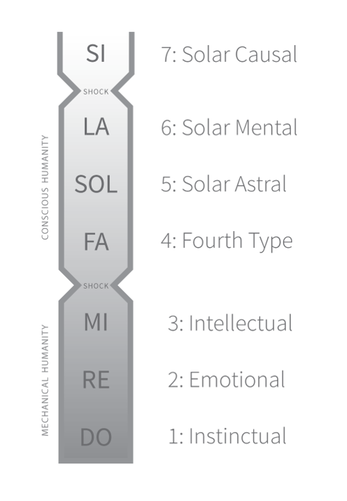
In the cosmic scale that you see here with seven notes, there is a fourth type of person, not merely just intellectual, emotional, or instinctive, but a conscious person, a person with equilibrium, meaning, in our careers, our jobs, our struggles, we enter the necessary shock of a situation that kind of provokes our consciousness. It strikes us in our heart, our mind, our body in terms of impressions, situations, experiences. We have a type of energy that is provided for us to help us awaken.
That fourth state of consciousness or fourth type of person we see [represented] by this musical scale. These seven notes do relate in a metaphorical way to states of consciousness. The fourth state has to do with being present, being mindful, being here and now. This is the beginning of mastery. Without facing life in its brutal rawness and totality, and transforming our reactions―whether they are intellectual, emotional, or instinctive, motor, related to our sexual center, our sexual impulses―we can not change. Psychological equilibrium is the state that initiates the Major Mysteries. If we want to create what some religions have called soul, spiritual development, higher bodies, vehicles that do not belong to nature, but belong to divinity, we have to be shocked. It does not mean that we go look for trouble. It means that we face whatever hardships divinity gives us and we transform our mind. In this way we can enter higher musical notes or gradations of spiritual development, states of consciousness. This relates to what are known as higher bodies. Gurdjieff called them the Kesdjan bodies in Beelzebub's Tales to His Grandson. These are known as the solar vehicles, the Wedding Garment of the Soul, the garments of reverence, the armor of Vulcan by which the great gods have prepared the Greek heroes for great battles, like Achilles or Aeneas. That armor signifies and symbolizes bodies that do not belong to a type of mechanical development. These are not something that one inherits. They are something that one creates. We create these bodies in a marriage, in a marriage between a husband and a wife whom are joined together through conscious love, sacrifice for humanity, and by conserving that most potent force of nature, the sexual force, transforming it in their marriage. They can learn to use the force that can create a child in order to create the soul. In this way, that energy instead of being directed outward, is directed inward― with very strict ethical requirements. These forces do not operate consciously in a person because of attachment or fear, anger or pride, desire, any defect. These forces elevate within the human being when we face the necessary shocks of our daily life, situations, when we transform them and when we maintain the most profound ethical, moral purity. We enter initiation through the qualities of our heart. In this way we enter higher notes and higher states of development. These relate to creating what is known as a solar astral body, a solar mental body, a solar causal body. These bodies operate with a type of divine force, connect us with the divine. In a way these energies are what allow one to form a conduit within the psyche. As we are now, if divinity were to try to connect with us fully, we would vaporize, evaporate, would be electrified, because that power is so profound. We need these vehicles to go up spiritually. In that process, what happens is that we raise what is known as the sacred fire of the Divine Mother. This is known as Kundalini in some traditions. Now specifically this force, as I said, is nothing mechanical. It is an entirely conscious potential that is latent within us, but can be activated through shocks, ordeals, when we overcome them and work in a marriage. Unlike contemporary, New Age perspectives or beliefs that this Kundalini force is something that awakens in the base of the spine and rises immediately to the head― you know in terms of a mechanical development, something spontaneous―it is something that is very gradual. It is a slow process, one measured by ethics, one measured by development in the heart. 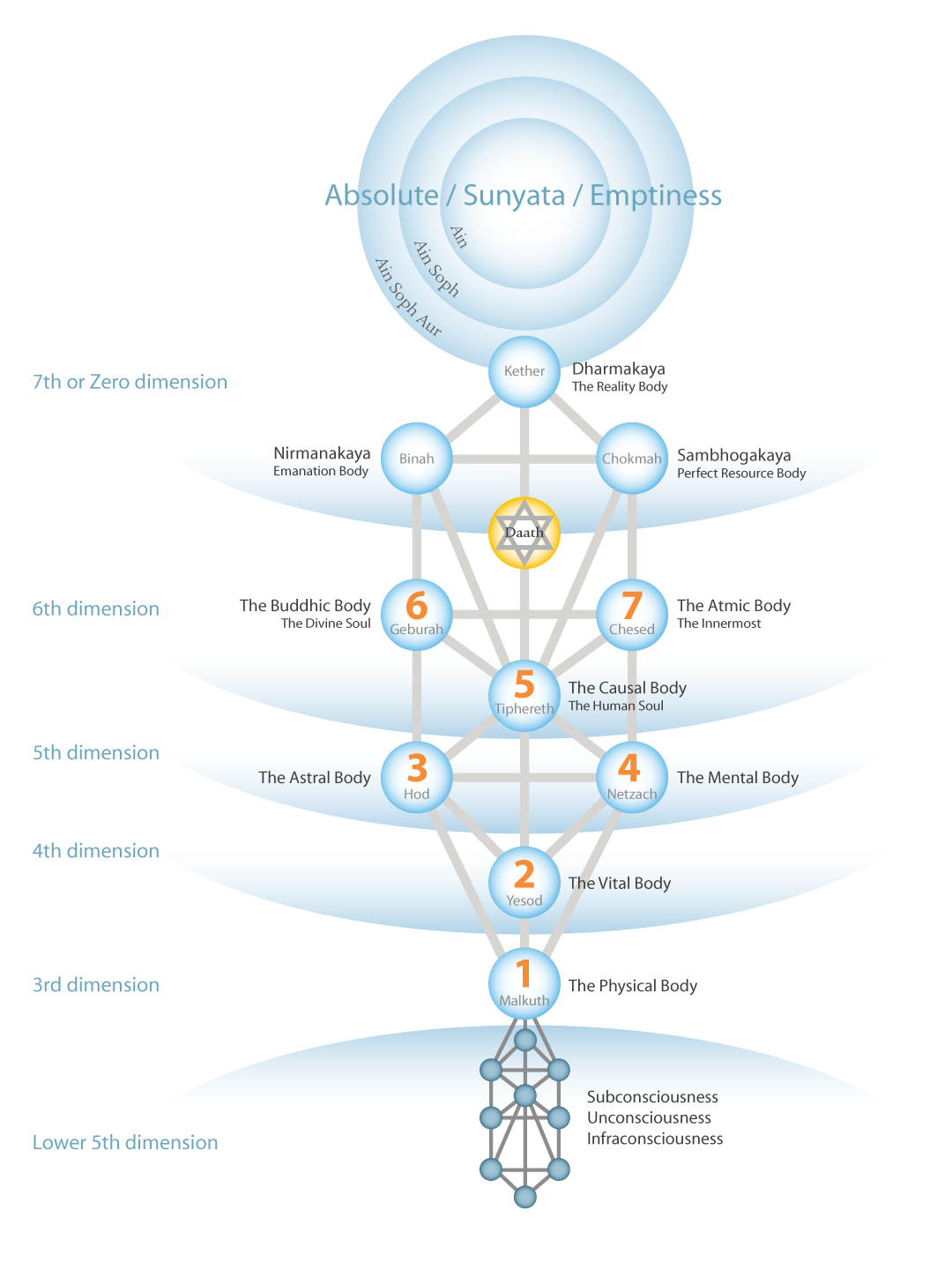
There are seven serpents of fire. We call them Kundalini forces. The Kundalini has seven levels. So, there are layers to this, levels, gradations in terms of development, requirements. It is good to talk about these lower vehicles that we see here present in the Kabbalah.
There is a physical body, a vital body, an astral body, a mental body, a causal body. It is important to learn how to raise that force within these lower vehicles. That fire, when it rises to the spine, patiently, gradually, with much work on one's psychology, that force will form what is known as a surplus of energy, of forces. Imagine like you are filling up a cup with water, and that it gradually fills to the too, so that afterward, one can fill a new cup at another octave, another level. That is also one correlation with the law of the musical scale, because by working psychologically in ourselves, we raise those forces upward, psychologically, up the spine. However, this also elevates our level of being our state of perception. One has a surplus of energy, a lot of force. When there is a surplus in the physical body, it transfers to the vital body. Likewise, upward to the astral body, then the mental body, the causal body, creating these vehicles of the soul, creating the spirit. Only with a surplus of energy do we have the force necessary to master ourselves, because without energy there is no will. There is no ability to do, and that is why we work with the Kundalini, which is sometimes referenced as the Divine Mother. She is the intelligence of God. She only works and rewards those initiates who have proven their candidacy through patient work. When that fire rises up within these lower five bodies one can be called a master, and this is only at the beginning level. So here we are just talking about the initial stages of mastery, what that entails. So, there are seven serpents of fire, seven Kundalini serpents that we are greatly focusing on today. Samael Aun Weor mentions in The Perfect Matrimony: Five great Initiations of the Major Mysteries exist. Seven serpents exist. Two groups of three, with the sublime coronation of the seventh tongue of fire that unites us with the One, with the Law, with the Father. We need to climb the septenary scale of fire. ― Samael Aun Weor, The Perfect Matrimony, “Initiation”
It is interesting that he says that these are tongues of fire, which reminds us of the fires that anointed the heads of the apostles in the Book of Acts. Also, a tongue references the mouth from which the word is gestated.
In the beginning was the Word, the Word was with God, and the Word was God. ―John 1:1
If you have read the writings of Samael Aun Weor, he explains that in The Perfect Matrimony, one can pronounce sacred sounds, mantras or forces that help to transform the creative fire of our sexual glands into light, into understanding, into that serpentine force, which can elevate our spirituality.
He also says here that there are two groups of three. It is interesting that this does correlate with the musical scale. It does not mean that it is necessarily, perfectly mapped out in terms of the seven lower spheres of the Tree of Life and also the seven musical notes, although there is a relationship there, like you see here with the two groups of three notes―the lower three notes, then there is the second three, and then a final shock leading to Si, in a sense. The musical scale is more psychological. I wanted to include this in the context of this lecture, because we need to learn to be responsible people by competently managing the necessary forces. We need to learn to be responsible people, meaning, when we save energy, we do not use it for negative means, not merely just for the intellect or emotions or body itself, but for the soul. 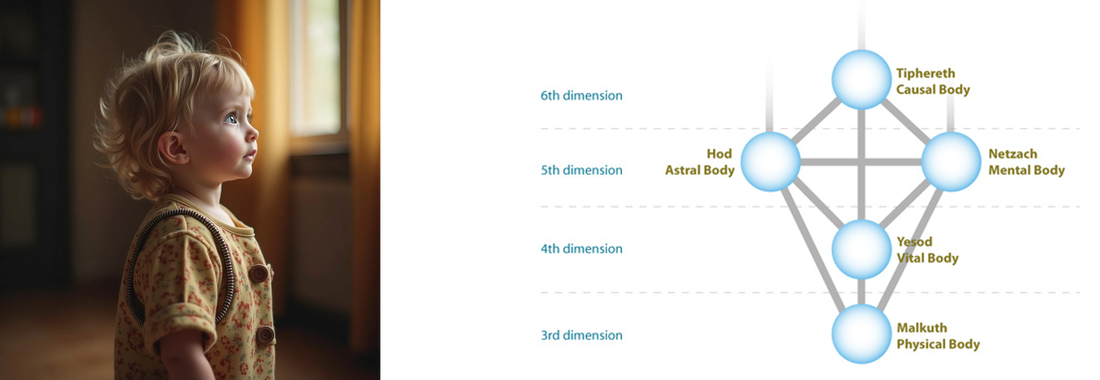
Mastering the Lower Quaternary
To master that lower quaternary, or the lower vehicles of the Tree of Life, we need to develop the heart.
Sometimes we refer to these lower five spheres as a lower quaternary, which seems contradictory, but the reality is that our physical body has a superior component, which is known as the vital depth. You saw it in Hebrew, יסוד Yesod, the foundation or vital body. Our physical body would not have life without our vital depth or vital forces. Then lastly, we have a solar astral body, solar mental body, solar causal body, vehicles that we must create. But how do we create this? What state of mind do we need? What quality of our heart is the requisite of entering initiation? Samael Aun Weor mentions that it is the heart and mind of a child. Unfortunately, I think a lot of people become skeptical when they read this. They think that in order to be like a child that means one has to be naive or gullible, someone who can be manipulated or fooled, taken advantage of. This is not the meaning to have the mind and heart of a child. In order to enter the spiritual path of Initiation and to become a master of oneself requires that we have a state of alert novelty. We are willing to look where an adult does not, the latter being jaded or perhaps disillusioned with life. Now primarily, the innocence of a child is often referenced in the Gospels, such as the sayings of Jesus in the New Testament: You must become like a little child to enter the kingdom of heaven. ―Matthew 18:3
What he means is that we need purity, the purity of a child, the innocence of an infant, someone who is able to look at all the filth of humanity and also our own inner psychological dirt, and to face it, to not run away, to see it for what it is, our own errors. It also signifies the need for patience and spontaneous love, the inspiration, the joy that we see in children, the playfulness of the spirit, to be able to confront all of this in oneself, because in truth, we do not tend to see ourselves as we really are.
A child can see everything with a great alertness and novelty. We tend to be jaded, conditioned by our own thoughts, feelings, desires, habits, preconceptions, biases, fears, whatever complex defines our personality in life. We tend to be very conditioned by that. We do not tend to see what is new. It is the state of newness that allows us to master ourselves. To be a master of oneself means to learn to see ourselves as we really are, to learn to develop the skills that we feel that we do not have―or that we may think we have, but do not. You see a child who is inquisitive, eager, and youthful will seek to learn from their parent. Now in this case, that state of seeking and aspiration, is what can help us to learn the skills that we really need. Samael Aun Weor mentions in The Major Mysteries the following: We need to have the mind of a child in order to enter into the Major Mysteries. We need to be like children in our minds and hearts. We need to be perfect as our Father who is in heaven is perfect. The great mysteries are not achievable through vain intellectualisms; the Major Mysteries are achievable with the heart of a child. ―Samael Aun Weor, The Major Mysteries
When he talks about Major Mysteries, he is talking about these initiations themselves. A Major Mystery relates to each of these spheres on the Tree of Life. So, these five Major Mysteries we have been talking about relate to the physical body, the vital body, the astral body, the mental body, and finally, the causal body.
We also learn to psychologically integrate these levels when we are learning to see ourselves for who we are, and not running away from the ugliness of, perhaps, our intellect, our emotions, or impulses, our desires. 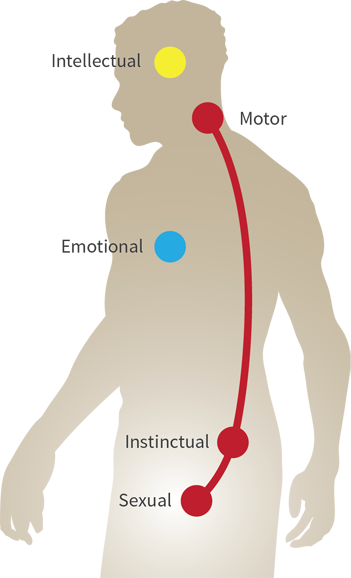
These lower spheres relate to what are known as the three brains within Gurdjieff's literature, but also Samael Aun Weor: the intellect, the emotions, and our motor-instinctive-sexuality. These brains have to do with how we process life, not only physically, but psychologically.
With our intelligence we master ourselves, when we understand the functionalism of our intellect, our emotions, and body, and are learning to manage energy wisely, not channeling that force through pride or anger or fear, but through innocence, spontaneity, joy, insight, intuition, alertness, awareness, concentration, meditation. 
The First Initiation (Malkuth: The Kingdom)
Now, while I mentioned some physical components to our reality with this, it is also good to relate to some of the spiritual phenomena that correlate with this path. So, while I mentioned some physical requirements related to initiation, especially how to work with the Major Mysteries, we can also talk about some of the spiritual experiences that relate to these higher degrees of mastery.
What happens is that as we are transforming our situations in life―our circumstances, our jobs, our careers, our marriage (whatever it may be), when we are facing the ordeals of life with a sense of competence and skill, with perhaps resignation that, you know, life is hard, but, also, something that can be transformed into wisdom―we can then learn to integrate our psychology, but also learn to integrate with the spirit, integrate with the divine. As we are integrating our conscious parts in our physical world, meaning our psyche in relationship to the ordeals of life, the spirit and soul of the higher dimensions, the higher parts of us also do a type of work: they integrate. They fuse. In their fusion―because right now certain parts are disparate and separate―they produce great light. If we raise the fire of Kundalini up the spine of the physical body, when that fire rises up all the 33 vertebrae of our spinal column through many patient ordeals and challenges, with a lot of meditation and work on our psychological states, what happens is that what is known as the spirit, our Innermost God, our Being, fuses with a divine soul, integrates with that divine part of our consciousness, which does not mix with impurity. These two aspects are like a married couple: husband and wife. Different religions have depicted this aspect of ourselves in different ways.
Tchaikovsky depicted this in his Sixth Symphony: the beauty of the divine soul that is united with God.
You also find Arthur and Guinevere. We are like Lancelot trying to conquer the kingdom of Avalon, doing our part so that divinity can integrate and merge above. Samael Aun Weor also explains that as we are entering initiation, as we are entering these degrees of development, we also have experiences. We enter higher stages of wisdom in our visions when we go to physical sleep, and we enter the dream state where we can perceive these initiations firsthand, we can participate in them, and we also witness how our inner divinity is crowned with glory. Here is what Samael Aun Weor had to say about the First Initiation, what happens with this: The Soul and the Spirit come before the great White Lodge without the bodies of sin and in complete absence of the “I.” They look at each other, they love and fuse as two flames which unite to form a single flame. Thus, this is how the divine hermaphrodite is born, and receives a throne in order to command and a temple in order to officiate. ―Samael Aun Weor, The Perfect Matrimony, “Initiation”
As we are developing ourselves spiritually in this physical world, our Innermost God becomes a master. The real master is the Spirit, our inner divinity, our Being. We do our part, like we are the foot of our body that acts in accordance with the will and commands from above. Both need to work together. The whole body must be integrated. In a sense, this work is about removing the imperfections of the self so that these elements can become pure and can merge.
In the First Initiation of Major Mysteries, our inner God receives a temple. In that temple, our Spirit officiates. The physical body is, in a sense, also a temple in which our Spirit must learn to command through our spinal column. As we raise the fire of Kundalini up this first body, its spinal column, we receive a type of initiation here. Then we can learn to express more of those divine qualities in our life. 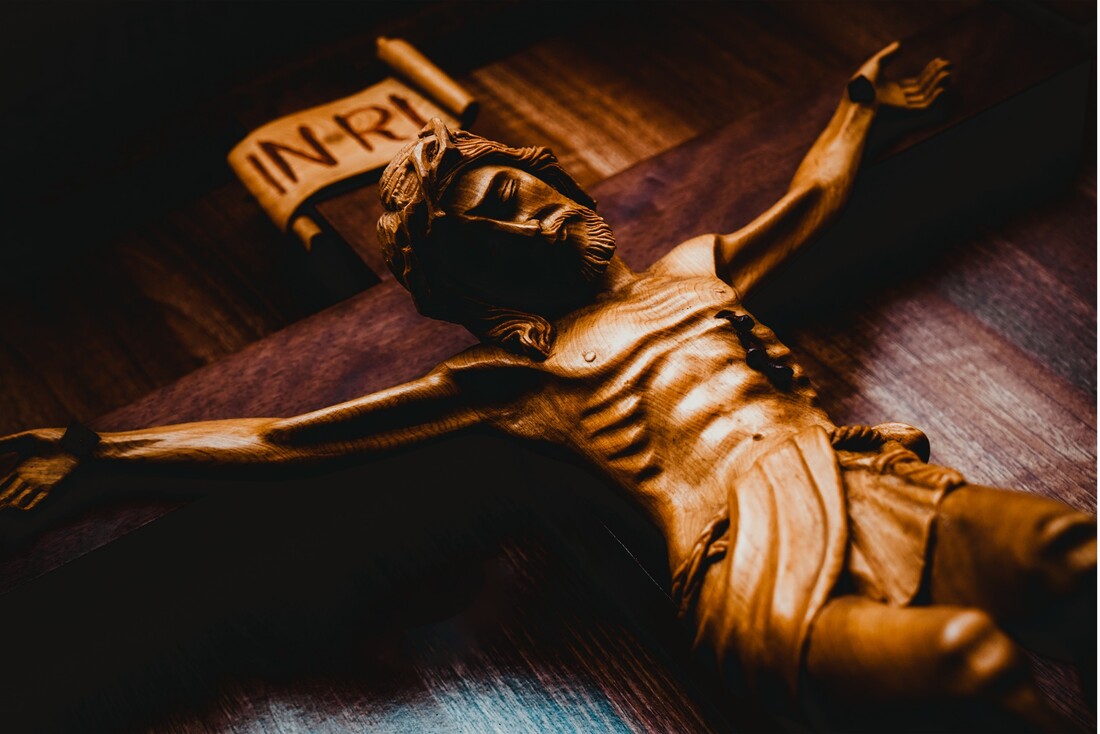
The Second Initiation (Yesod: The Foundation)
In the Second Initiation relating to יסוד Yesod, this is the vital body.
Likewise, after the surplus of energy from the physical body rises within our internal vehicles, we raise it up our vital depth. Likewise, up 33 new canyons or vertebrae of the spine―we sometimes call them canyons in esoteric language, because, in a sense, it is kind of like a gorge. We have to fill the depths or fill the depths of ourselves with this force and to bridge heaven and earth. In this initiation, one learns to develop a type of spiritual potential within one's vital energies. In this process of spiritual development, we have to learn to crucify our negative states. This is symbolized in the life of Jesus of Nazareth, who depicted through his passion and his crucifixion the psychological path that we must follow. As he was crucified, so must we also crucify our passions. This deeply relates to our etheric body. We have many impulses, instincts, sexual drives, complexes, passions, appetites of a sexual nature that relate to the etheric body. Our etheric body is like the vital sheath that interpenetrates our physical body. Due to our instincts and desires, we tend to take that force and waste it. Obviously, as we are saving our energies physically and sexually in this work, we have a surplus of force. With that surplus, we can learn to see these deep-rooted psychological elements. The vital body is sometimes known as To Soma Psuchikón. It is known as the Wedding Garment of the Soul. It is the vehicle of our sexual forces, more specifically. There are different forces that relate to our vital depth. Some authors have referred to the ethers. These ethers are not merely physical. They are vital and energetic. They are known within Qigong or Chinese medicine. These two, really there is a duality to the vital body, there are four ethers, two superior, two inferior. This is referenced in the Book of Genesis as the division of the waters from the waters, above and below. This is relating to the second day of Genesis (1:6), which also correlates with these levels of initiation symbolically. There are superior ethers and there are inferior ethers. These superior ethers develop our ability to go profoundly within ourselves. The lower ethers obviously relate to more physical functions like our biochemistry, our metabolism, our appetites, our physical health. But the superior ethers relate to our perception and memory, our ability to understand and perceive the higher worlds. These ethers separate. The superior ones go above and are integrated with our spirit. The lower ethers work to maintain the psycho-spiritual forces of the physical body. As we are giving this superior force up to divinity, we are learning to give divinity more power. It might seem sacrilegious to say this, but we are necessary in this work. We are part of divinity and divinity needs us, which is why there is a path of initiation itself. In this second initiation, there is a particular experience that anyone in the path experiences relating to the crucifixion of the Innermost, symbolized by Jesus. In this way, we create what is known as a body of gold. This is not physical gold, obviously, in relation to alchemy, but spiritual gold, virtue, potential, realization. Here is what Samael Aun Weor had to say about this: The Innermost, together with his ethereal body, is crucified within the temple. That is to say, the Innermost clothes himself with the ethereal body for the Crucifixion. This is how the ethereal body is Christified. To Soma Psuchikón, the Wedding Garment of the Soul, the body of gold, is born in the Second Initiation. This vehicle is formed with the two superior ethers. The ethereal body has four ethers, two superior and two inferior. Thus, with the Wedding Garment of the Soul we can enter all the regions of the Kingdom. ―Samael Aun Weor, The Perfect Matrimony, “Initiation”
So, this is a very useful tool. With the vital body, the Wedding Garment, we can learn to navigate the higher worlds. This is a form of initiation because one has made a major step.
There is a greater ability to enter at will these superior dimensions with competence and skill. This path of crucifixion is like becoming like Christ and working with the Christic force that we have been explaining in other courses. But there is more. 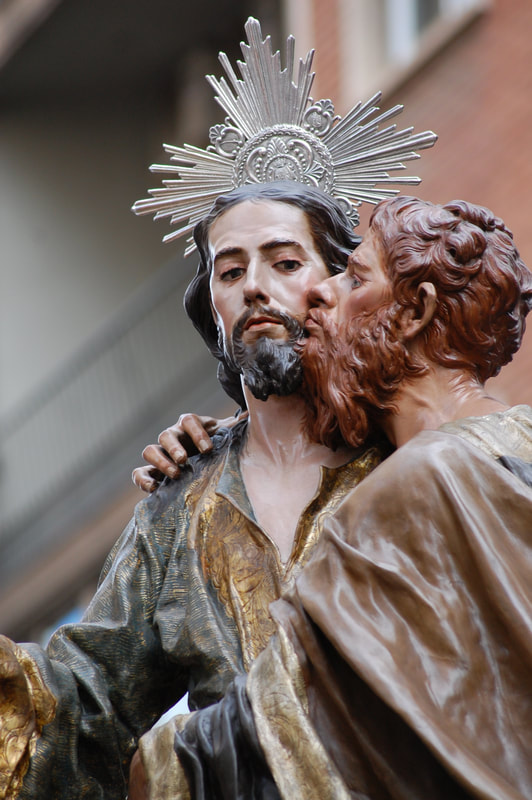
The Third Initiation (Hod: Glory)
The third initiation relates to what is known as the astral body. In this level of development, one has to conquer a lot of negative emotion. We tend to be very afflicted by anger or pride, fear, psychological elements which are very heavy in the emotional center.
The third initiation works to really develop a type of fortitude in the heart, a conscious quality of managing emotions which requires great reservation and patience. This relates to the third sphere of the Tree of Life, Glory or הוד Hod in Hebrew. This is the third serpent of fire. Now unlike the first two serpents, this serpent not only rises up from the base of the spine to the head, but then goes to the heart, which is very significant. The first two only go to the head, but here the fire enters the heart. Symbolically in the astral dimension, one experiences the Passion of Christ. One lives that passion directly as Jesus did, and one is given a symbolic form of a Christ child, the Christ-astral, a vehicle that is relating to the solar forces of divinity. That energy is made up of divine force, and that force is symbolized by the Christ child. One receives this child within the temples of great mysteries with this initiation. But more importantly, one has to first face the ordeals of Christ's betrayal, especially in his crucifixion. This is very interesting relating to this sphere because as relating to the heart, one has to face betrayal, treachery, condemnation, ridicule, pain, and yet face it with love for humanity. This initiation is tightly related to ordeals of the heart, great crises of the heart in which one has to crucify their negative emotions, to die to those negative emotions, and to be born as a soul. Here is what Samael Aun Weor said in The Perfect Matrimony: When the third serpent reaches the heart, a most beautiful child, the Christ-astral is born. The outcome of all this is the Initiation. The neophyte has to experience within his Astral Body the entire drama of the Passion of Christ. He has to be crucified, die and be buried. He has then to resurrect and must also descend to the Abyss and remain there for forty days before the Ascension. ―Samael Aun Weor, The Perfect Matrimony, “Initiation"
So, there are levels to this. In a microcosmic scale, the descent into hell and to remain 40 days within the inferior dimensions of nature known as Klipoth in kabbalah, the hell realms, is one type of scale in terms of a greater cosmic development. Obviously, one has to face one's deepest defects in degrees. In this level one has to go to the abyss, face one's own hell realms, and remain there for a certain period of time in internal worlds, when physically one goes to sleep, so that after the purification of the astral body, that vehicle learns to ascend to a higher state. This is known as the Ascension represented in Christ's life.
The number 40 in terms of 40 days is highly significant as well. 40 days or 40 nights in the wilderness meditating facing the devil in Christ's story of his ministry. Also, we find 40 years in the wilderness of the Israelites facing great hardships. These are, in a sense, symbolic days one has to face hardships and be qualified for certain coronations and degrees, because we only receive spiritual experiences and development when we have earned them. 
The Fourth Initiation (Netzach: Victory)
There is also the fourth level relating to נצח Netzach (the mind). This means Victory in Hebrew.
This is also a very challenging ordeal, challenging initiation. One has to clean out the mind very much. The mind is the den of desire, and the intellect, with its sophisms and complexes, its distractions and its associations, its wandering and meanderings, is often difficult to control, especially as we are learning to meditate. In the fourth initiation, one has to clean out the intellect very deeply. By cleaning out the mind, one has greater serenity, more concentration, more insight, more intuition. One also acquires what is known as the degree of a buddha, and a buddha in Sanskrit means “awakened one.” This is a very beautiful stage and development in which one has become crowned as a beginning master, or better said, a beginning initiate. One has conquered the mind to a certain degree and has a certain level of mastery of oneself. In this way, one is beginning to enter the world of the gods. Now there are obviously levels of buddhas. There are beginning buddhas and there are self-perfected buddhas. Here we are talking about the beginning levels of mastery, not merely just the end goal. I think some people get stuck on the idea that a master is someone or some person who only has really reached the heights, perfection, but there is beginning mastery and there is also perfection in mastery. There is a certain initiate who welcomes these beings, or new candidates, these buddhas, into the temples of sacred mysteries. His name is Sanat Kumara. He is the founder of the College of Initiates on our planet from many ancient times, very old. He is an immortal master who teaches those and prepares candidates in the internal worlds. Here is what Samael Aun Weor had to say about this initiation: In the world of the mind, Sanat Kumara always welcomes the candidate saying, “You have liberated yourself from the four bodies of sin. You are a Buddha. You have entered the world of the Gods. You are a Buddha. Everyone who liberates himself of the four bodies of sin is a Buddha. You are a Buddha. You are a Buddha. ―Samael Aun Weor, The Perfect Matrimony, “Initiation" 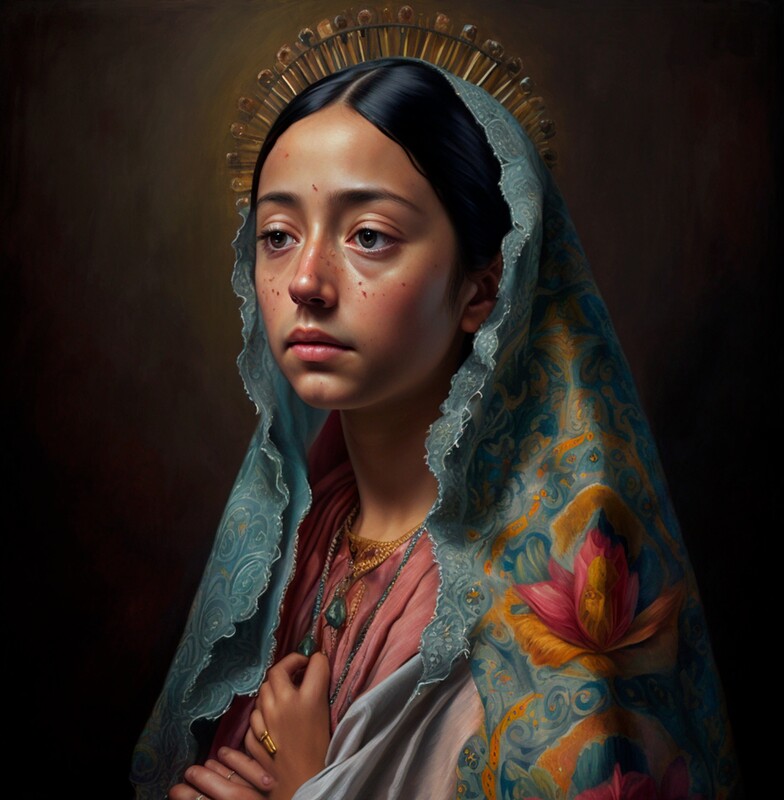
Obviously, this festival is very divine and sacred, very grandiose. Samael Aun Weor gives many beautiful descriptions here where also the Divine Mother Kundalini, our sacred eternal feminine, greets us in the temples and presents her child congratulating us or congratulating the candidate for initiation.
Samael Aun Weor continues: The cosmic festivity of this Initiation is grandiose. The entire world, the entire universe trembles with happiness, saying, “A new Buddha has been born.” The Divine Mother Kundalini presents her child in the temple saying, “This is my beloved child. He is a new Buddha. He is a new Buddha. He is a new Buddha.” The holy women congratulate the candidate with a sacred kiss. The festival is terribly divine. ―Samael Aun Weor, The Perfect Matrimony, “Initiation”
Obviously, when Samael Aun Weor was writing in Spanish, he was using the pronoun “he,” but in general it refers to both men and women, to humanity in general, because women have the same rights as men, as he clarifies in other lectures.
But here the temple is grandiose and spectacular. The festival is sacred and, obviously, these initiations are very beautiful and inspiring and elevate the heart. What is also important to mention about the fourth initiation as well, is that one learns to extract the most pure elements of this mental body, or we can say inferior qualities of mind, in order to unite it with divinity. This extract is a type of removal of the most pure elements from the impure, which is a symbol of alchemy, in terms of the medieval hermetic traditions of Europe. One transforms the lead of personality into the gold of the spirit. One extracts that type of substance of a spiritual type from the inferior elements of pride and mental arrogance, a type of mind that is erudite and intellectual, but divorced of spirit. We remove and extract that which is pure from those conditions and learn to develop a mind that is like Christ, a mind that is in tune with divinity and that is not antithetical. It is a mind that is intuitive. It does not need to think. It is a mind that knows how to know, to perceive, and to understand. This does not discredit the necessity of intellectual deliberation in our daily life. Obviously as we are developing and learning how to develop a more spiritual type of mind, it does mean that gradually, less and less, the intellect is utilized. In the beginning it is a burden. Instead, through this initiation, the intellect becomes a useful tool. In this fourth initiation of Major Mysteries, this fourth degree, one has achieved a level of mastery with that. Here is what Samael Aun Weor says about this ceremony: 
The great masters of the mind extract from within the mental specter the beautiful child of the Christ-mind. This child is born in the Fourth Initiation of Major Mysteries. Everyone who receives the Fourth Initiation gains Nirvana. Nirvana is the world of the Holy Gods. Whosoever reaches the Fourth Initiation receives the Globe of the Imperator of the mind. The sign of the cross shines upon this globe. ―Samael Aun Weor, The Perfect Matrimony, “Initiation"
So, we see here an image of the Christ child with the Virgin Mary, a symbol of how the Christ mind is crowned and carries the globe of the ruler of the world. This is a very powerful and beautiful symbol.
The reality is that people look for power in this physical world by using their intellect. They fail to realize that there is a greater power of really a mind, spiritual mind, a solar mind, that can learn to govern not only physical circumstances, but also the internal nature of our inner kingdom. This globe with this cross is a symbol of how one conquers the inferior aspects of our lower kingdom, signified by the four points, the cross, the four elements (earth, air, fire, and water), which are deeply significant in order to transform one's life. That globe of the imperator of the mind is a symbol of how one has a certain level of mastery by which one can instead navigate life with even greater wisdom. 
The Fifth Initiation (Tiphereth: Beauty)
But there is a fifth initiation that is very important to talk about too. This is in the world of Nirvana, the world of תפארת Tiphereth in Hebrew, which means “Beauty.” This is related to the body of conscious will. This is the will of God.
We obviously in our beginning levels of practice do not have much willpower, but with initiation and mastery, one develops will. This means the ability to focus and do one thing, to see its resolution carried out, no matter the shocks of a conscious experience that we face. 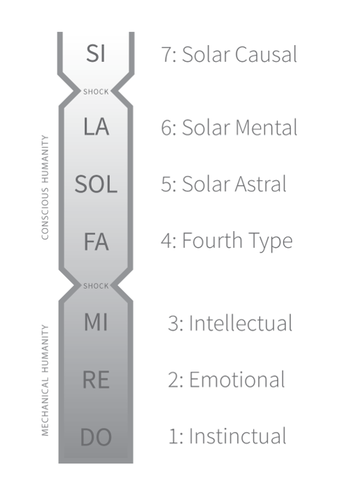
So, going back to that image of the seven notes, one reaches the top of that musical scale by entering in another type of shock, because it is a very profound and different thing to have a solar will, a will that can obey divinity. That requires a lot of ordeals and challenges, shocks in life, so that by facing the most submerged elements of the mind, one can enter the Fifth Initiation of Major Mysteries.
When one has a solar will, has created a solar causal body, one can incarnate their soul. The soul is developed. It is initiated. It was an embryo, and now it is a certain level of mastery. It is the beginning. Here is what Samael Aun Weor had to say about this: The body of Conscious Will is born in the Fifth Great Initiation. Everyone who is born in the world of the conscious will inevitably incarnates his Soul. Everyone who incarnates his Soul becomes a true human being with Soul. Every true complete and immortal human being is an authentic master. Before the Fifth Initiation of Major Mysteries no one must be called by the title of master. ―Samael Aun Weor, The Perfect Matrimony, “Initiation"
In a sense, the real master is our inner Being, our spirit, our inner God. But, obviously, mastery is conferred in a beginning level to the soul that is developing. It is better that we give credence and respect to divinity. It is divinity that is really the master of oneself, the one who is organizing this whole work, who is inspiring the soul to be able to change, to become a true human being.
This level of an initiate is someone who has soul. This is a person who is not easily influenced or driven by desires, impulses, contradiction, outward influences, forces, situations that in most beginners produce a lot of chaos psychologically. This is someone who knows how to respond to life in its full depth and totality without a type of, perhaps, reservation or hesitancy. These are beings initially documented or symbolized by the life of Christ and many other masters like buddha, who really had a lot of self-possession in the face of great situations, great ordeals. That is someone who is a real human being whose soul or theosophical मनस् manas is united with हूम् Hum, the spirit in Sanskrit. This is a person who is integrated psychologically and, therefore, their actions emanate great beauty. Now, it is important to emphasize that it is often very difficult to recognize a real master, because we are so conditioned by our own delusions that we have many false ideas about what this state is. But as we are learning to awaken our consciousness and shock ourselves psychologically, by facing the hardships of life consciously and learning to change what must be changed, we learn to come into contact with beings of this nature. But more importantly, we want to aspire to this ourselves, to develop this level of spirituality or being practically in us. 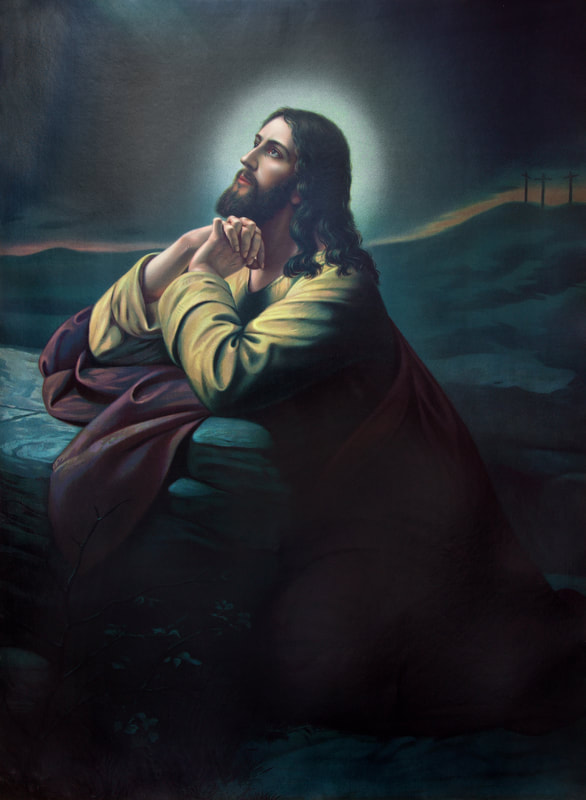
Here we see Christ praying in the Garden of Gethsemane. In the will of Christ is precisely the Fifth Initiation of Major Mysteries, that willpower united with the divine to obey the impulses of our spirit.
Unfortunately, in us as beginners, we tend not to know the difference between our desires and our real will because we have not discerned intuitively the origin and sense of where our impulses or desires come from. We tend to just respond or react to life in terms of our state of being. But a person who has developed will, the will of the Father, is someone who can obey the insights they receive from their inner divinity without hesitating. I mean it could be difficult at times, but they still do it, as symbolized by Christ and his Passion as he prayed in the Garden of Gethsemane: “Not my will, but Thine be done” (Luke 22:42). As Samael Aun Weor stated: In the Fifth Initiation we learn to do the will of the Father. We must learn to obey the Father. This is the Law. ―Samael Aun Weor, The Perfect Matrimony, “Initiation”
This is the ability to act out the insights given to us from divinity. But obviously in our level, we tend to be very confused. We do not have that clarity. We do not know the right action in certain circumstances. But the whole point of the Major Mysteries is to know that and to develop it and to make the will of divinity the law.
When we were told by divinity what we must do, even if it is difficult, we do it because it is the right thing, even though it might create a lot of conflict in our life. But obviously, knowing the difference requires a lot of meditation and discrimination, discernment. 
The Decision of a Master
Now, also it is important to emphasize that in the Fifth Initiation of Major Mysteries one has a choice. One has become a master of the beginning levels, but one must also decide what further development one will take.
There are two paths as mapped out and symbolized, you could say, in the Mona Lisa by Da Vinci, who not only was a master of physical art, but was a master of Major Mysteries. In fact, many initiates of art were masters of Major Mysteries: Beethoven, Wagner, Chopin, Liszt, Berlioz, Bach, Michelangelo, many great skilled artisans and people who mastered a physical craft, a skill, an art form, a philosophy, have really developed themselves spiritually and therefore their physical life reflects that. In the Mona Lisa we see two paths. She is a symbol of our Divine Mother, our divine feminine, who awaits us in terms of what we will do. If we have entered the initial degrees of mastery, we begin the Major Mysteries, we have reached the fifth degree, we now have to decide if we are going to stay in that level of Nirvana, that type of bliss and development, or to renounce it in order to descend back to the physical world in order to help humanity. There are two paths. One can remain in heaven or renounce it and return to the earth, the physical world, in order to sacrifice oneself. In reality, this latter path is represented by the birth of Christ. In the manger a Christ child is born, and it is a symbol of how Christ enters the soul, which is still filled with many defects, many animals, in order to begin a very difficult and challenging work. He enters the soul, that aspect of Christ in ourselves, the divine, enters the soul who is now working to fully eliminate their imperfections and enter what is known as the straight path. They seek to enter higher degrees of development, but that requires first renouncing power, heaven, abilities, peace, security, in order to face all of one's past errors and defects, one's debts to the world, consciously. This is known as the path of renunciation, the path of the bodhisattva, somebody who incarnates Christ. But only by sacrificing oneself can one gain that right. This is known as the Venustic Initiation, and this Venustic initiation has to do with when a master chooses to renounce heaven and to incarnate Christ. But that requires love, symbolized by Venus, love of humanity, so much love that one is willing to sacrifice their last drop of blood for others. That is a very noble aspiration, but also very rare. Many do not take that path. Instead, what many do is stay in Nirvana and enter a spiral gradation of development, remaining in heaven and renouncing the world, and choosing not to help those who are suffering below in this valley of tears. Here is what Samael Aun Weor had to say: In the Fifth Initiation we must decide between two paths, which one to take to continue on: either to remain in Nirvana enjoying the infinite bliss of the boundless sacred space, sharing with the ineffable Gods, or rather to renounce that immense bliss of Nirvana and remain living in this valley of tears in order to help poor suffering humanity. Renunciation, the long path of woe and bitterness is different. Whosoever renounces Nirvana in order to live to benefit mankind later attains the Venustic Initiation, this after Nirvanas gained and lost from boundless pity and compassion for humanity. ―Samael Aun Weor, The Perfect Matrimony, “Initiation"
That is real love, to give up comfort and ease to face “the slings and arrows of outrageous fortune,” but “to take arms against a sea of troubles, and by opposing end them” (Shakespeare’s Hamlet).
In this way, there are two paths. That is the beginning stages of mastery. Obviously, we will go into more depth into other degrees of development, but these are just some initial explanations about certain experiences one may have in this certain work that Samael Aun Weor described, but also some psychological requisites. 
There are two books you should study if you want to know more about this topic: The Major Mysteries as well as The Perfect Matrimony by Samael Aun Weor.
At this point, I invite you to ask questions. Questions and Answers
Question: Going back to the analogy of the water in the cup, such as filling it through the spine, will this water in the cup reduce every time one climaxes in intimacy?
Instructor: Yes. Samael Aun Weor mentions many times in his writings that when we conserve the sexual force and raise it up the spine and gradually through our works of meditation by eliminating certain defects, that fire graduates vertebra by vertebra. Obviously, when a person has a climax or loses their sexual force, that energy descends in the vertebra of the spine in according to the magnitude of the fault. Obviously, there are more serious falls. Some are more minor. It depends on the degree of intensity, but also the type of psychological identification that was associated with that fall. Now, obviously one has to regain that development with work and patience. It is not easy to learn this science. Do not beat yourself up if you are still learning. It is difficult, but with time and practice it gets, in terms of controlling the energies, easier. What tends to be harder in terms of psychological development is that even though one is conserving that force and avoiding climax, one still needs to control the heart. The struggle is terrible: brain against sex, sex against brain, and that which is most terrible, that which is most grave and painful: heart against heart.―Samael Aun Weor, The Perfect Matrimony: “Initiation"
The path of initiation is actually harder in relationship to psychological ordeals. So yes, even though if you have an accident, which happens to many people, one will lose a certain degree of energy in the spine. But obviously that is relative to the degree of the intensity of the fault. But also it is important to recognize too, that if we had the fire in our spine, but are investing into a lot of anger and pride or lust, even though physically not ejaculating that force, one is still going to lose energy. In the sense one will take that force and instead of raising up the spine, will fortify the ego.
So that is why this path is dangerous, because we have to be not only just responsible physically, not wasting energy through the orgasm, but also we have to be able to control our emotions, our heart, through the challenges of life. That is also difficult. Obviously, the ordeal of heart against heart has to do with a marriage, because the most painful emotional crises can occur between a couple. So, there is a level of development there. Question: What happens if you keep failing ordeals? Do you run out of chances? Instructor: We will keep repeating the same ordeals until we change. Obviously, if we are sincere and we really want to change, then divinity will give us the ordeals as many times as it takes until we learn to do it. Obviously, we run out of chances when we give up, not divinity. If a person decides to not practice anymore, then obviously they have resigned themselves. But we could say that we do not run out of chances if we are determined and if we keep trying. Divinity is compassionate and will give us the situations that we need to grow. But we have to be willing to work, to face the shocks of our situations consciously, the ordeals of life which shock our awareness, and to learn to face those certain defects which are keeping us trapped. Otherwise, we are just going to repeat. Question: Does having an arched physical spine, not straight, affect the initiations or spiritual development? Instructor: No. Obviously, the physical body has a correlation to our internal bodies. You know, any physical illness will have some effect on our body and our health. Maybe even psychologically too, as we are, you know, related to our biochemistry too. But we have to remember that this Kundalini force is not merely physical. It is a spiritual force. Therefore, if you have a physical ailment with your spine, you know, there may be some effect there. But we have to remember that initiation is granted through the powers of the heart, right? Initiation is gained through qualifications of the heart, our moral and ethical caliber. So, it is not a hindrance. Question: Lastly, if you renounce nirvana and are reborn on earth, do you remember who you are as a master? Instructor: Well, yeah. Mastery means someone has a level of consciousness that they can remember where they came from or where they are going. They can choose where to be when they want. So, there are many masters like that. There is the Dalai Lama, for example. He already reached the Fifth Initiation of Major Mysteries before he was physically born. This explains why he reached mastery even without being physically married. So, he developed that before and consciously chose to be here to help humanity. Question: How do you know if you have the right partner? Instructor: It is a tough one. I recommend you read and meditate on the first chapter of The Perfect Matrimony. I believe it is called Love. Very beautiful! He explains very clearly how to know. I do not have it memorized verbatim, but it is a very beautiful excerpt from the whole book where he talks about what is required of us to really evaluate and know who the right partner is for us. Obviously, it is not something that you can just judge on a whim or by mere sexual attraction, but by multiple levels of analysis and compatibility. It is not enough to have chemistry. People can have chemistry, but it would be totally unfit for each other. Instead, there needs to be seven levels of affinity, not merely just physically or chemically with attraction, but emotionally, mentally, and even with will. Consciously, the soul must be in affinity, but also even the inner divinities of the couple should be in alignment with each other. This relates to the seven spheres of the Tree of Life, the seven degrees of initiation. So, you know when you meditate on your own self in relationship to this person, are you willing to give even your last drop of blood for this individual, to die for them? I recommend you read that chapter. It is very profound. We will provide it in the chat for you. Question: Is the story of Noah's Ark symbolic or related to the initiations? Instructor: It is. Remember that Noah had three sons. Their names escape me at the moment, but three children [Shem, Ham, Japheth], three bodies: solar astral , solar mental, solar causal. His Ark, which is a boat, is what navigates the waters of sexuality. It is the great arcanum, the great law that unites us with the Father. It is a symbol of how we enter initiation. When the floods of life come to devour the earth, when situations are terrible, when people are drowning around us, we rise. So that is the symbol of Noah or I believe in Hebrew his name is נחַ Noach. נ Nun. It is hard to remember the spelling of his Hebrew name, but he has the Hebrew letter נ Nun in his name, the letter N. That letter נ N relates to the sexual seed, the fish, the ovum or sperm, which is the power life, ח Chet, חי Chai. The Ark, the law, our development is managed by how we use that force spiritually. Question: Every time I interact with others, I am given the chance to reflect on aspects of myself that I was not fully aware of. The conversations often shed light on character defects I did not know I had. Although I do not express these reactions outwardly, my ego turns on me and it feels like I am being torn apart from the inside. Almost as if I am being attacked by a wild animal. It is a painful experience. In these moments, I notice more ego is trying to rise to the surface, but I resist. I recognize that I am the one who needs to change and I do not blame others for their behavior. But my question is how does one cope with the remorse that follows? I feel weighed down by the darkness I am seeing in my psyche. I am thinking this too is another cunning ego, but the feeling will not seem to go away. At the same time, I am grateful to my inner Being for these experiences so I can face my character defects. Instructor: This is obviously a very common problem we all face, especially if we are very introverted and, perhaps, very reflective. We see things in ourselves that are very ugly and that we may feel shame. So, there is a common reaction, especially in the beginning, as we face the shocks of certain situations. Our defects emerge from the depths that we do not like to see. Now, obviously there could be a complex there. One is the egotistical qualities that are producing conflict in our life, but then secondly the shame that follows, maybe self-criticism or maybe even fear. Now, I would say remorse is a different thing. Shame is an ego. Shame is an ego that hates itself and hates life, wants to self-destruct. In a sense, remorse for one's errors is a good thing. It is a conscious quality, when we see in ourselves that we are responsible for causing suffering and that we have the will to change. What will help to alleviate that pain is especially if we have done something that we feel is wrong, we can seek to rectify the situation, maybe repairing a relationship or doing something kind to someone we may have harmed. In order to help not be so weighed down by the heaviness of our error, it is not good to bottle it up. It is good to reflect, but also not only just develop an understanding of shame. It is also important to also develop our understanding of virtue. It is very easy to get morbid. We see a lot in ourselves that is negative and ugly that we do not want to see, and that there is a resistance to not want to face that. That is obviously another defect. The ego does not want to be caught, and so it hides. It does so through resistance. One way to overcome the heaviness of all that is to meditate on virtue. Meditate on your Divine Mother. Meditate on the qualities of God: patience, equanimity, serenity, acceptance, tolerance, fearlessness, strength. There are a lot of virtues that we do carry within, but we tend to ignore that. It can be good to meditate on those virtues. Literally, you can visualize your Divine Mother in any form that is natural to you or inspires you, no matter the religion. In this way, you can reflect on the good qualities of our divinity. Otherwise, we risk being one-sided, you know, just focusing on the bad. We have to be balanced, integral.
I also recommend work with the magic of the roses.
If you feel like you are dealing with a lot of emotional pain, especially seeing your own defects, it is good to do the magic of the roses. There is a practice given by Glorian Publishing, which is a form of elemental magic, working with the soul of the rose so that it can help to strengthen our heart. In that way you could have more strength by which to not only just accept the situation, but also have the will to change and also to alleviate the sorrow that you feel. Question: I feel like I have had times in which I have been perfectly in tune with my Being. How is this different from the Major Mysteries? Instructor: Basically, these are degrees of development. To know what that is going to look like for you is obviously going to be something that is personal. It is one thing to be in tune with divinity, you know, for moments of the day, but an initiate of Major Mysteries is someone who has continuity. They are consistent. They are established. Their center of gravity psychologically is in their divine will. So, while our tendency is to kind of get stuck within thoughts, feelings, or desires, we kind of fluctuate and maybe we enter a state of conscious perception, a shock of awakening. A person who has entered the Major Mysteries is someone who has that developed consistently. Their level of gravity psychologically is established within superior sentiment, superior mind, and superior will. So that is more permanent for them. They are living in that type of state. But obviously what that is going to look like for you, you know, mastery is very individual. It is something unique to us. You know, that is a general principle, but in reality, every master is going to be unique. Also, if we enter mastery, that is going to be unique to us, the qualities and character of our divine personality. So, there are differences in terms of intensity, degree. Question: How long should it take to get through the nine minor initiations to begin the major initiations? And how do I know how old I am initiatically? Instructor: Good questions. I would not say there is a set time physically in terms of our material calendar by which one enters the Minor Mysteries or finishes them or enters the Major Mysteries. It is going to be something personal to us in dependence on our degree of intensity and work, our consistency, our development. Obviously, people who are married physically could enter the nine minor initiations very quickly, I mean relative to someone who is working independently as a bachelor, who is working with their energies sexually, pranayama, mantras and runes, etc. A person, who is in a marriage, has more fire and force by which to accelerate that process. So, it is relative in degrees. We say it is faster than being single, but as for physical time, there is no set calendar for this. It depends on one's will. It is something that could be verified through our inner experiences. So, we know how old we are initiatically by experiencing that in the internal worlds. For those who are not familiar, these levels of Major Mysteries are mapped out numerologically. So, the kabbalah is assigned to numbers and there are certain numbers associated with levels of development. From the years of zero and 90 are, basically, for every decade, an initiation of Minor Mysteries―10 through 90, better said―the first to the ninth degree of Minor Mysteries. A 100 years, which relate to esoteric age, in terms of quality and development in oneself, has to do with 100 to 500–the first five initiations of Major Mysteries. Every one hundred for every Major Mystery. You learn those initiatic ages when you are told internally by divinity or from a master, from your inner experiences. They can tell you: “You are 90 years old,” which means ninth degree of minor mysteries. Or maybe you are 200 years old, the Second Initiation of Major Mysteries. These numbers are going to be relative. There is, you know, it is going to relate to where you are initiatically, for those who do not know. But you learn that by working with dream yoga and astral travel. Question: At what point does even the desire for advancement of the path have to be transcended? Instructor: Honestly, that is something that can last a long time. There are masters who still have pride. You look at the works of Homer, such as The Odyssey, where Odysseus is a great hero. He is a master of strategy and skill, and yet he has hubris. He is proud. Even his ambition for greater achievements and glory is something that has to be transcended. So even masters of Major Mysteries still have defects like that. So, one fully eliminates that or transcends that completely after perfecting themselves in mastery. So, there are degrees. |
The Gnostic Academy of Chicago
Free online courses, lectures, podcasts, and transcriptions. Categories
All
|


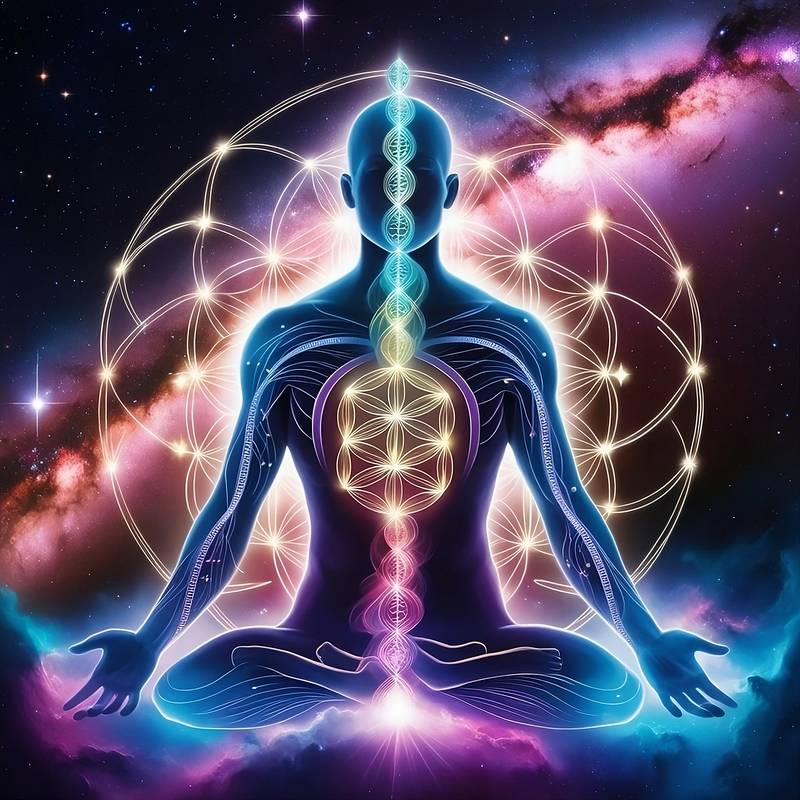




 RSS Feed
